LEARN WITH HIM / 10
The basin & the towel
When the teacher kneels
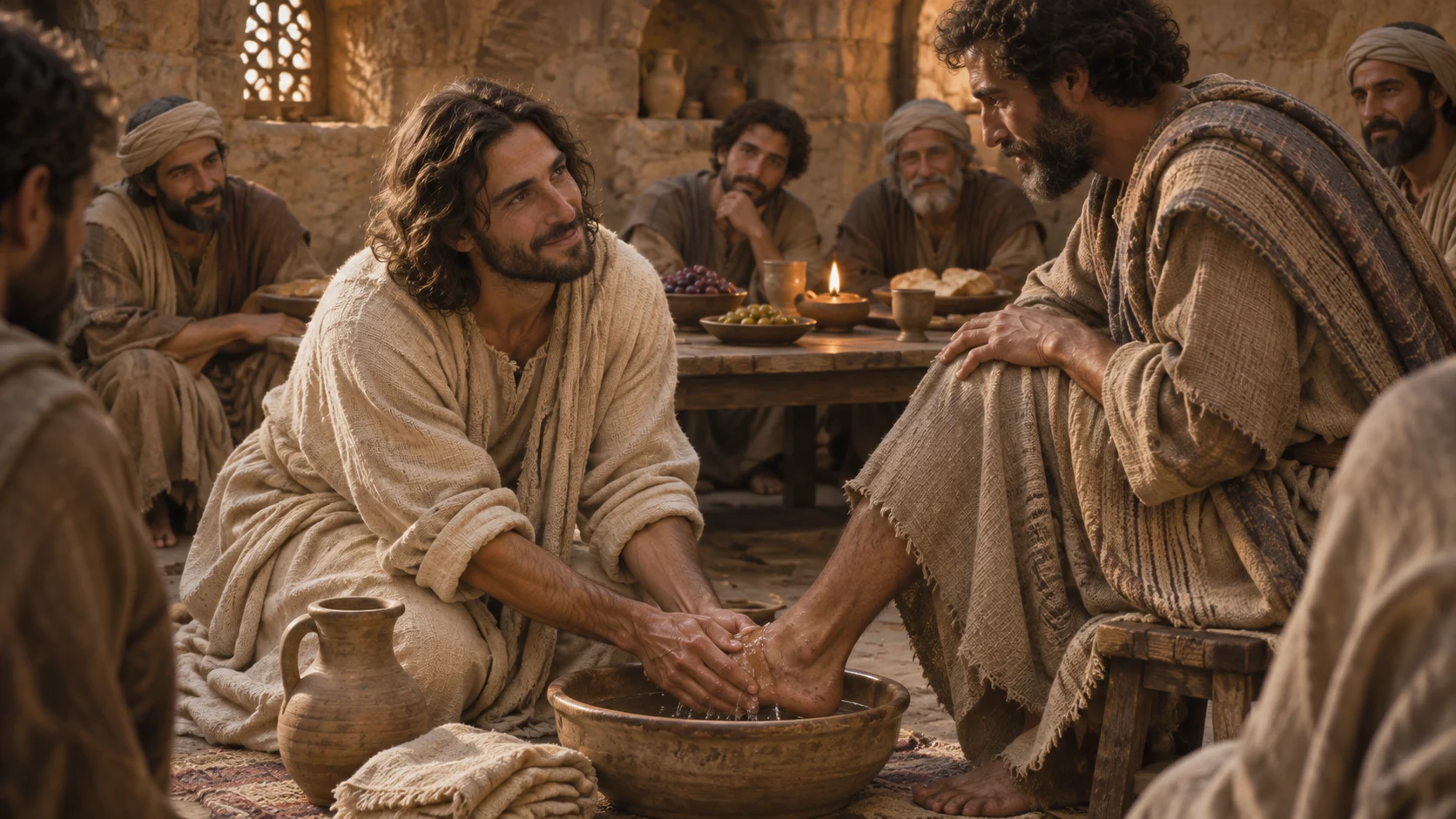
John 13:1–17The room holds a meal and a coming separation. In John’s account, Jesus rises from supper, takes a towel, pours water, and begins to wash the disciples’ feet. Love becomes an action close enough to be uncomfortable. The teacher gives attention to the ordinary need of another person’s body.
FIRST, THE SETTING
John opens the scene by speaking of Jesus’ knowledge of his coming departure and his love for his own. The foot washing is placed within that love. The passage then turns the act into an example for the disciples to practice.
Foot washing has different liturgical places in Christian traditions. Readers can begin with the narrative itself: authority, service, resistance, receiving, and the instruction to do for one another what Jesus has done.
Read John 13:1–17+
1Now before the feast of the Passover, Jesus, knowing that his time had come that he would depart from this world to the Father, having loved his own who were in the world, he loved them to the end.
2During supper, the devil having already put into the heart of Judas Iscariot, Simon’s son, to betray him,
3Jesus, knowing that the Father had given all things into his hands, and that he came from God and was going to God,
4arose from supper, and laid aside his outer garments. He took a towel and wrapped a towel around his waist.
5Then he poured water into the basin, and began to wash the disciples’ feet and to wipe them with the towel that was wrapped around him.
6Then he came to Simon Peter. He said to him, “Lord, do you wash my feet?”
7Jesus answered him, “You don’t know what I am doing now, but you will understand later.”
8Peter said to him, “You will never wash my feet!” Jesus answered him, “If I don’t wash you, you have no part with me.”
9Simon Peter said to him, “Lord, not my feet only, but also my hands and my head!”
10Jesus said to him, “Someone who has bathed only needs to have his feet washed, but is completely clean. You are clean, but not all of you.”
11For he knew him who would betray him; therefore he said, “You are not all clean.”
12So when he had washed their feet, put his outer garment back on, and sat down again, he said to them, “Do you know what I have done to you?
13You call me, ‘Teacher’ and ‘Lord.’ You say so correctly, for so I am.
14If I then, the Lord and the Teacher, have washed your feet, you also ought to wash one another’s feet.
15For I have given you an example, that you should also do as I have done to you.
16Most certainly I tell you, a servant is not greater than his lord, neither is one who is sent greater than he who sent him.
17If you know these things, blessed are you if you do them.
World English Bible · Public domain
Read the whole chapter ↗Notice the sequence of ordinary things
A garment is set aside. A towel is taken. Water is poured. Feet are washed and dried. The Gospel spends attention on the acts through which care becomes real.
It is possible to speak of loving humanity while overlooking the person who needs a small, inconvenient kindness. This scene asks us to bring the large word love down to the scale of an actual body and an actual task.
Peter struggles to receive
Peter questions the reversal and resists having Jesus wash his feet. Jesus answers that Peter does not yet understand what he is doing. The exchange gives the reader room to notice that receiving care can be difficult, even when it is freely offered.
Some of us know how to be useful but do not know how to let someone help. Receiving can expose a need we would rather manage privately. The story allows the discomfort to be spoken.
Authority used for care
Jesus names himself as Lord and Teacher, then points to what he has done. His example concerns the use of that authority. He does not become less worthy of attention by serving; the act reveals how his companions are to treat one another.
For someone with responsibility in a home, workplace, or community, this is a searching question. Does my position make it easier for others to receive care, or do I expect them to protect my comfort first?
Mutual care rather than endless self-erasure
The instruction is reciprocal: wash one another’s feet. Service should not become an arrangement in which one person must disappear so that everyone else can avoid responsibility. Care can be shared, consented to, and offered with attention to real limits.
Begin with a task that helps someone without taking over their choices. Ask what is needed. If you are the one in need, consider whether there is a kindness you can receive. Both giving and receiving can make love visible.
ONE SMALL WAY TO BEGIN
Let it meet
your day.
You can choose one of these practices. This is an invitation, not a measure of your worth.
- Ask someone what would make their day a little easier, and listen to the answer.
- Offer one useful act without making the recipient responsible for praising you.
- Accept a reasonable offer of help if you have been trying to carry everything alone.
QUESTIONS TO STAY WITH
Is it harder for you to offer care or to receive it?
How could your responsibility become a source of safety and dignity for someone else?
AN ORIGINAL PRAYER
Love in ordinary things
Jesus, teach my hands to care and my heart to receive care. Help me use responsibility with humility, ask before assuming, and share the work of love with others.
The stranger on the road
Walk to Emmaus ↗Source: John 13:1–17, World English Bible. Commentary and prayers are original reflections. Images are artistic reconstructions; parable scenes illustrate a story Jesus tells. Read the whole passage alongside the reflection.