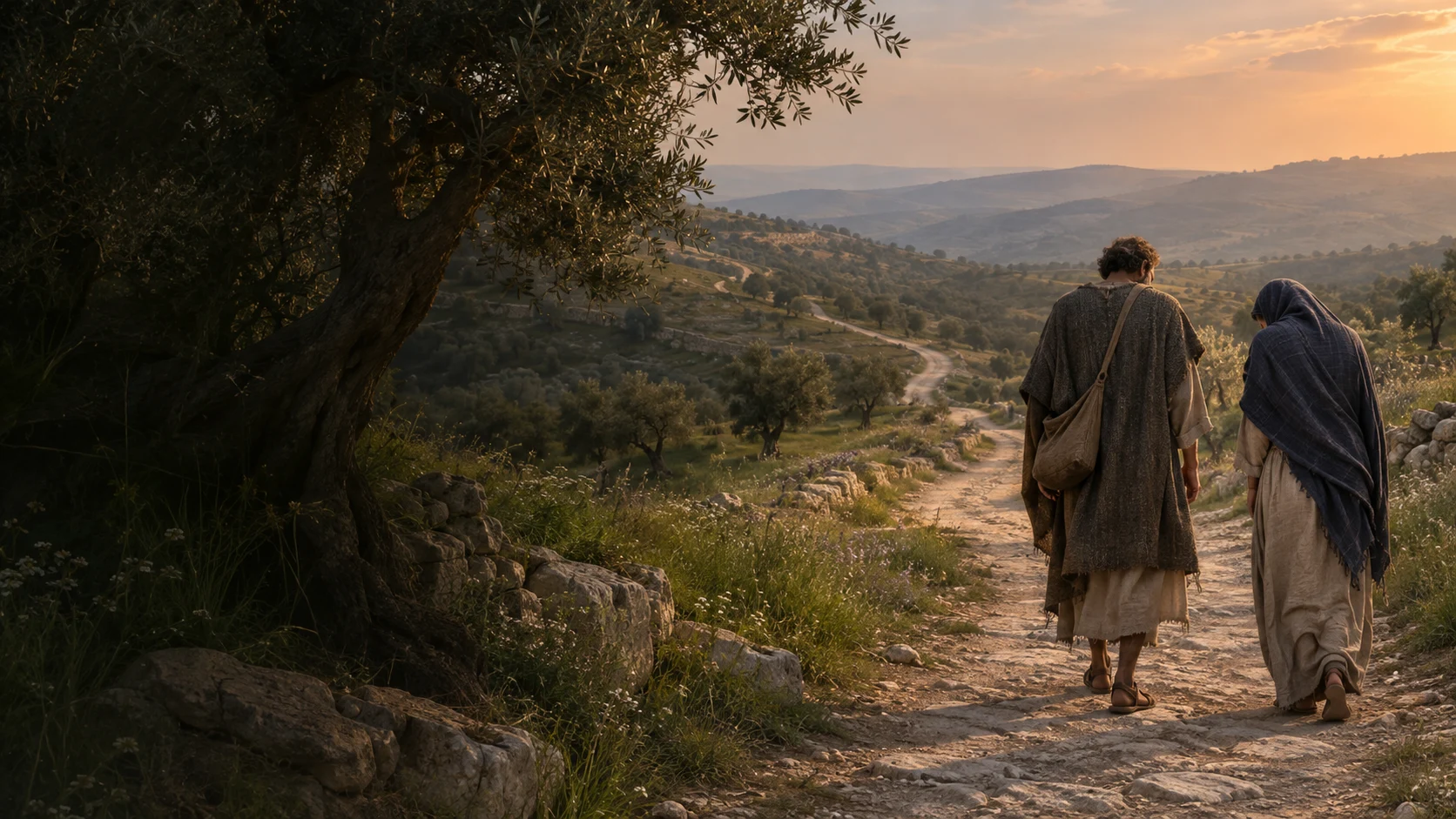
AN ENCOUNTER / LUKE 24:13–35
The stranger
on the road.
They were walking with their disappointment.
He came and walked with them.
Some conversations
need the length
of a road.
The unnamed companion is pictured as a woman; Luke does not identify that person’s gender or relationship.
Sixty stadia in Luke’s account.
A real journey; an uncertain route.
01 / Leaving Jerusalem
A road with room
for disappointment.
Imagine the road in the late afternoon. Pale stones hold the warmth of the day. Two people are walking away from Jerusalem, talking about what has happened there. The landscape is open around them, but their conversation keeps returning to the same loss.
Luke places this journey on the day of the resurrection. The village is named Emmaus, at a distance of sixty stadia from Jerusalem in this textual tradition, roughly eleven kilometers or seven miles. The exact site and route remain debated. Our images offer a landscape to enter rather than a recovered itinerary.
One traveler is Cleopas. The other is not named. We do not know the companion’s gender or relationship to Cleopas; the woman in these illustrations is an artistic choice. What Luke gives us is a conversation shared by two people trying to understand events that have shaken their hope.
Join them without needing to improve the conversation immediately. Some roads begin with an account that must be spoken more than once. The story has room for the things they cannot yet put together.
Luke 24:13 ↗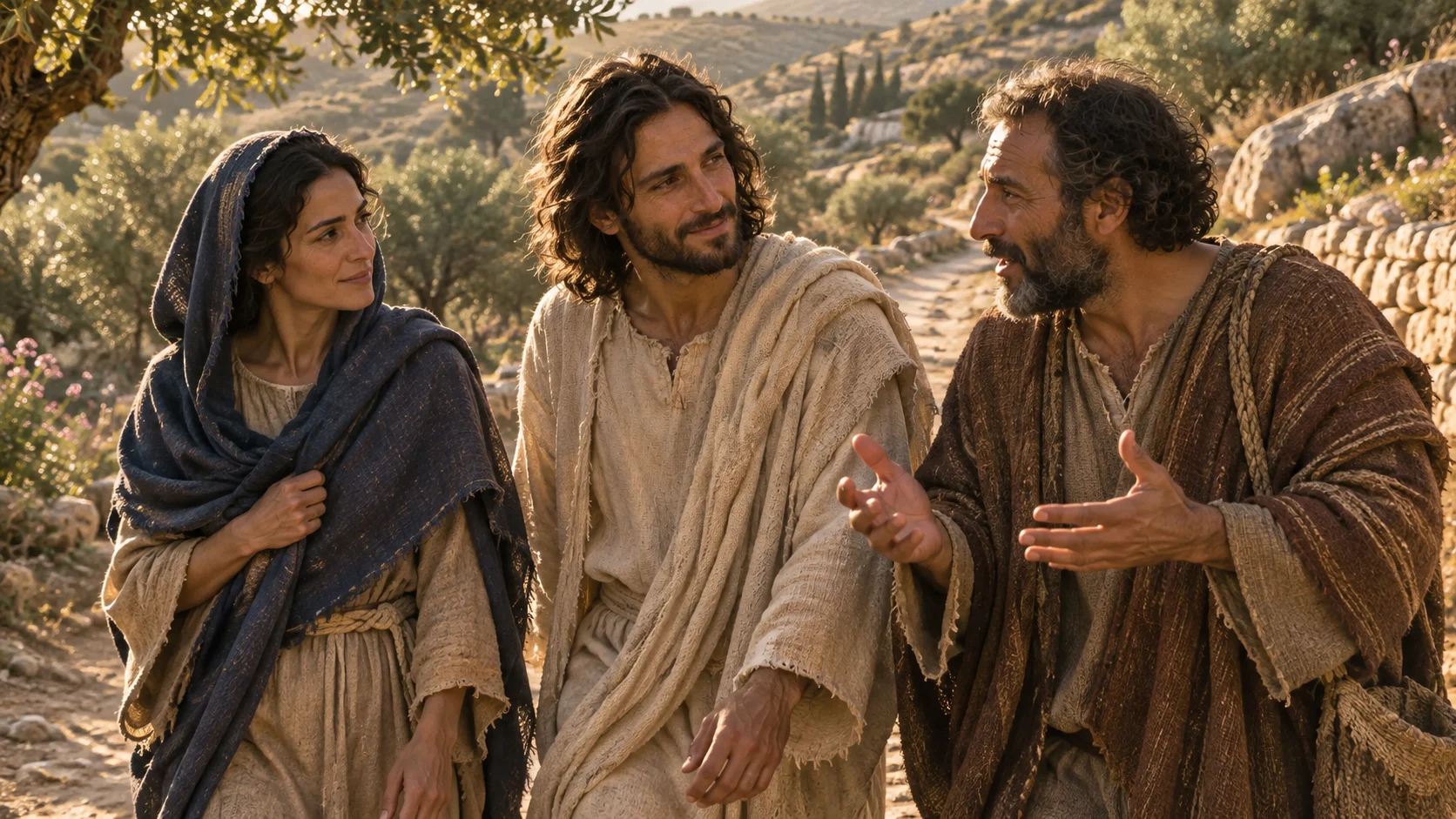
02 / Another set of footsteps
He comes near.
While they talk and question, Jesus comes near and goes with them. Luke tells the reader who has joined the road before the travelers recognize him. Their eyes are kept from knowing him.
Imagine the change in the rhythm of walking when a third person comes alongside. There is space to make, a pace to find. In our retelling, the ordinary movement holds the extraordinary nearness. The account does not begin with a dramatic announcement of identity.
Jesus asks what they are discussing as they walk in sadness. Cleopas responds with astonishment that a stranger could be unaware of the events in Jerusalem. Jesus asks what things. The question opens a place for their account.
As a reader, notice the attention before the explanation. The story will include a strong challenge to their understanding, but it first allows their disappointment to be heard in their own words.
Luke 24:15 ↗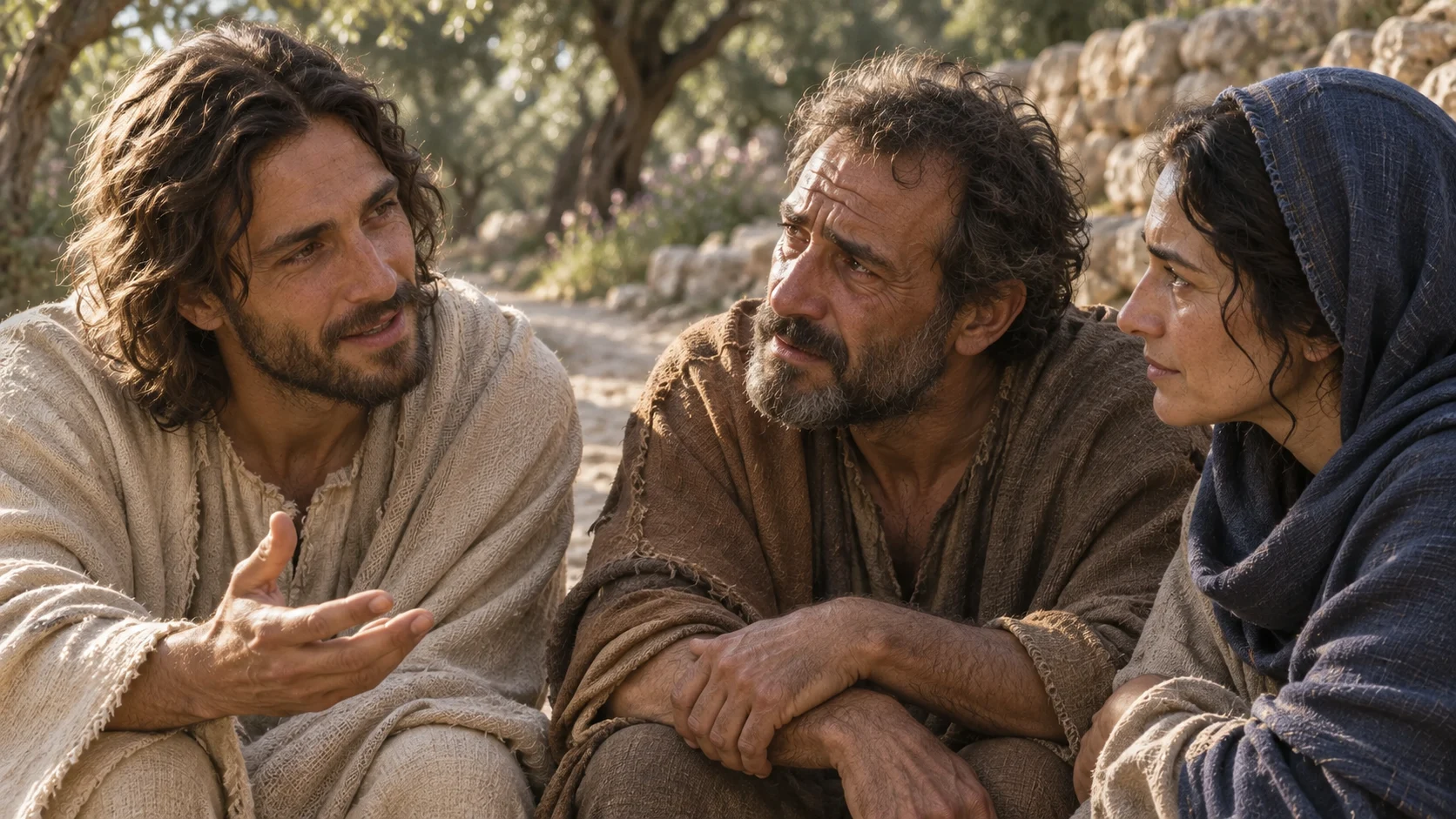
03 / What they had carried
“But we
were hoping…”
They tell him about Jesus the Nazarene, about his deeds and words, about his condemnation and crucifixion. They speak of hoping that he would redeem Israel. The words look back toward a future they had expected to inhabit.
Listen to that turn of language: we were hoping. It can hold a whole life’s disappointed expectation. We were hoping the news would be different. We were hoping the relationship would endure. We were hoping the work would lead somewhere. Those are connections we bring as readers, not extra events Luke narrates.
The travelers also know something of the women’s report of the empty tomb and the vision of angels. Other members of their company have gone to the tomb. They have information that astonishes them, yet their account still reaches toward an absence: they have not seen him.
You do not have to make every uncertain person in the story foolish or insincere. Luke lets bewilderment be part of this day. The travelers can tell the truth about the hope they have lost before they understand the one who is listening.
Luke 24:21 ↗04 / A story opened again
He walks them
through the Scriptures.
Jesus challenges their slowness to believe what the prophets have spoken. He asks about the Messiah’s suffering and glory. Beginning with Moses and the prophets, he interprets the Scriptures in relation to himself.
Luke does not give us a transcript of this teaching or a list of every passage discussed. We should resist inventing a secret complete sermon and presenting it as his recovered words. The movement Luke describes is enough to dwell on: a story they thought had ended is being read again in a wider frame.
Within the Christian reading the Gospel offers, the cross belongs inside the story of the Messiah rather than simply defeating it. That claim should not be turned into an explanation that every personal tragedy is necessary or secretly good. The passage’s interpretation concerns Jesus’ story; it does not authorize us to explain away someone else’s suffering.
Consider what it means to learn while still on the road. Their understanding develops in conversation and company. They have not arrived at a place where all the questions are settled before they are allowed to listen.
Luke 24:27 ↗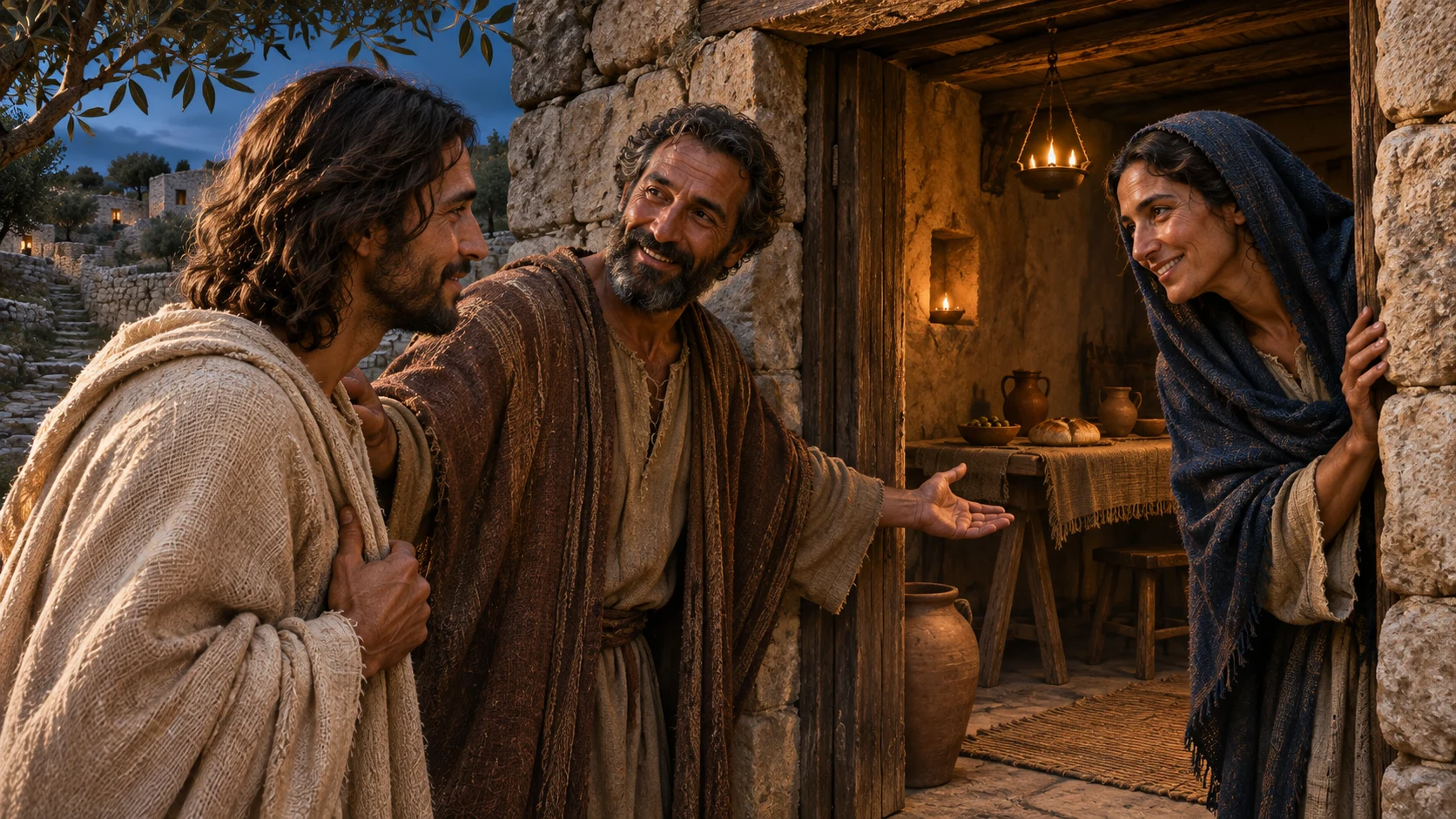
05 / At the threshold
Stay with us.
They draw near to the village. Jesus acts as though he will continue. The travelers urge him to remain because evening is approaching and the day is nearly over. He enters to stay with them.
There is a threshold here, both literal and human. A conversation on the road becomes an invitation into shelter and a meal. In the imagined scene, a little warm light falls through a doorway while the sky outside deepens toward blue.
The travelers offer hospitality before they know the stranger’s identity. Recognition has not yet become the reason to welcome him. They make room for the person who has been walking beside them.
This can become a small question for our own lives: what does a fitting welcome look like here? Sometimes it is a meal. Sometimes it is time, a seat, an introduction, or a willingness to let another person finish speaking. Wise limits can remain part of hospitality; the story invites attention rather than indiscriminate exposure to danger.
Luke 24:29 ↗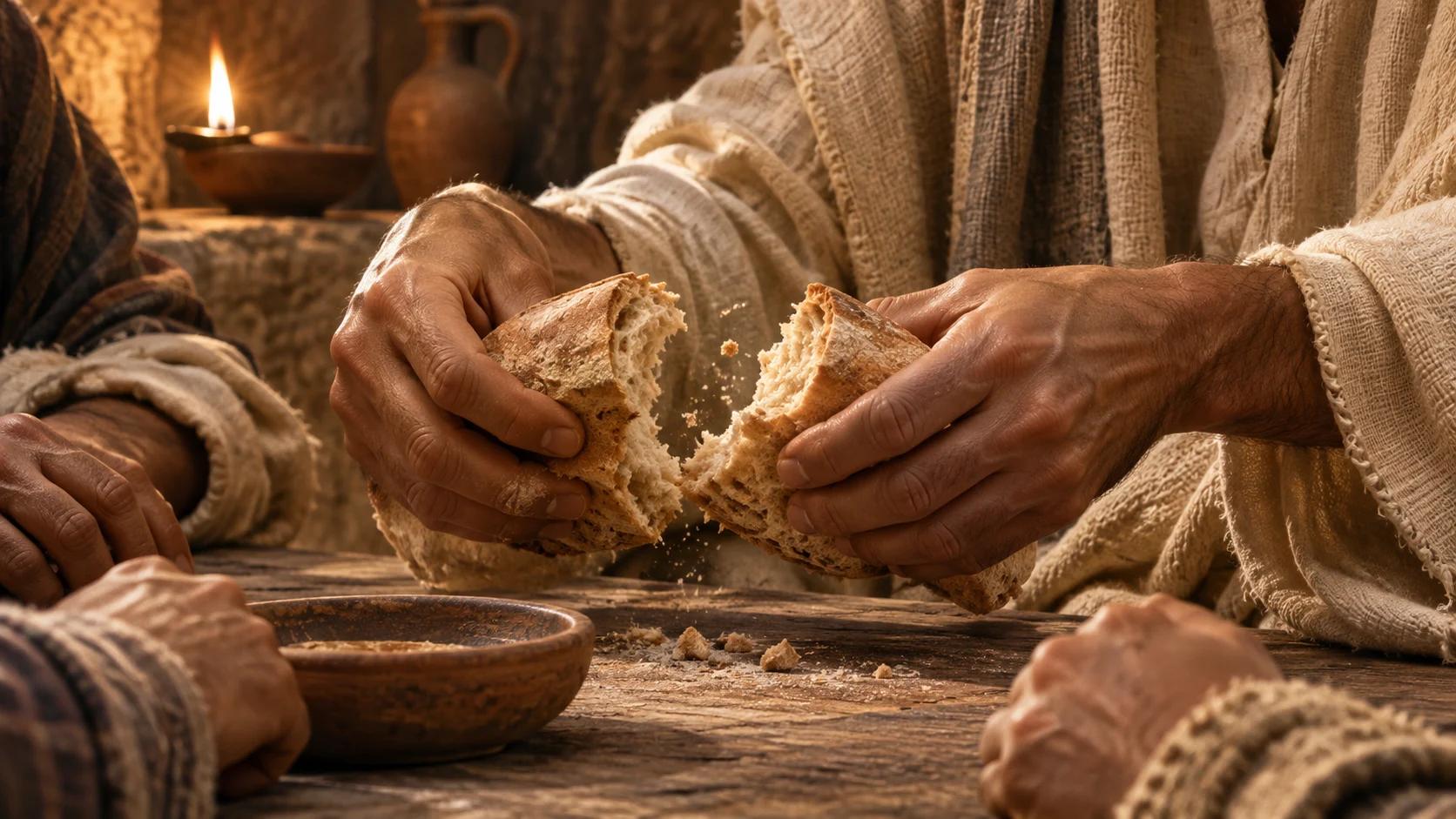
06 / At the table
Bread in
his hands.
At the table, Jesus takes the bread, blesses it, breaks it, and gives it to them. Luke slows the action into these familiar movements. The one welcomed into the house becomes the one who gives.
Look at the smallness of the scene. Hands. Bread. A shared table. The sequence has a place in the wider pattern of meals in Luke’s Gospel, and Christian readers have long heard eucharistic resonances in it. Different traditions describe that relationship in different ways.
You do not need to settle every theological question before attending to the passage. Stay with the action as Luke gives it. An ordinary need for food becomes the setting of a moment they will remember.
In the scene we imagine, crumbs fall onto the table and a lamp lights the room. These details are artistic. The bread being taken, blessed, broken, and given belongs to the text.
Luke 24:30 ↗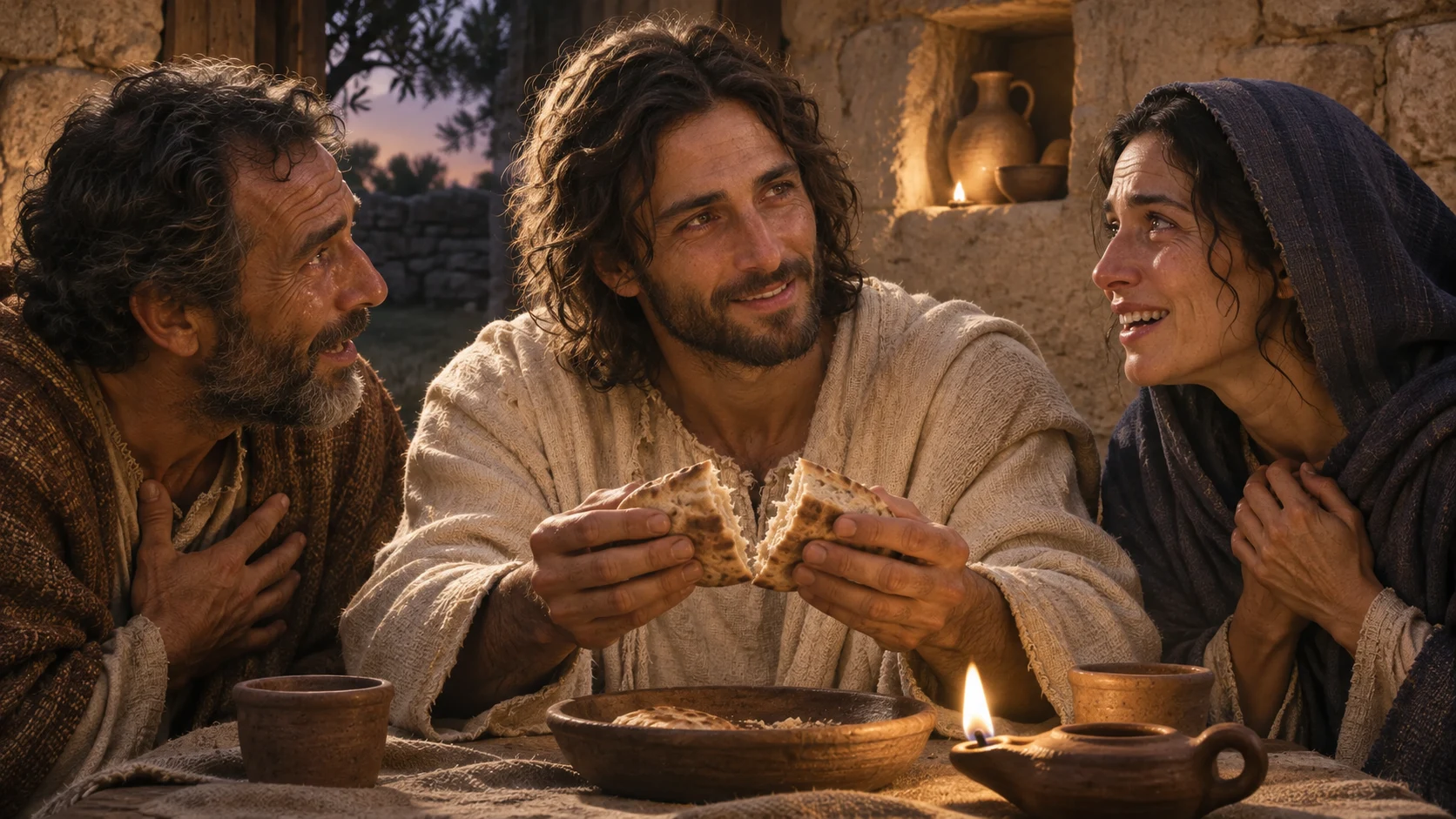
07 / Their eyes are opened
The stranger
is known.
Their eyes are opened. They recognize him. Then he vanishes from their sight.
Luke gives recognition and disappearance in the same verse. The meeting does not become a way of holding Jesus in place. The people at the table are left with the knowledge of whom they have encountered.
They speak to one another about their hearts burning while he talked with them on the road and opened the Scriptures. Looking back, the conversation becomes newly intelligible. They recognize something in the journey as well as in the meal.
This is a particular Gospel account, not a promise that every reader must have a similar sensation to possess faith. You can read it with wonder, questions, longing, or a quieter attention. The story’s warmth does not require you to manufacture an experience.
Luke 24:31 ↗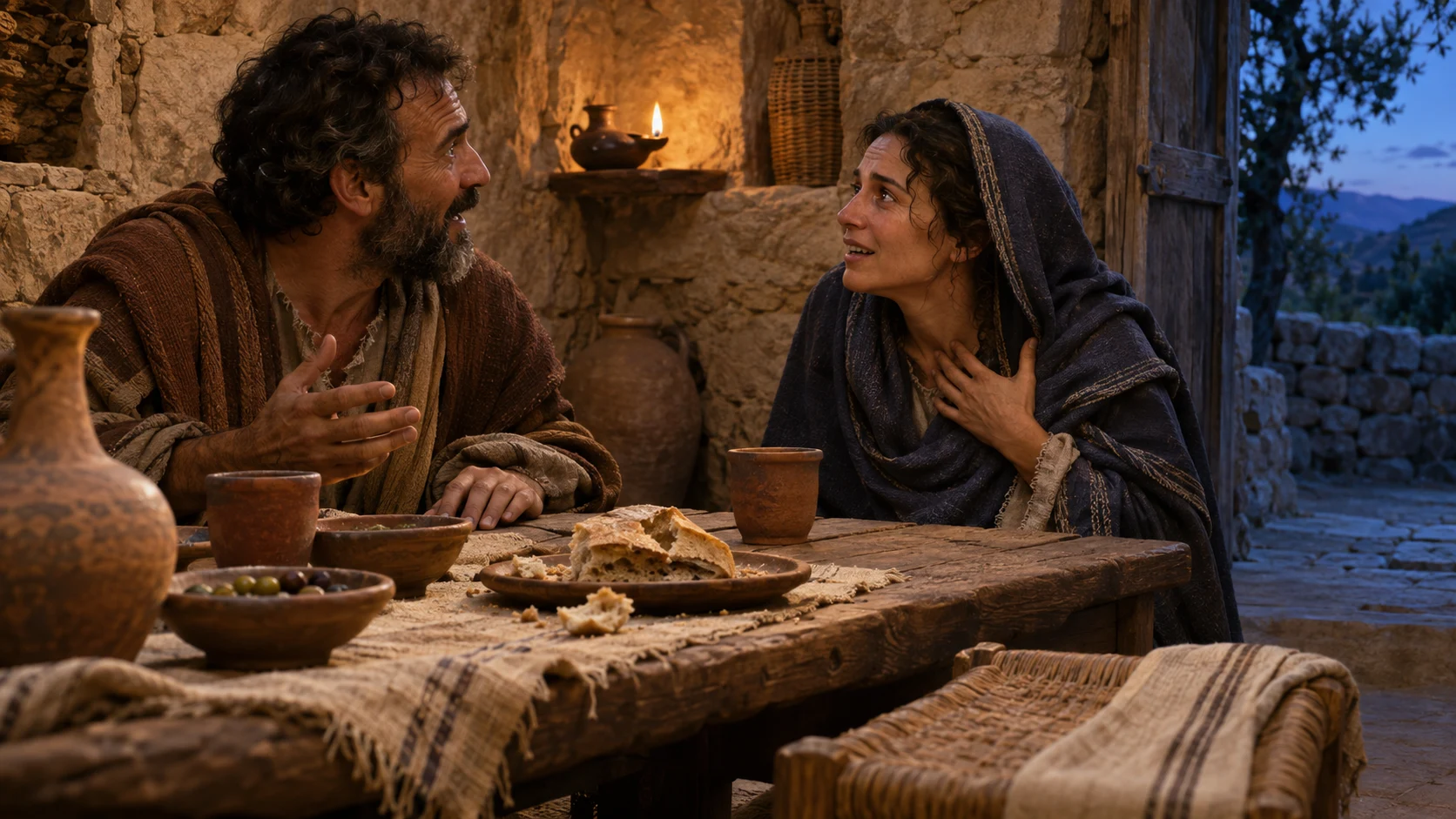
08 / The road again
They go back.
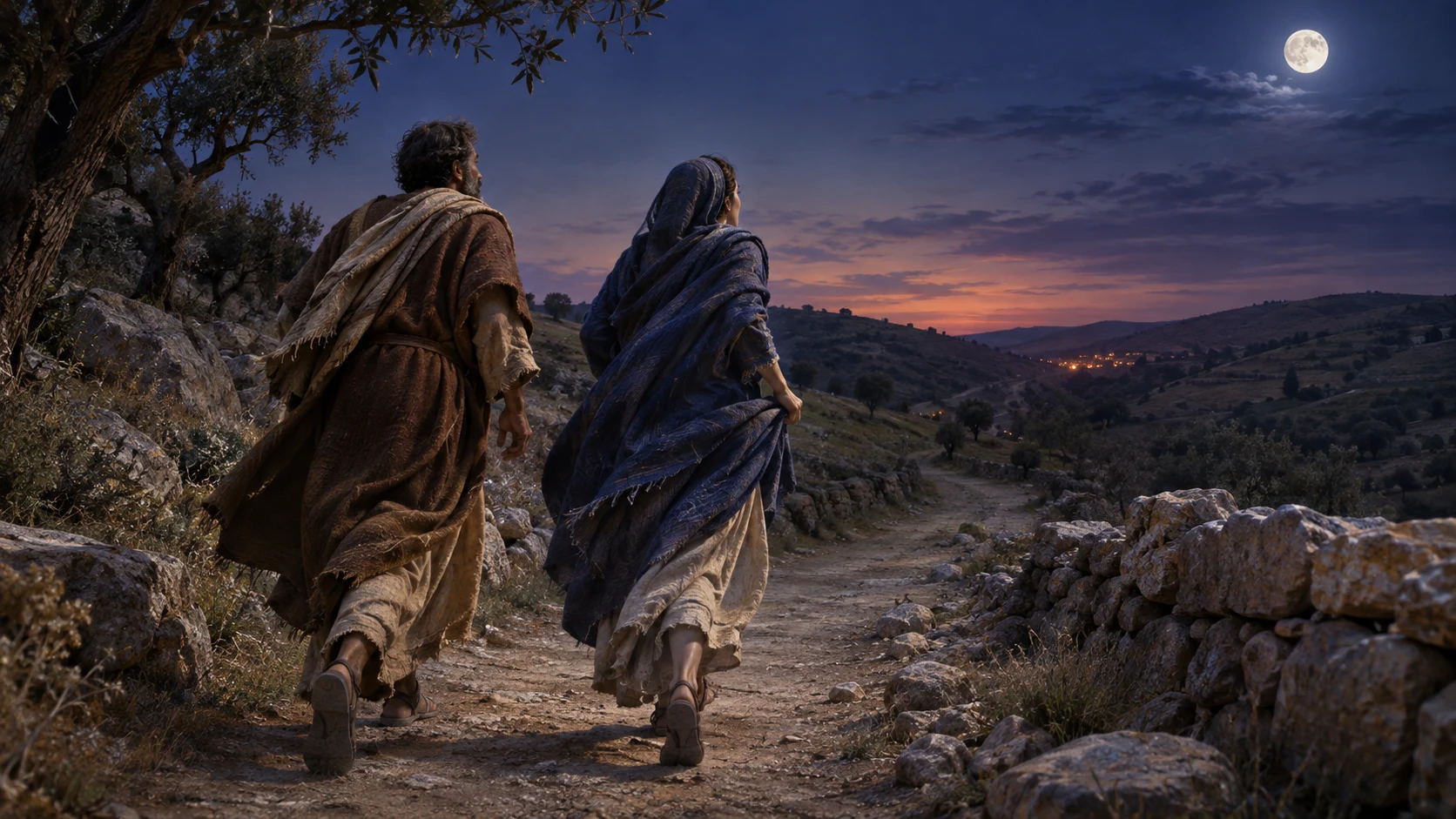
At that very hour, the two rise and return to Jerusalem. They find the Eleven and the others gathered, hearing that the Lord has risen and appeared to Simon. They tell what happened on the road and how he was known to them in the breaking of bread.
The road that carried disappointment away from Jerusalem now carries a report back toward the community. Luke does not describe every difficulty of the return. Our night scene imagines the change in their purpose through movement beneath a darkening sky.
Their encounter becomes something to share. The table leads back to other people, other accounts, and a conversation larger than the two travelers. Hope does not remain sealed inside a private room.
Let the story leave you with a modest possibility. A question can be spoken. A passage can be read again. A person can accompany another person. A place can be made at a table. You do not have to reproduce their evening to practice the attention, hospitality, and willingness to listen that the narrative brings into view.
Luke 24:33 ↗BRING YOUR OWN ROAD INTO PRAYER
A little company.
A little hope.
When hope has disappointed me
+
Jesus, walk with me when the future I imagined has fallen away. Give me room to tell the truth about what hurts. Bring patient company, an open mind, and light enough for the road I am on.
Stay with us
+
God, be near as the day grows quiet. Help me welcome trustworthy company and offer a fitting welcome to others. Let an ordinary table become a place of attention, nourishment, and care.
Teach me along the way
+
Jesus, help me listen before I assume I understand. Open the Scriptures with patience in me. Let what I learn become a kinder presence, a more honest life, and a little hope I can share.
RETURN TO THE WORDS
The road
in Luke’s telling.
Read Luke 24:13–35+
13Behold, two of them were going that very day to a village named Emmaus, which was sixty stadia from Jerusalem.
14They talked with each other about all of these things which had happened.
15While they talked and questioned together, Jesus himself came near, and went with them.
16But their eyes were kept from recognizing him.
17He said to them, “What are you talking about as you walk, and are sad?”
18One of them, named Cleopas, answered him, “Are you the only stranger in Jerusalem who doesn’t know the things which have happened there in these days?”
19He said to them, “What things?” They said to him, “The things concerning Jesus the Nazarene, who was a prophet mighty in deed and word before God and all the people;
20and how the chief priests and our rulers delivered him up to be condemned to death, and crucified him.
21But we were hoping that it was he who would redeem Israel. Yes, and besides all this, it is now the third day since these things happened.
22Also, certain women of our company amazed us, having arrived early at the tomb;
23and when they didn’t find his body, they came saying that they had also seen a vision of angels, who said that he was alive.
24Some of us went to the tomb and found it just like the women had said, but they didn’t see him.”
25He said to them, “Foolish people, and slow of heart to believe in all that the prophets have spoken!
26Didn’t the Christ have to suffer these things and to enter into his glory?”
27Beginning from Moses and from all the prophets, he explained to them in all the Scriptures the things concerning himself.
28They came near to the village where they were going, and he acted like he would go further.
29They urged him, saying, “Stay with us, for it is almost evening, and the day is almost over.” He went in to stay with them.
30When he had sat down at the table with them, he took the bread and gave thanks. Breaking it, he gave it to them.
31Their eyes were opened and they recognized him; then he vanished out of their sight.
32They said to one another, “Weren’t our hearts burning within us while he spoke to us along the way, and while he opened the Scriptures to us?”
33They rose up that very hour, returned to Jerusalem, and found the eleven gathered together, and those who were with them,
34saying, “The Lord is risen indeed, and has appeared to Simon!”
35They related the things that happened along the way, and how he was recognized by them in the breaking of the bread.
World English Bible · Public domain
Read the whole chapter ↗What is known, and what is imagined? +
The sequence follows Luke 24:13–35. Cleopas is named; the second traveler is not. The companion’s appearance and gender in the images are imagined. The sixty-stadia distance is preserved in this edition; textual variants and proposed locations complicate a precise reconstruction of the route. The Scripture conversation is described by Luke, but no complete transcript is supplied. Light, weather, the house, faces, and meal details beyond the text are artistic reconstructions.
Original narrative, prayers, and reflections by Via Jesus. Scripture: World English Bible, public domain. This is a Christian reading offered without denominational affiliation; it does not claim that all experiences of grief, doubt, or faith follow this emotional sequence.
KEEP LEARNING WITH HIM