AN ENCOUNTER / JOHN 20:1–18
When he said
her name.
Mary Magdalene. The garden. The morning
that began before she could believe it.
Come into the garden slowly. We know what this morning will mean. Mary does not.
Let her arrive before the answer does.
A narrative inspired by John 20. Sensory details and images are imagined.Jesus’ and Mary’s quoted words come from the biblical passage.
01 Before dawn
While it was
still dark.
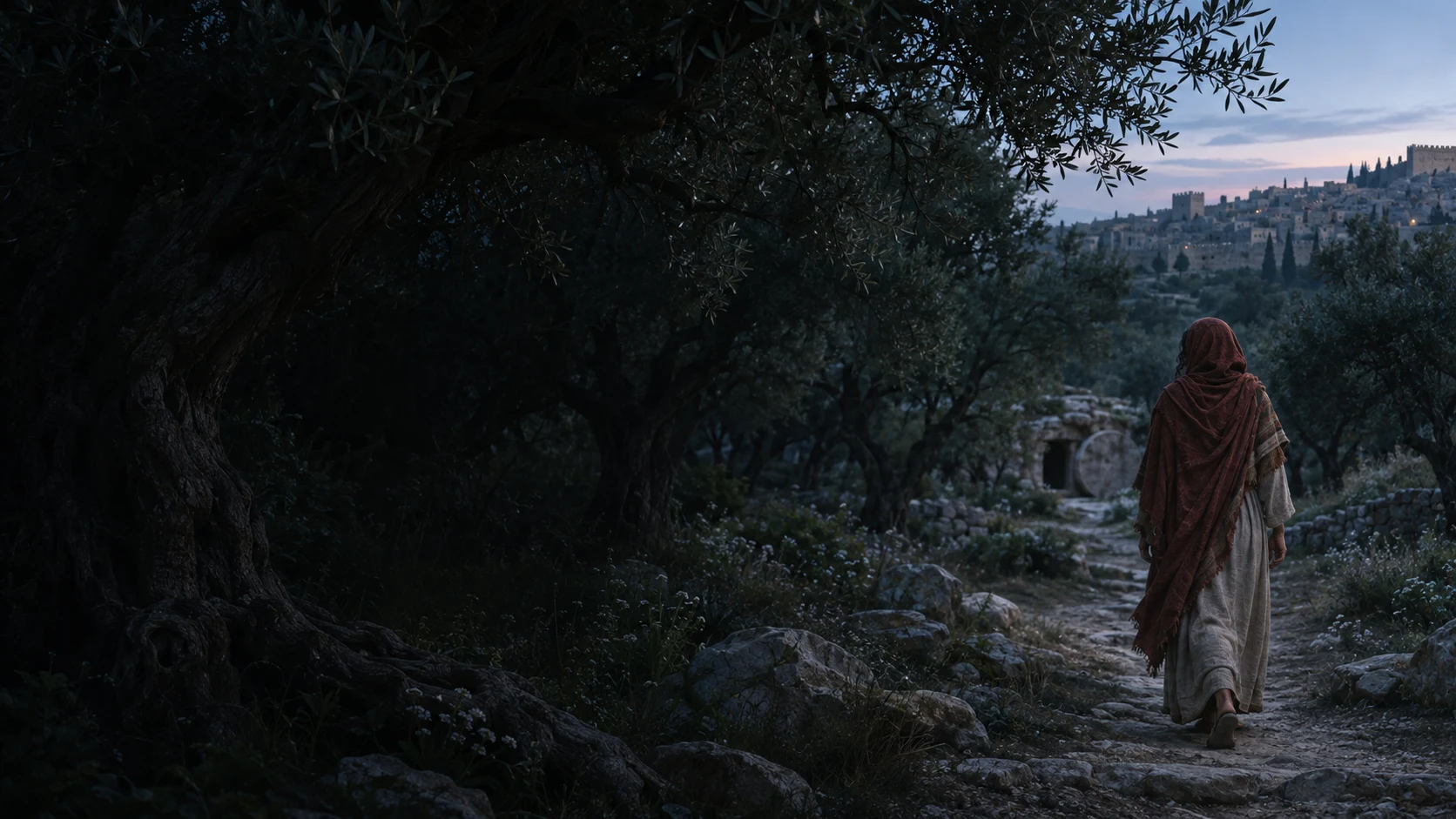
Imagine the quiet of a path before sunrise. The ground is uneven beneath your feet. Somewhere beyond the garden, a city is beginning another day. Close by, a woman is walking toward the place where someone she loves has been buried.
Walk beside her for a moment. You do not have to tell her what comes next. You do not have to make this morning brighter than she can yet bear. Let the darkness be the darkness in which John begins.
Mary Magdalene comes early on the first day of the week. The entrance to the garden is still ahead. In this imagined walk, the edges of the path appear a little at a time: a pale stone, a root, the dark shape of an olive tree. There is so much she cannot see yet. For now, there is the next step.
What the story does give us is her presence. The day has scarcely begun, and she is already on the way to the tomb. Before she knows anything has changed, she comes.
John 20:1 ↗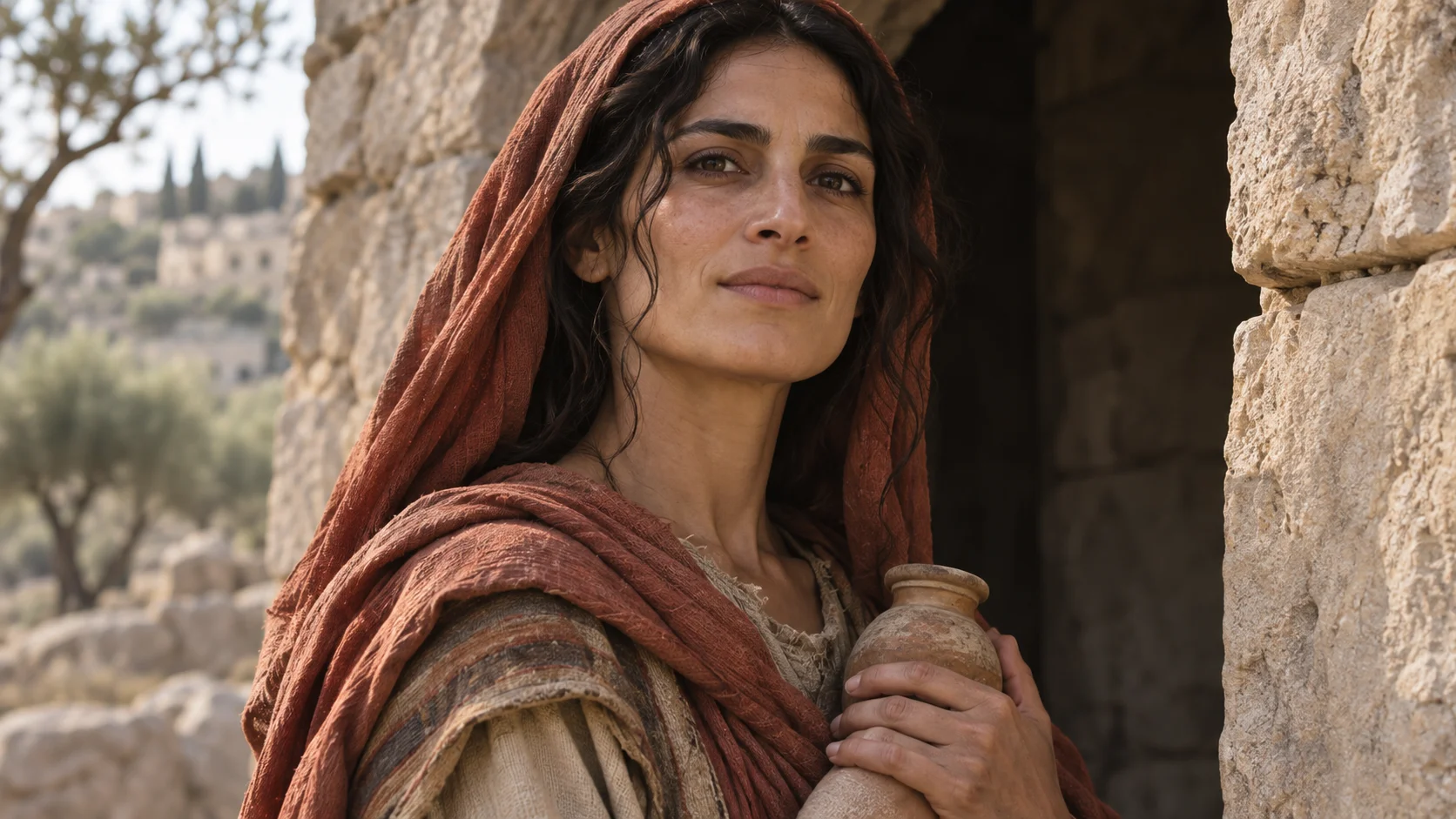
02 The woman on the path
Before this garden, there were roads. Luke names Mary Magdalene among the women accompanying Jesus and the Twelve. Joanna and Susanna are named beside her. These women help sustain the ministry from what they have. Their presence belongs to the life of the journey.
Luke also says that seven demons had gone out of Mary. He does not turn that brief account into a history of sexual wrongdoing. The Gospels do not call Mary Magdalene a prostitute. When we approach her, we can let go of a story that the text itself does not tell.
John places her near the cross, alongside Jesus’ mother and other women. The Mary who comes to the tomb has a place in the story of his life and his death. She is not appearing here simply to provide an emotional ending. She has already accompanied him.
Consider what it means to return after witnessing loss. There is a particular tenderness in the small things that remain possible: going somewhere, standing nearby, keeping company with a memory. We do not need to invent the whole of Mary’s grief to recognize something human in her coming.
Luke 8:1–3 · John 19:25 ↗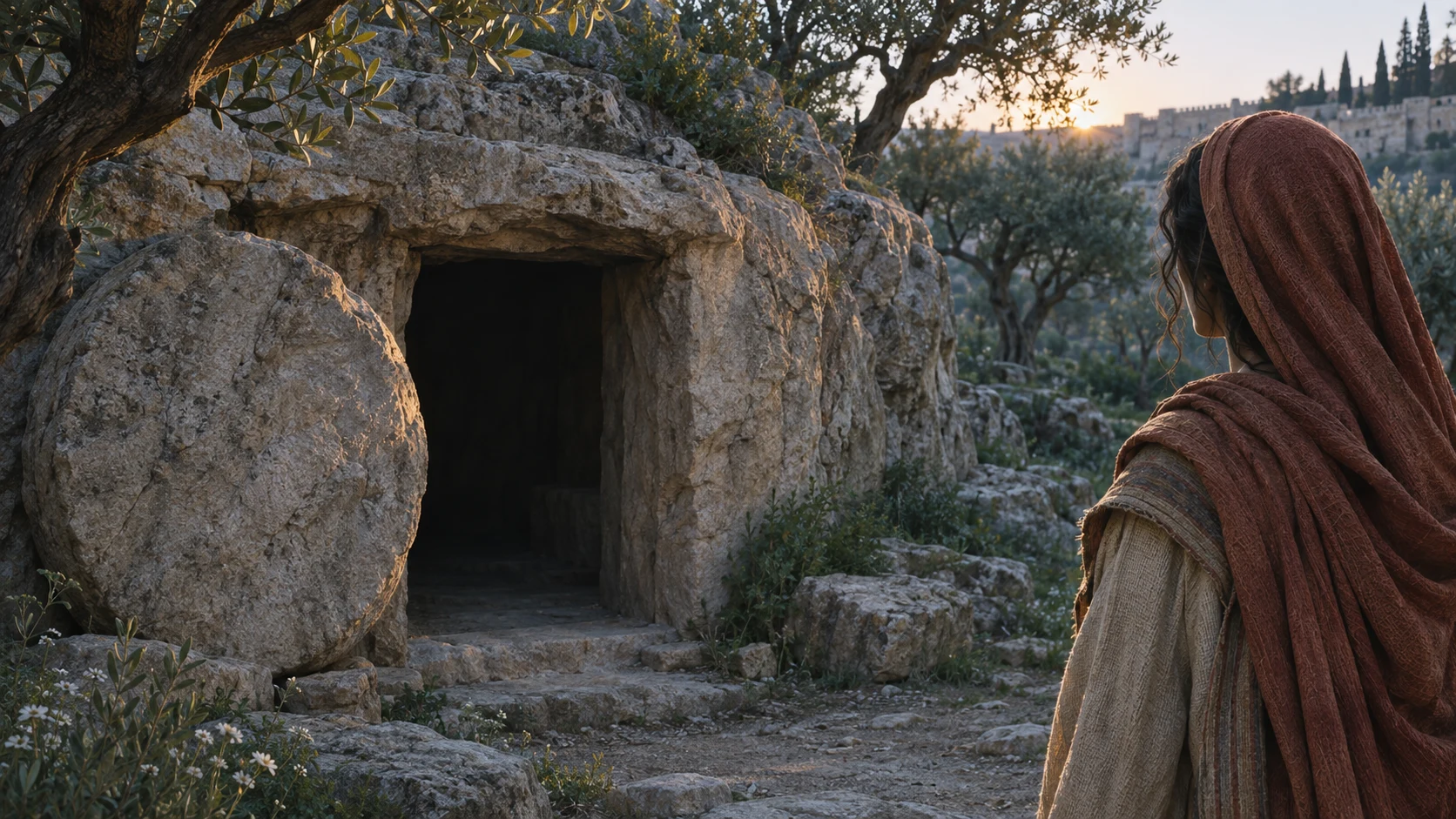
The stone
is already moved.
03 The open entrance
You reach the tomb with her. In the scene we imagine, pale light has begun to find the edges of the limestone. The opening is dark. The stone is out of its place.
John tells us that Mary sees the stone has been taken away. Her first response is to run to Simon Peter and the other disciple, the one Jesus loved. She tells them that the Lord has been taken from the tomb and that they do not know where he has been laid.
Stay with the distance between what Mary sees and what she understands. An open tomb does not immediately become good news for her. At this point, the absence means another loss. Even the place where she expected to find him no longer offers certainty.
The story allows her to say what she thinks has happened. It lets urgency enter before understanding. Her running is part of the morning, too.
John 20:1–2 ↗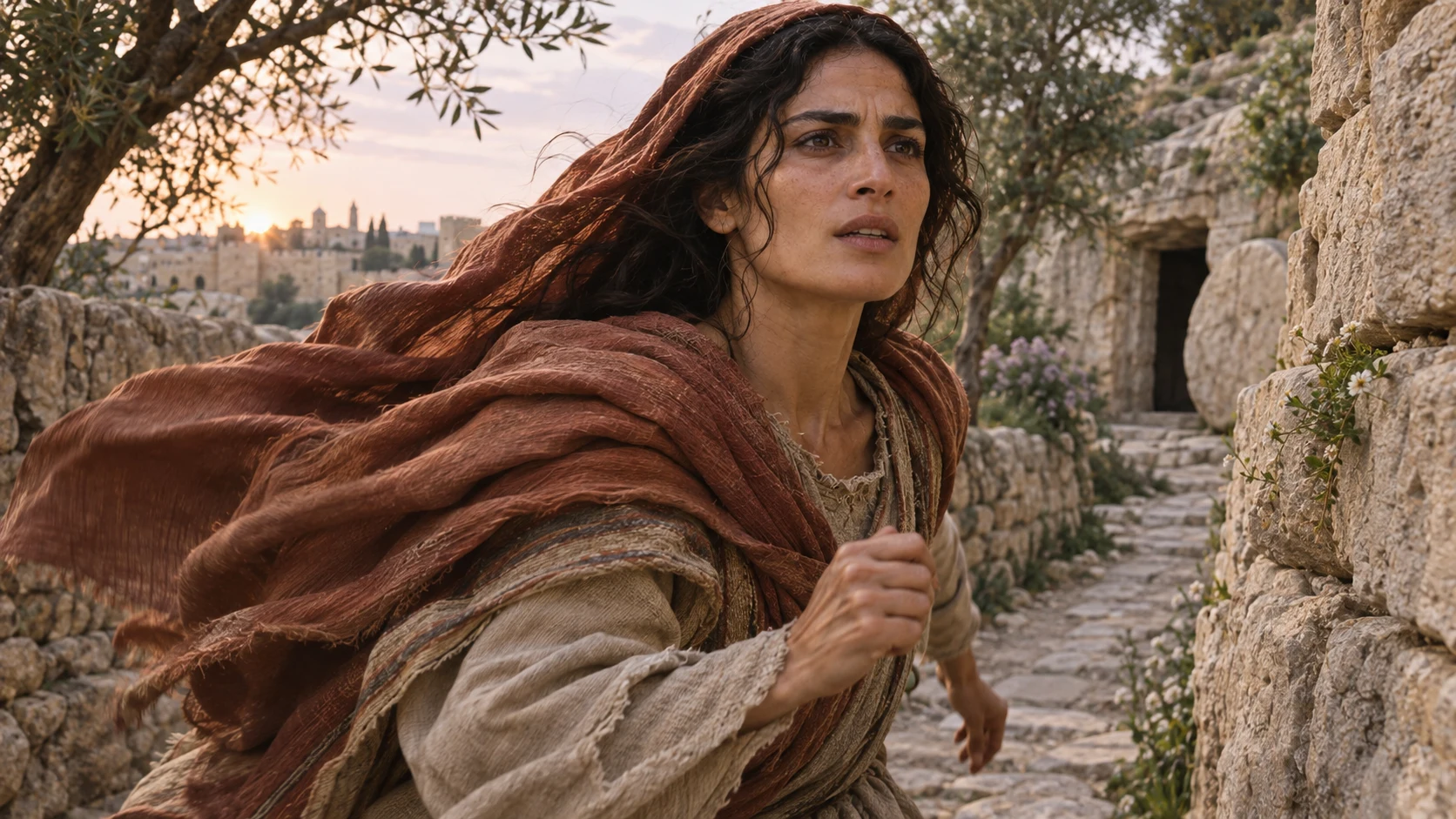
04 Inside the tomb
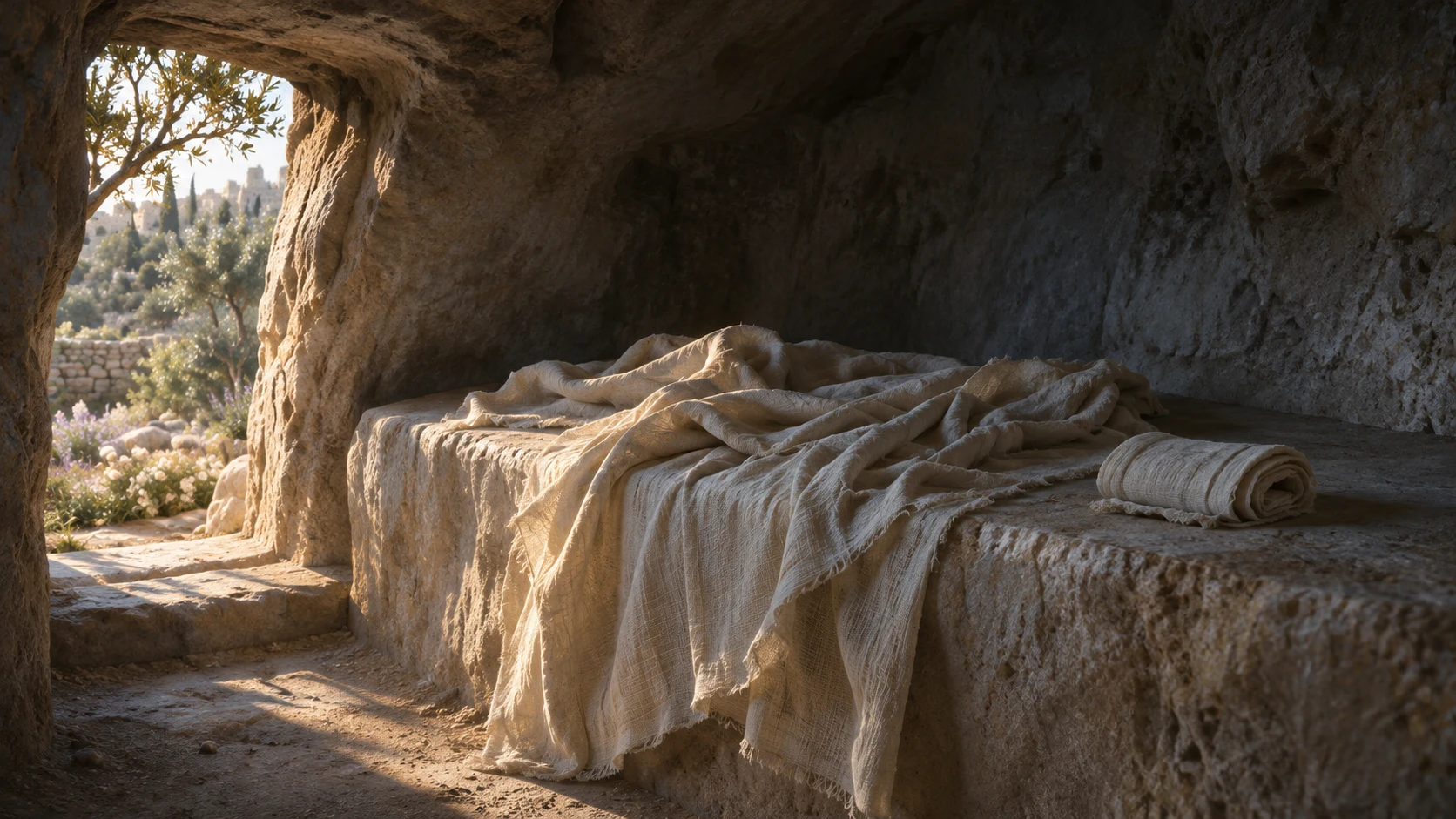
The cloths remain.
Peter and the other disciple run toward the tomb. One arrives first and looks in. Peter enters. John slows the account to describe what they see: linen cloths lying there, and the cloth that had been on Jesus’ head rolled up separately.
Imagine the difference between the rush of running and the stillness of that small space. A person enters expecting something that is no longer there. Attention falls on what remains. The Gospel makes the ordinary material of burial part of its witness.
The disciple who arrived first also enters. John says that he sees and believes, then adds that they do not yet understand the Scripture about Jesus rising from the dead. Seeing, believing, and understanding appear close together without becoming a perfectly simple sequence.
The small details ask us to look carefully: linen that has touched a body, a cloth lying apart, the place where he had been. Imagine the stillness after the men have finished looking. They leave again for their homes. Outside, Mary is still there.
John 20:3–10 ↗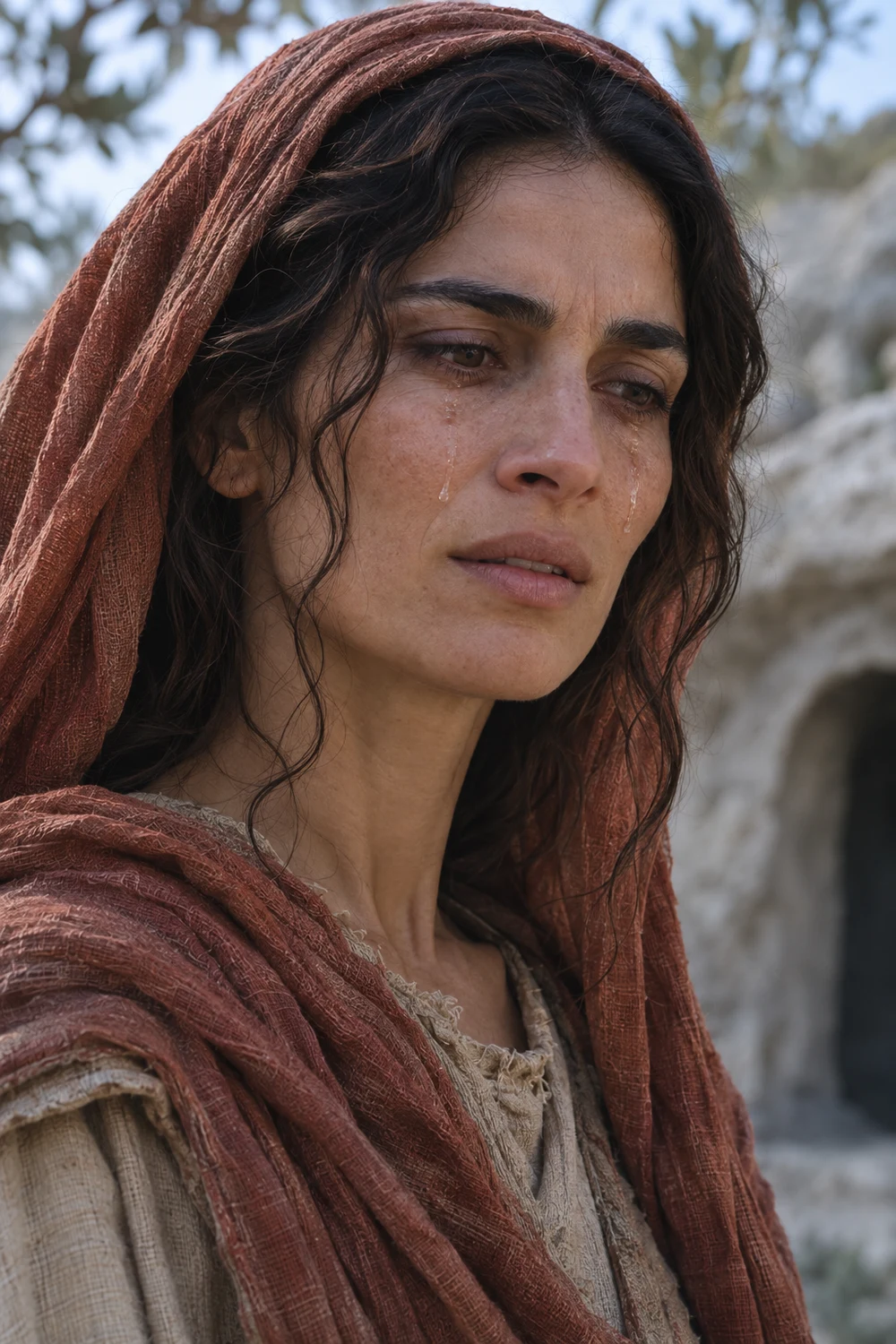
But Mary was standing
outside at the tomb
weeping.JOHN 20:11 · EXCERPT
05 Outside
Mary stays.
Outside the tomb, Mary is weeping.
John has described running feet and careful looking. Now the movement slows around one person’s tears. Stand a little way from her. Give her enough space to breathe. In the scene we imagine, the limestone holds the cool of the night, and her crying is a small sound in a large quiet.
If you have ever stayed after others have gone, you may recognize something in this pause. A room empties. A conversation ends. Everyone seems to know where to go next, while you are still trying to understand how the world can continue with someone missing from it.
Perhaps you have a name you find difficult to say aloud. Perhaps a place still makes you expect to see someone who is gone. You can bring that part of yourself close to this scene. Let Mary’s tears be hers, and let whatever they awaken in you have its own space.
You do not have to hurry through this part to earn the morning that follows. The Gospel has room for her weeping. As we read, we can make room for it too.
John 20:11 ↗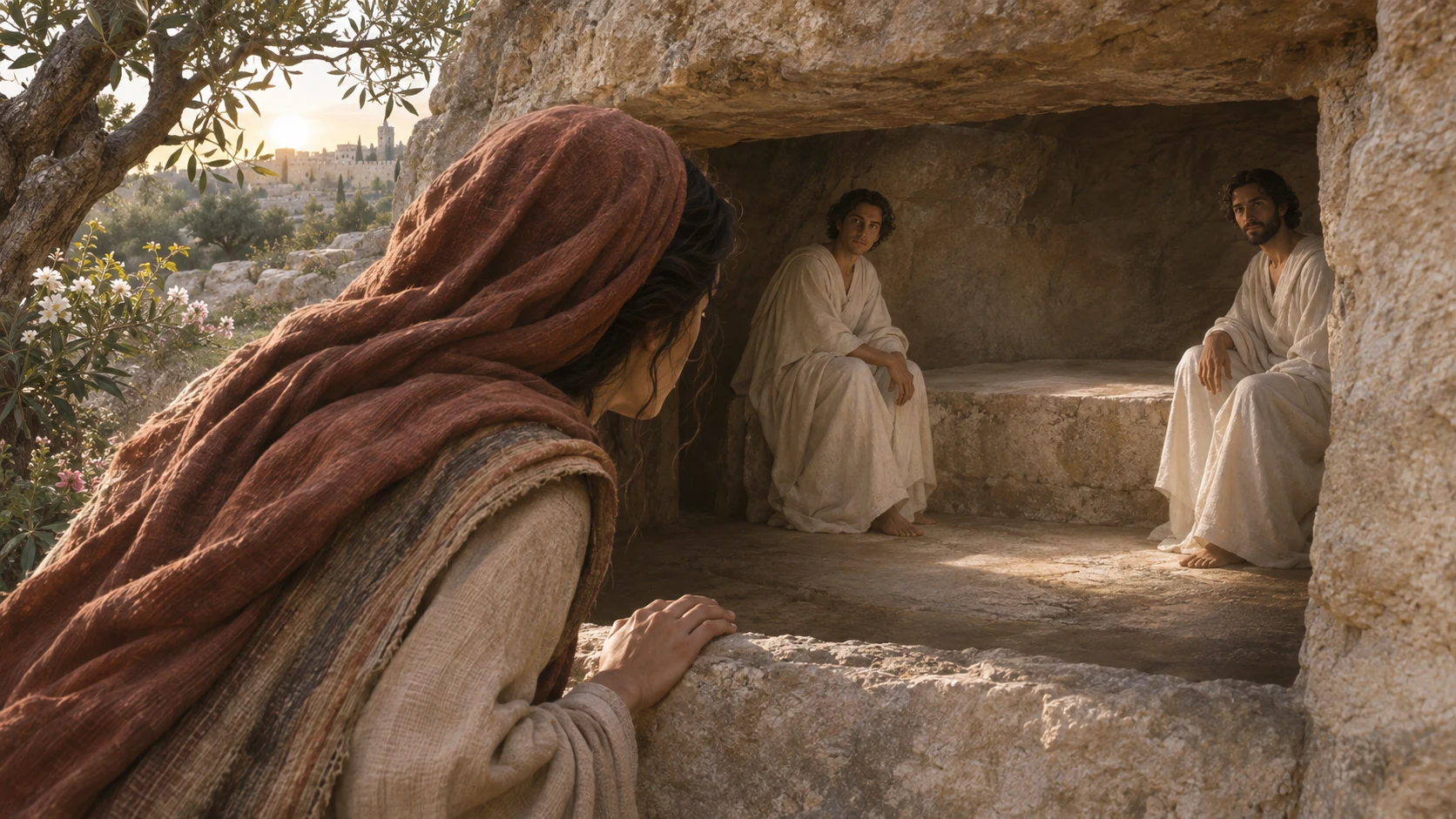
06 A question in the quiet
Still weeping, Mary bends to look into the tomb. John tells us that she sees two angels in white, seated where Jesus’ body had been, one at the head and one at the feet. They ask why she is weeping.
Her answer returns to the absence that has brought her here. They have taken away her Lord, and she does not know where they have laid him. The extraordinary sight does not immediately displace the grief. The question makes space for her to speak it again.
There is something tender in letting a person give the same answer twice. We often want grief to move forward on our timetable. We look for a new sentence, an improvement, a sign that the sorrow is becoming manageable. Here, Mary can name what hurts without making it sound different for the listener.
Pause with the question. You may have an answer ready. You may have several. You may need silence. As a prayerful reading, this moment can hold any of those responses.
John 20:11–13 ↗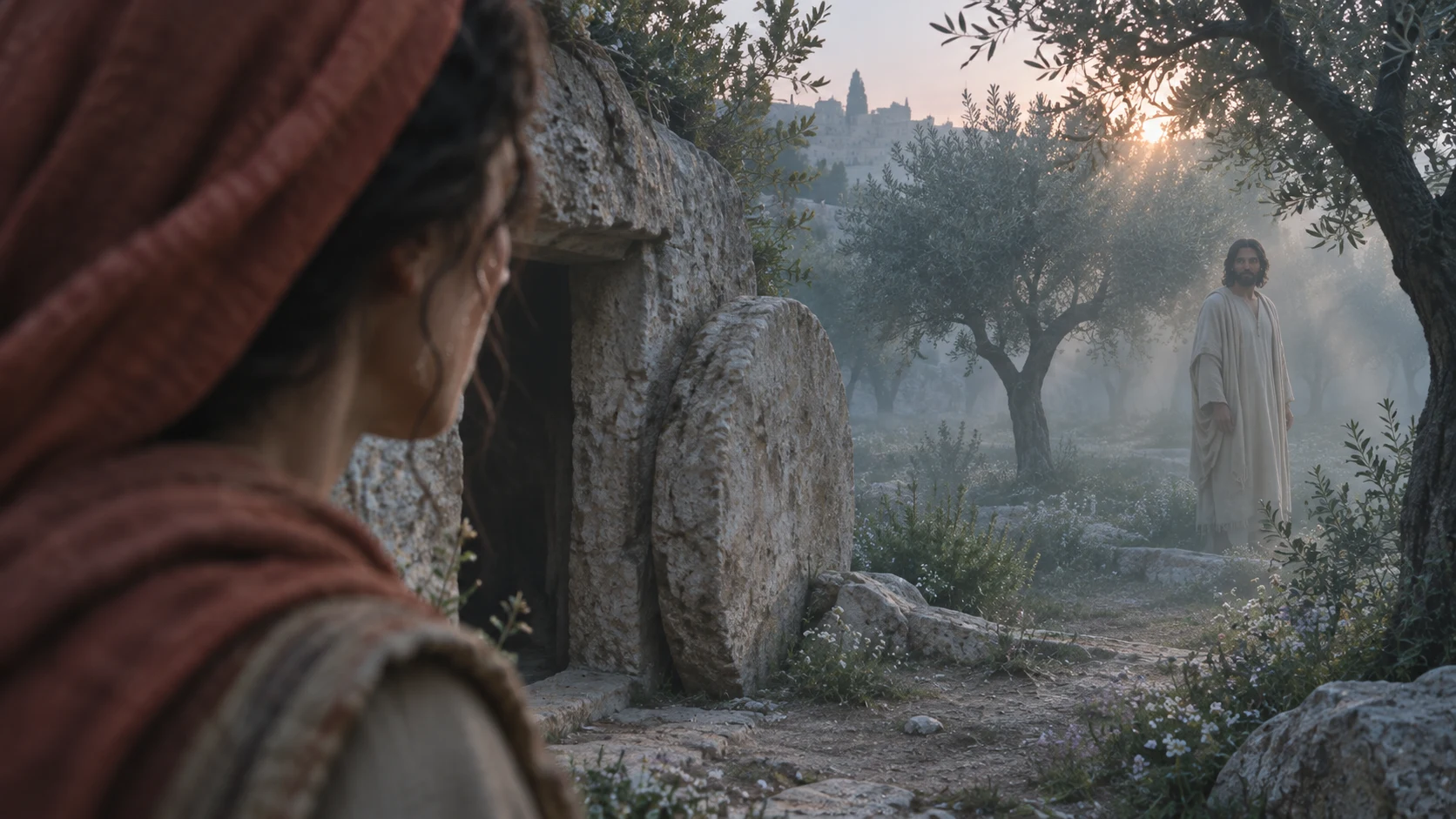
He is here.
She does not know.
07 Someone behind her
Mary turns. Jesus is standing there. She does not recognize him.
Read that movement slowly. The person she is seeking is present, and her understanding has not yet reached him. John does not explain the failure of recognition. We may imagine tears in her eyes or the confusion of grief, but the account leaves the reason open.
Jesus asks why she is weeping and whom she is looking for. Mary supposes he is the gardener. She asks him to tell her where he has put the body, if he has carried it away. She says she will take him away.
Her words are practical, urgent, directed toward finding him. She is still speaking within the world she thinks she inhabits: a death has happened, a body has been moved, someone may know where it is. The resurrection has not yet become something she can name.
As readers, we stand in the space between her assumption and our knowledge. We can feel the closeness of the answer. But let the meeting unfold at its own pace. There is still one word to come.
John 20:14–15 ↗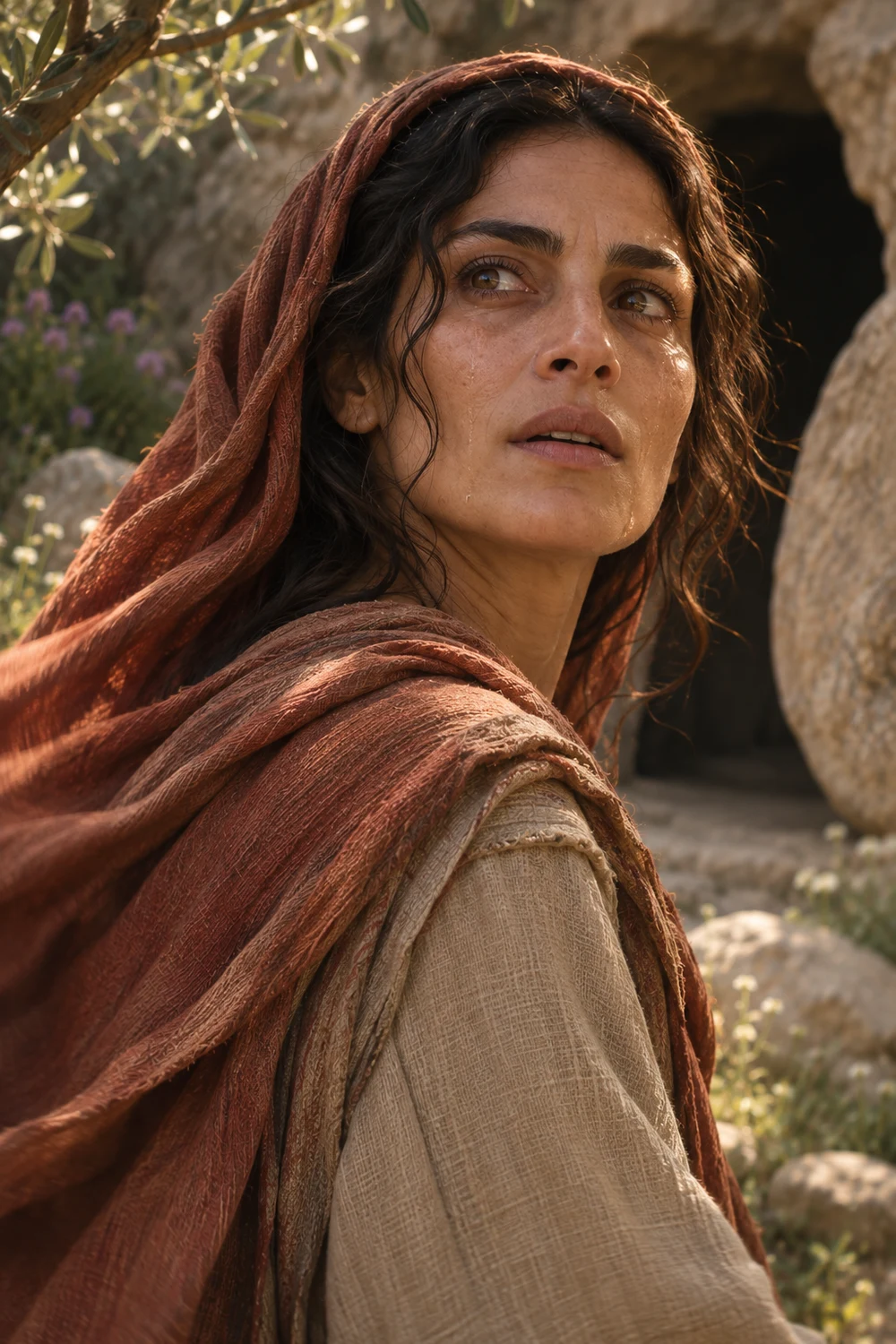
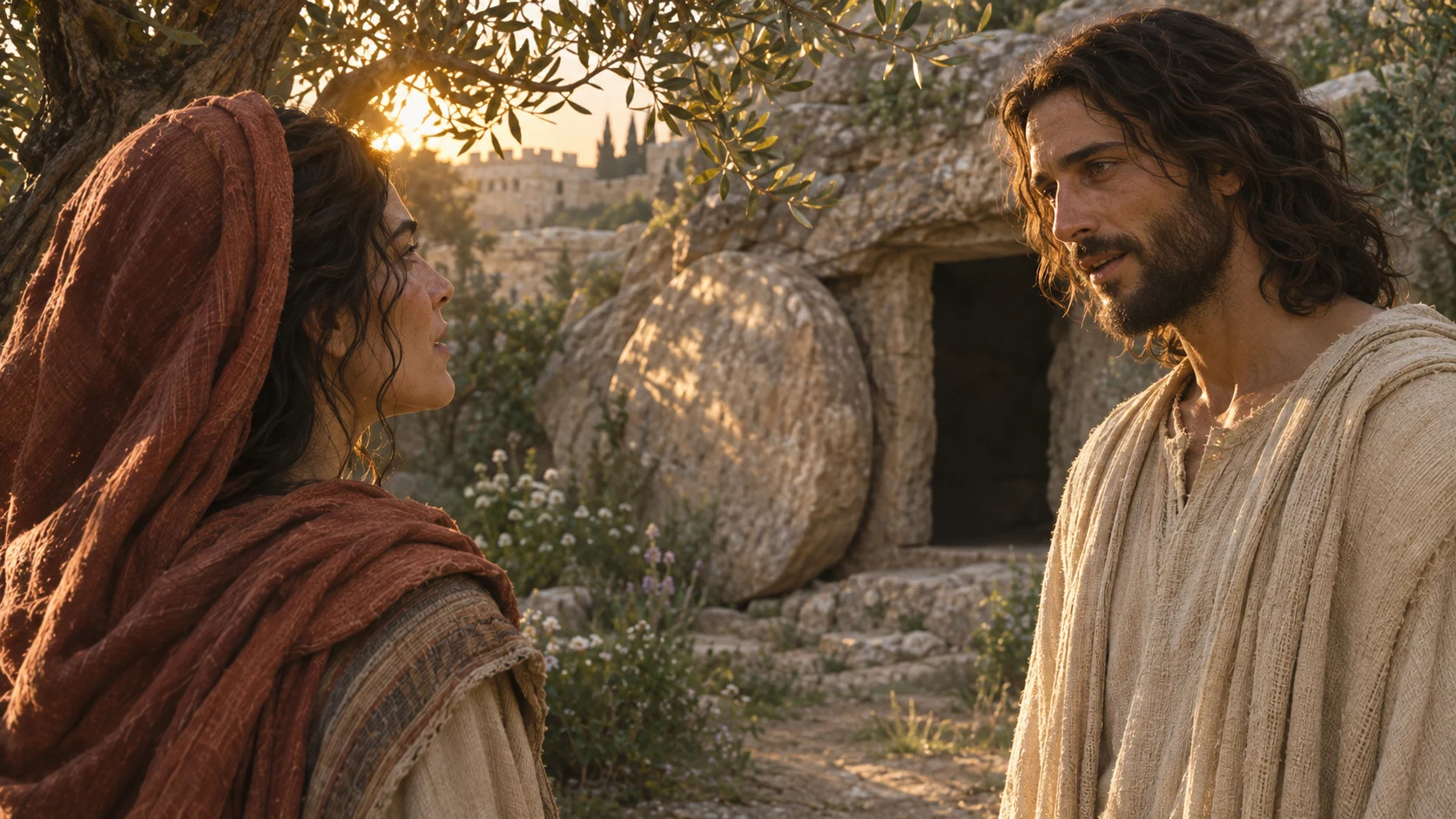
“Rabboni!”TEACHER. / JOHN 20:16
08 Recognition
Jesus says her name.
The Gospel gives us a single word at the turning point. Before Mary can explain the morning, before she can report it to anyone else, she is addressed personally. A name reaches her in the middle of the search.
Mary turns and answers, “Rabboni!” John explains the word for his readers: Teacher. Her reply carries recognition into a relationship. The one she has been looking for is the one who taught her. The familiar word belongs inside an encounter she could not have prepared herself to expect.
Imagine her face in that instant: the attention gathering, the recognition arriving before she has found all the words for it. The tears are still there. The same eyes that searched the entrance to the tomb now turn toward him. Her answer is small enough to say in a breath: Teacher.
Take a little time here. Read her name, then her answer. Let the smallness of the exchange remain. A story that has moved through public violence, burial, running, and bewilderment gives this recognition the intimacy of one person addressing another.
John 20:16 ↗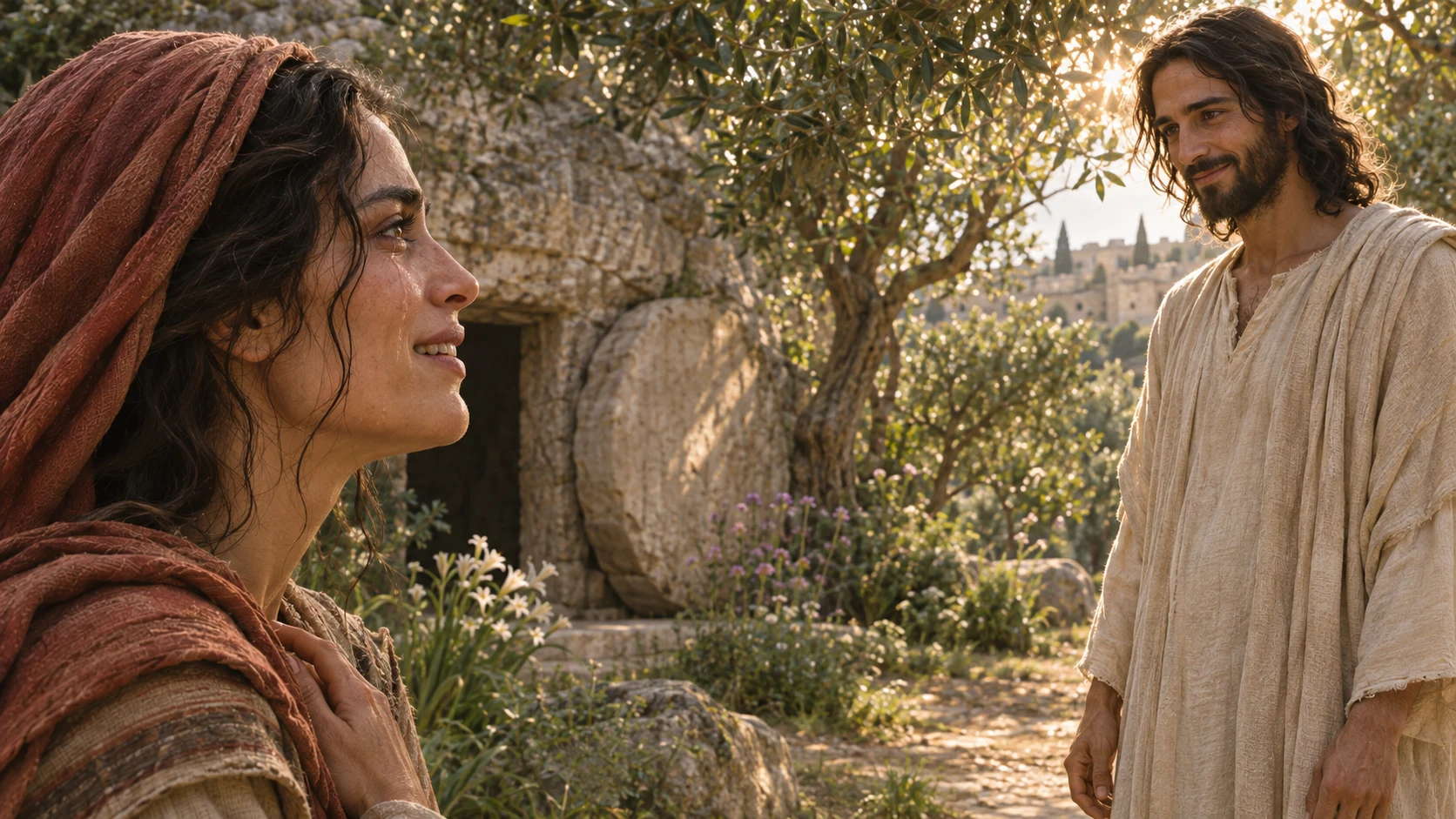
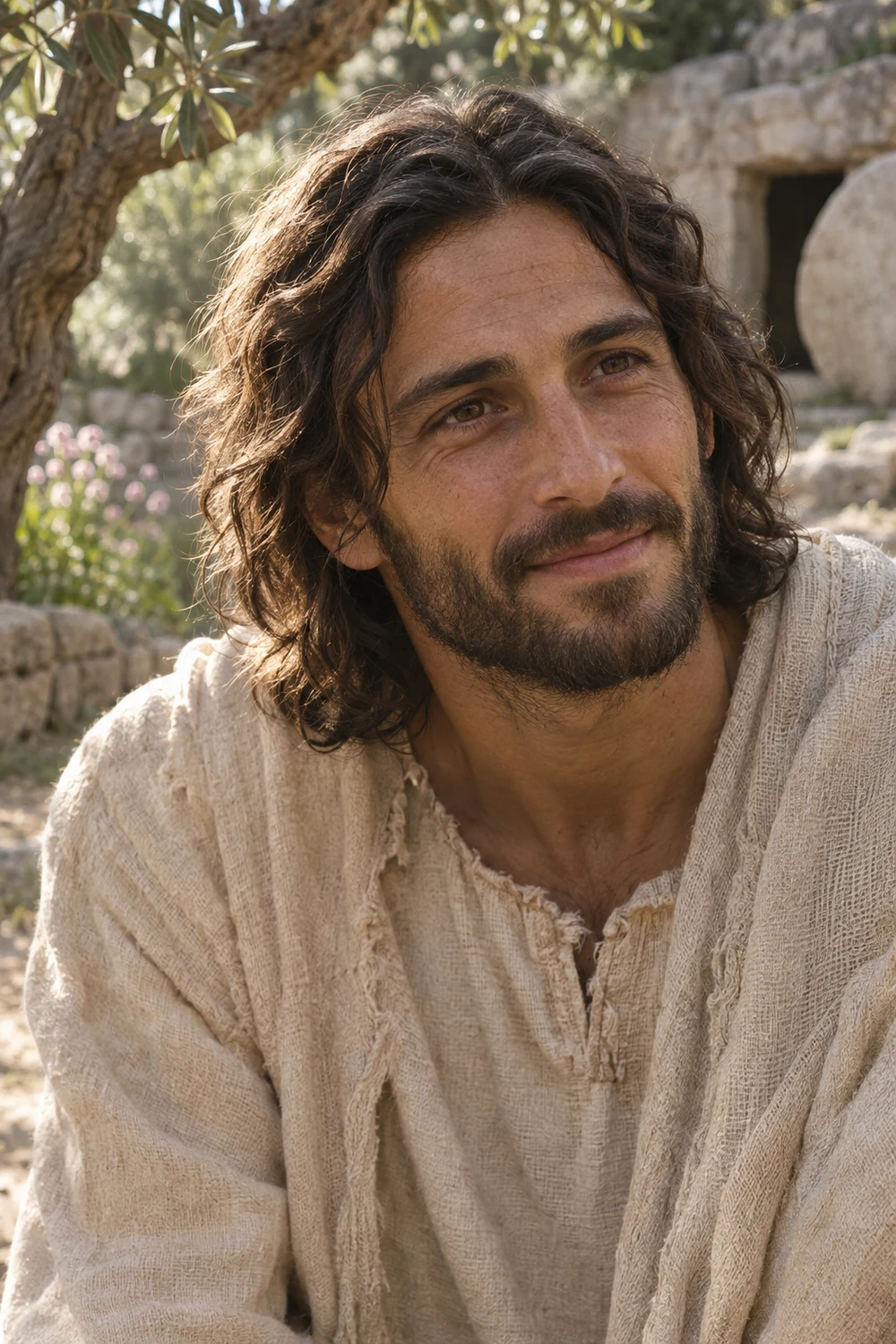 AN IMAGINED LIKENESS / THE TEACHER SHE RECOGNIZES
09 The encounter opens outward
There is more
to this morning.
The scene does not stop at recognition. Jesus tells Mary not to hold him, speaks of his coming ascension, and gives her a message for his brothers.
Translations express the opening instruction in different ways: do not hold, do not cling, do not touch. The wording has a long history of interpretation. We should be careful about turning it into a claim that Jesus is rejecting Mary, or into a description of exactly how she moved. John does not narrate an embrace here.
What the verse clearly does is move the encounter toward a task. Jesus speaks of his Father and their Father, his God and their God. Mary is to go to the others. The words she receives make a connection between this garden and the people who are absent from it.
For a reader, this can become a difficult and beautiful reflection: an encounter may change what comes next. Mary is allowed the intimacy of recognition, and she is entrusted with something to carry beyond it. The garden becomes a place from which she will leave.
John 20:17 ↗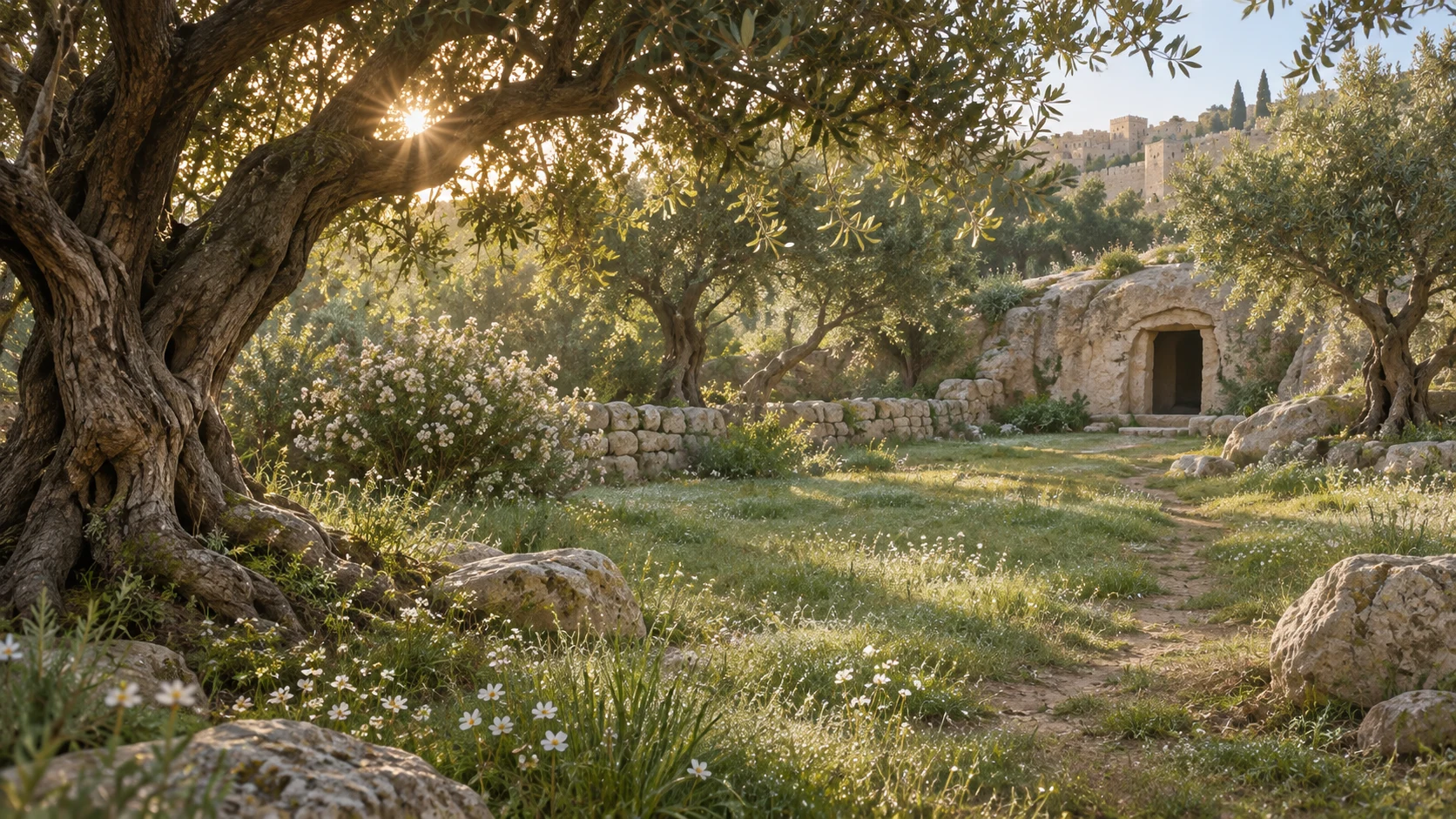
The same garden.
Morning, at last.
10 / A WITNESS TO THE MORNING
She has
seen him.
And now, there are people to tell.
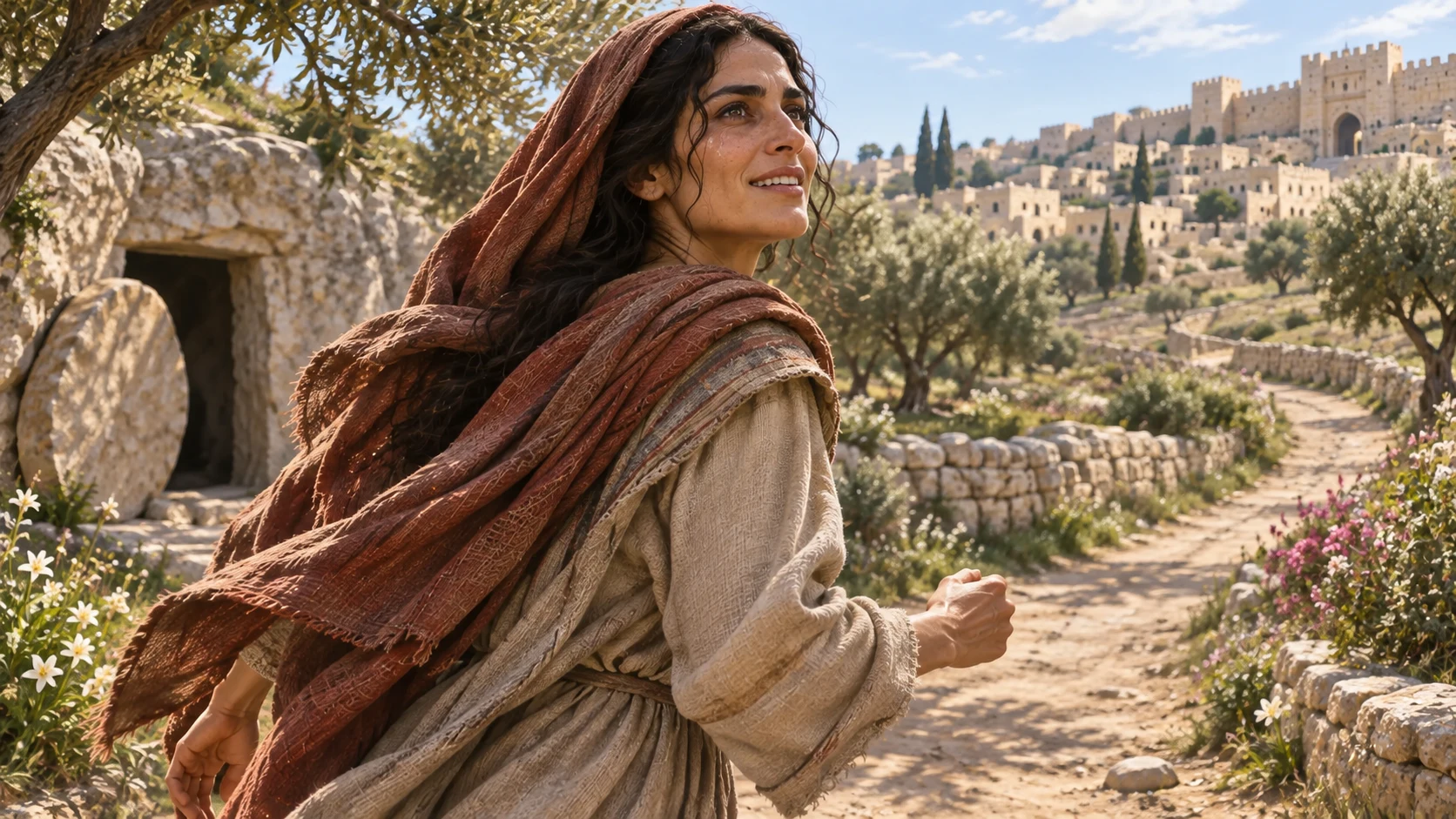
10 A witness to the morning
Mary Magdalene goes to the disciples and tells them that she has seen the Lord. She also tells them what he has said to her.
Notice the distance the narrative has travelled. Earlier she ran with news of a missing body. Now she goes with the account of a meeting. Her name remains in the sentence. The woman who wept outside the tomb becomes the person who carries this report to the others.
Imagine her making her way back through the morning. In our imagined scene, sunlight has reached the stones. Her shawl moves as she walks. The way back has the familiar turns of the way she came; she carries an encounter into those ordinary surroundings. Somewhere ahead are the people to whom she must speak.
We have walked beside her as readers. Now we let her go. She has a message to deliver. The story will continue in a room where the disciples gather, and later beside a lake. For this moment, remain with the wonder of the garden: she came, she wept, she was addressed, she recognized him, and she went.
John 20:18 ↗A LITTLE ROOM FOR YOUR OWN HEART
Bring what
this has stirred.
You can borrow these words, change them, or sit quietly.
01When I cannot see the way
God, meet me in the part of the story I do not yet understand. Give me enough light for the next step, and someone to walk beside me. Help me be honest about the darkness without closing my heart to morning.
02Room for my tears
Jesus, I bring you the sorrow I cannot make smaller. Receive the words I repeat and the silence beneath them. Give me patient companions, the courage to receive their care, and freedom to grieve without pretending.
03Known by name
God who knows me, help me remember that I am more than what I have lost, achieved, or failed to do. Let me receive love without first making myself perfect. Teach me to offer that same tenderness to another person.
04Carry a little hope
Jesus, let what I receive become kindness in the world. Help me carry hope gently, listen before speaking, and honor the stories of people whose morning has not yet come.
THE WORDS BENEATH THE IMAGES
Return to
the passage.
John 20:1–18 · World English Bible
Read the complete passage here +
1Now on the first day of the week, Mary Magdalene went early, while it was still dark, to the tomb, and saw that the stone had been taken away from the tomb.
2Therefore she ran and came to Simon Peter and to the other disciple whom Jesus loved, and said to them, “They have taken away the Lord out of the tomb, and we don’t know where they have laid him!”
3Therefore Peter and the other disciple went out, and they went toward the tomb.
4They both ran together. The other disciple outran Peter and came to the tomb first.
5Stooping and looking in, he saw the linen cloths lying there; yet he didn’t enter in.
6Then Simon Peter came, following him, and entered into the tomb. He saw the linen cloths lying,
7and the cloth that had been on his head, not lying with the linen cloths, but rolled up in a place by itself.
8So then the other disciple who came first to the tomb also entered in, and he saw and believed.
9For as yet they didn’t know the Scripture, that he must rise from the dead.
10So the disciples went away again to their own homes.
11But Mary was standing outside at the tomb weeping. So as she wept, she stooped and looked into the tomb,
12and she saw two angels in white sitting, one at the head and one at the feet, where the body of Jesus had lain.
13They asked her, “Woman, why are you weeping?” She said to them, “Because they have taken away my Lord, and I don’t know where they have laid him.”
14When she had said this, she turned around and saw Jesus standing, and didn’t know that it was Jesus.
15Jesus said to her, “Woman, why are you weeping? Who are you looking for?” She, supposing him to be the gardener, said to him, “Sir, if you have carried him away, tell me where you have laid him, and I will take him away.”
16Jesus said to her, “Mary.” She turned and said to him, “Rabboni!” which is to say, “Teacher!”
17Jesus said to her, “Don’t hold me, for I haven’t yet ascended to my Father; but go to my brothers and tell them, ‘I am ascending to my Father and your Father, to my God and your God.’”
18Mary Magdalene came and told the disciples that she had seen the Lord, and that he had said these things to her.
A little deeper.
What comes from John?+
The narrative sequence follows John 20:1–18: Mary arrives while it is dark, reports the moved stone, Peter and the other disciple visit the tomb, Mary weeps, encounters the angels, sees Jesus without recognizing him, recognizes him when he says her name, and goes to the disciples. The full passage is available below.
What is imagined?+
The weather, colors, light, paths, clothing, expressions, pacing between events, and all images are artistic reconstructions. The narrator invites you to imagine being nearby; no private thoughts or extra dialogue are presented as recovered history. The gradual sunrise is a visual interpretation, not a timeline supplied by John.
Who is Mary Magdalene?+
Luke 8:1–3 names Mary among women accompanying and supporting Jesus’ ministry, and says seven demons had gone out of her. John 19:25 places her near the cross. The New Testament does not identify her as a prostitute or as Mary of Bethany. Later traditions should be distinguished from these texts.
Why follow one Gospel here?+
Matthew 28, Mark 16, Luke 24, and John 20 tell the resurrection morning with different details and emphases. This episode stays with John’s sequence instead of silently combining the accounts. You can read the others alongside it through the links below.
Why does she not recognize him?+
John 20:14 states that Mary does not know it is Jesus. It does not explain why. Tears, light, and grief can be imagined in a retelling, but none should be asserted as the explanation given by the text.
What does “Don’t hold me” mean?+
The World English Bible renders John 20:17 as “Don’t hold me.” Other translations use language of clinging or touching. Interpretations differ. The instruction is followed by Jesus’ words about his ascension and his message for the disciples; this episode does not depict an embrace that John does not describe.
A reading for someone who is grieving+
This is a Gospel story and a space for reflection, not a promise that grief will resolve suddenly or that enough faith prevents loss. You can stop, skip a scene, read the plain Scripture text, or return later. Your own experience does not have to follow the emotional pace of the illustrations.
Scripture: World English Bible, public domain. Original narrative, reflections, and prayers by Via Jesus. All scenes are AI-generated artistic reconstructions; faces, settings, light, and expressions are imagined. This episode follows John’s account and does not claim to establish a precise timeline or historical likeness.