LEARN WITH HIM / 04
The one who stopped
The Good Samaritan
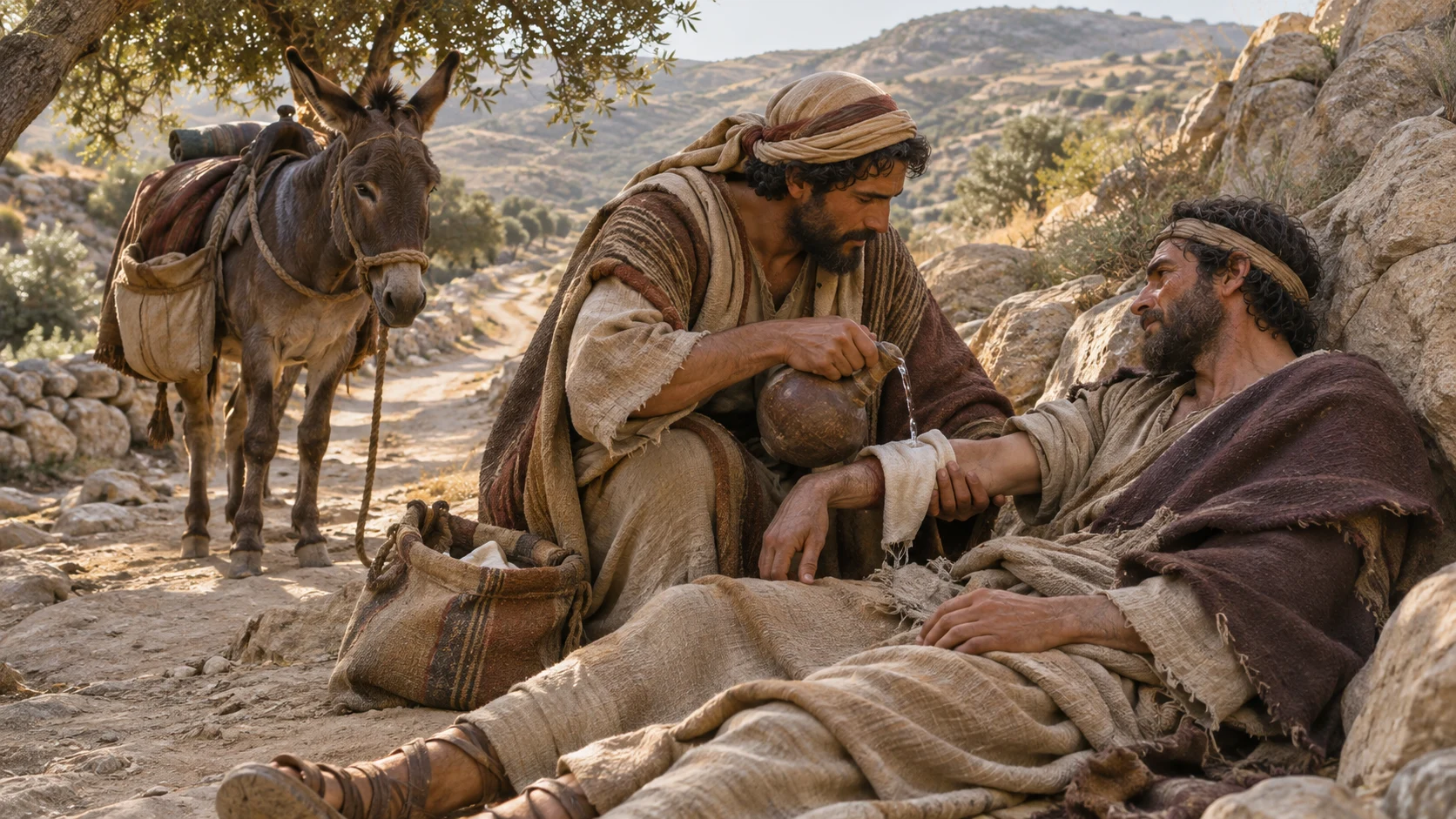
Luke 10:25–37A person lies wounded beside the road. Before the story gives us a lesson to repeat, it gives us someone whose need is immediate. Jesus’ parable asks what happens when another person’s suffering interrupts the journey we thought we were taking.
FIRST, THE SETTING
In Luke, a lawyer asks about inheriting eternal life. Jesus asks him to read the law; the answer joins love of God to love of neighbor. The next question asks who counts as a neighbor. Jesus responds with a story.
The road runs from Jerusalem to Jericho. The Samaritan identity of the person who helps matters: the story crosses a boundary its first hearers would recognize. The parable should never be used to stereotype Jewish people or turn the priest and Levite into portraits of a whole community.
Read Luke 10:25–37+
25Behold, a certain lawyer stood up and tested him, saying, “Teacher, what shall I do to inherit eternal life?”
26He said to him, “What is written in the law? How do you read it?”
27He answered, “You shall love the Lord your God with all your heart, with all your soul, with all your strength, and with all your mind; and your neighbor as yourself.”
28He said to him, “You have answered correctly. Do this, and you will live.”
29But he, desiring to justify himself, asked Jesus, “Who is my neighbor?”
30Jesus answered, “A certain man was going down from Jerusalem to Jericho, and he fell among robbers, who both stripped him and beat him, and departed, leaving him half dead.
31By chance a certain priest was going down that way. When he saw him, he passed by on the other side.
32In the same way a Levite also, when he came to the place and saw him, passed by on the other side.
33But a certain Samaritan, as he traveled, came where he was. When he saw him, he was moved with compassion,
34came to him, and bound up his wounds, pouring on oil and wine. He set him on his own animal, brought him to an inn, and took care of him.
35On the next day, when he departed, he took out two denarii, gave them to the host, and said to him, ‘Take care of him. Whatever you spend beyond that, I will repay you when I return.’
36Now which of these three do you think seemed to be a neighbor to him who fell among the robbers?”
37He said, “He who showed mercy on him.” Then Jesus said to him, “Go and do likewise.”
World English Bible · Public domain
Read the whole chapter ↗Begin with the wounded person
The traveler is stripped, beaten, and left half dead. He cannot make himself useful to the person who passes. His claim on attention is simply his need.
This beginning asks us to look before we decide whether someone deserves our time. In ordinary life, needs can become invisible behind labels. The story places a human body in front of those labels.
Compassion becomes a sequence of actions
The Samaritan sees, is moved with compassion, approaches, tends wounds, lifts the traveler onto his animal, brings him to an inn, and provides for continued care. The verbs matter. Feeling becomes attention, movement, material help, and a willingness to follow through.
We cannot copy every action into every situation. We can ask what appropriate help looks like where we are: contacting someone equipped to assist, providing food or transport, making a useful introduction, or staying until help arrives when it is safe to do so.
The question changes
At the end, Jesus asks which person became a neighbor to the injured man. The lawyer answers by naming the one who showed mercy. The reader is moved from defining a category to practicing a relationship.
That shift can be uncomfortable. A boundary around who qualifies is easier to maintain than the readiness to respond. Jesus gives the listener something to do with the story.
Care that continues
The inn and the payment make room for care beyond a single dramatic rescue. The Samaritan does not have to become the only person involved. He makes provision through another person.
A generous response can include limits, cooperation, and shared responsibility. Sustainable care is often less visible than a heroic moment: a roster of meals, a follow-up call, a service that has the skills a situation requires. Mercy can have a practical structure.
ONE SMALL WAY TO BEGIN
Let it meet
your day.
You can choose one of these practices. This is an invitation, not a measure of your worth.
- Notice a need close enough for you to respond to responsibly.
- Ask what would actually help rather than assuming.
- Choose one action, including connecting the person with someone better equipped to help.
QUESTIONS TO STAY WITH
Who has become a category to you rather than a person?
What would it mean to become a neighbor this week?
AN ORIGINAL PRAYER
Help me stop
Jesus, interrupt my hurry with attention. Help me see the person beside the road, listen to what they need, and offer the help I can responsibly give. Teach me mercy that follows through.
While he was still far off
Continue learning ↗Source: Luke 10:25–37, World English Bible. Commentary and prayers are original reflections. Images are artistic reconstructions; parable scenes illustrate a story Jesus tells. Read the whole passage alongside the reflection.