LEARN WITH HIM / 05
While he was still far off
A father & two sons
Luke 15:11–32A son rehearses what he will say when he gets home. A father sees him before he reaches the house. An older brother stands outside a celebration he cannot share. Let all three people remain in view. The parable has room for hunger, welcome, resentment, and an unfinished conversation.
FIRST, THE SETTING
Luke places this story beside the lost sheep and the lost coin. The chapter begins with criticism that Jesus welcomes sinners and eats with them. The stories respond to a dispute about welcome and the joy of finding what was lost.
This is a parable Jesus tells, not a biography of a named historical family. Our illustration imagines its characters. The father can illuminate divine compassion without making every action of an earthly parent an expression of God.
Read Luke 15:11–32+
11He said, “A certain man had two sons.
12The younger of them said to his father, ‘Father, give me my share of your property.’ So he divided his livelihood between them.
13Not many days after, the younger son gathered all of this together and traveled into a far country. There he wasted his property with riotous living.
14When he had spent all of it, there arose a severe famine in that country, and he began to be in need.
15He went and joined himself to one of the citizens of that country, and he sent him into his fields to feed pigs.
16He wanted to fill his belly with the pods that the pigs ate, but no one gave him any.
17But when he came to himself, he said, ‘How many hired servants of my father’s have bread enough to spare, and I’m dying with hunger!
18I will get up and go to my father, and will tell him, “Father, I have sinned against heaven and in your sight.
19I am no more worthy to be called your son. Make me as one of your hired servants.”’
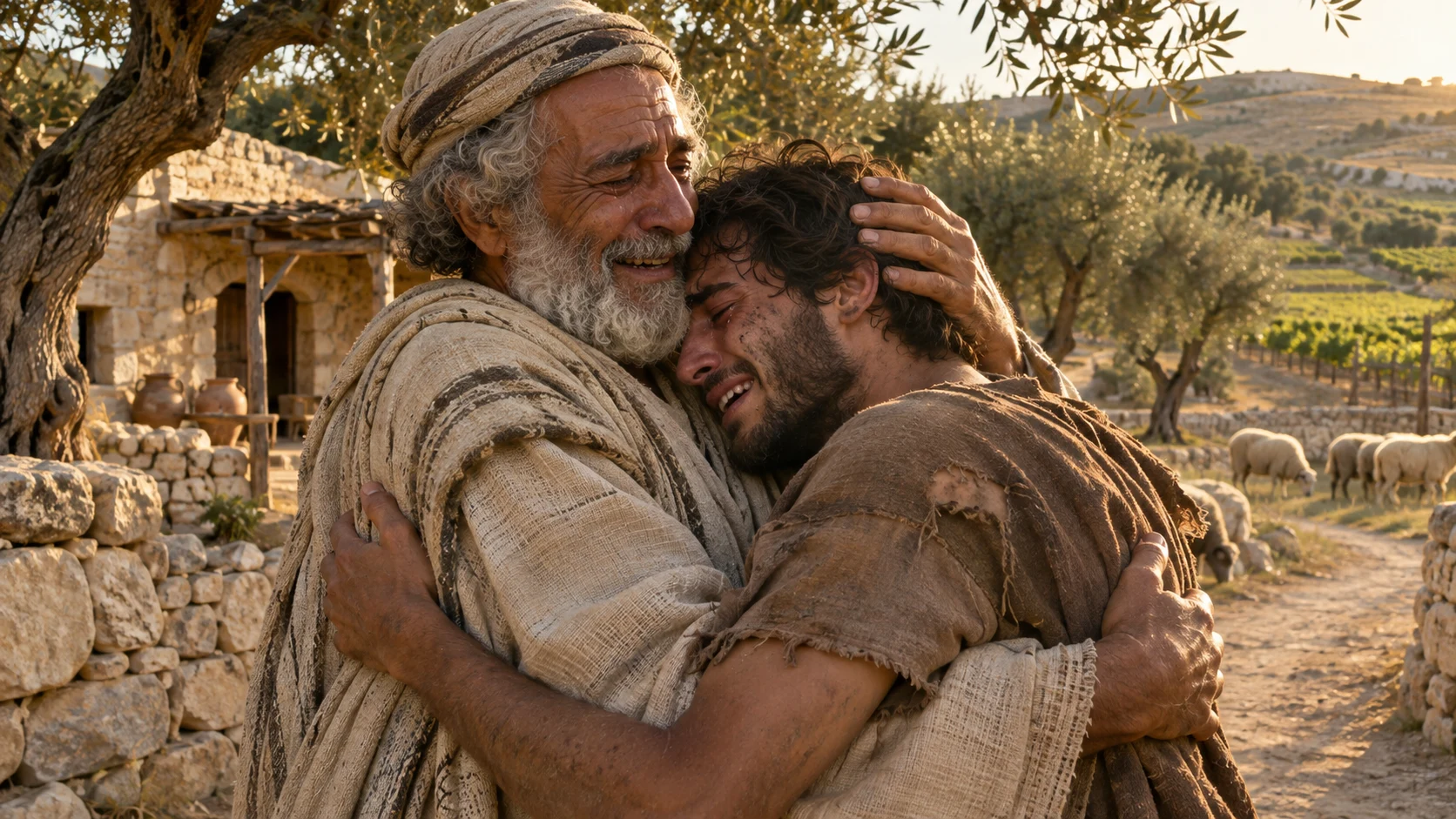
20“He arose and came to his father. But while he was still far off, his father saw him and was moved with compassion, and ran, fell on his neck, and kissed him.
21The son said to him, ‘Father, I have sinned against heaven and in your sight. I am no longer worthy to be called your son.’
22“But the father said to his servants, ‘Bring out the best robe and put it on him. Put a ring on his hand and sandals on his feet.
23Bring the fattened calf, kill it, and let’s eat and celebrate;
24for this, my son, was dead and is alive again. He was lost and is found.’ Then they began to celebrate.
25“Now his elder son was in the field. As he came near to the house, he heard music and dancing.
26He called one of the servants to him and asked what was going on.
27He said to him, ‘Your brother has come, and your father has killed the fattened calf, because he has received him back safe and healthy.’
28But he was angry and would not go in. Therefore his father came out and begged him.
29But he answered his father, ‘Behold, these many years I have served you, and I never disobeyed a commandment of yours, but you never gave me a goat, that I might celebrate with my friends.
30But when this your son came, who has devoured your living with prostitutes, you killed the fattened calf for him.’
31“He said to him, ‘Son, you are always with me, and all that is mine is yours.
32But it was appropriate to celebrate and be glad, for this, your brother, was dead, and is alive again. He was lost, and is found.’”
World English Bible · Public domain
Read the whole chapter ↗A life that becomes hungry
The younger son asks for his share, leaves, spends it, and encounters famine. His need becomes severe. Luke tells of hunger and work among pigs before the son begins to think of his father’s hired workers and their bread.
The story does not require us to decide whether his return is perfectly motivated. He comes to himself inside an actual need. A beginning can contain regret, hunger, fear, and a desire to change all at once.
Seen before the speech is finished
The father sees the son while he is still far away. Compassion becomes running, an embrace, and a kiss. The son names his wrongdoing. The father calls for a robe, a ring, sandals, and a feast.
Read the sequence without rushing it. The welcome arrives before the son can establish a new record of achievement. There is responsibility in his confession, and there is a generosity he could not have purchased by rehearsing the perfect sentence.
The person outside the celebration
The older son hears music and refuses to enter. His account of family life is full of work and unequal recognition. The father goes out to him as well. Both sons receive an approach from the father.
The elder brother’s pain should not be dismissed with an easy label. At the same time, his inability to celebrate another person’s return reveals something that can happen in a heart organized around comparison. The parable leaves us listening to an invitation whose answer is not narrated.
Return without erasing reality
For someone carrying shame, this story can offer room to imagine a future beyond failure. A return in our own lives may include an honest apology, restitution where possible, and changed behavior over time.
It should not be used to pressure someone to return to an unsafe household or reconcile with a person who continues to harm them. The compassion pictured here can guide a search for trustworthy welcome and responsible repair.
ONE SMALL WAY TO BEGIN
Let it meet
your day.
You can choose one of these practices. This is an invitation, not a measure of your worth.
- Name one thing you regret without turning it into your entire identity.
- Consider a repair you can make without demanding immediate forgiveness in return.
- Notice whether comparison is keeping you outside another person’s good news.
QUESTIONS TO STAY WITH
Which person in the story feels closest to you today?
What would a responsible beginning again look like?
AN ORIGINAL PRAYER
A way to begin again
God of compassion, meet me with truth and mercy. Give me courage to face what I have done, patience to make repairs, and hope that my life can grow beyond this moment. Help me welcome another person’s beginning too.
A life changed by mercy
Continue learning ↗Source: Luke 15:11–32, World English Bible. Commentary and prayers are original reflections. Images are artistic reconstructions; parable scenes illustrate a story Jesus tells. Read the whole passage alongside the reflection.