LEARN WITH HIM / 01
Blessed, even here
The Beatitudes
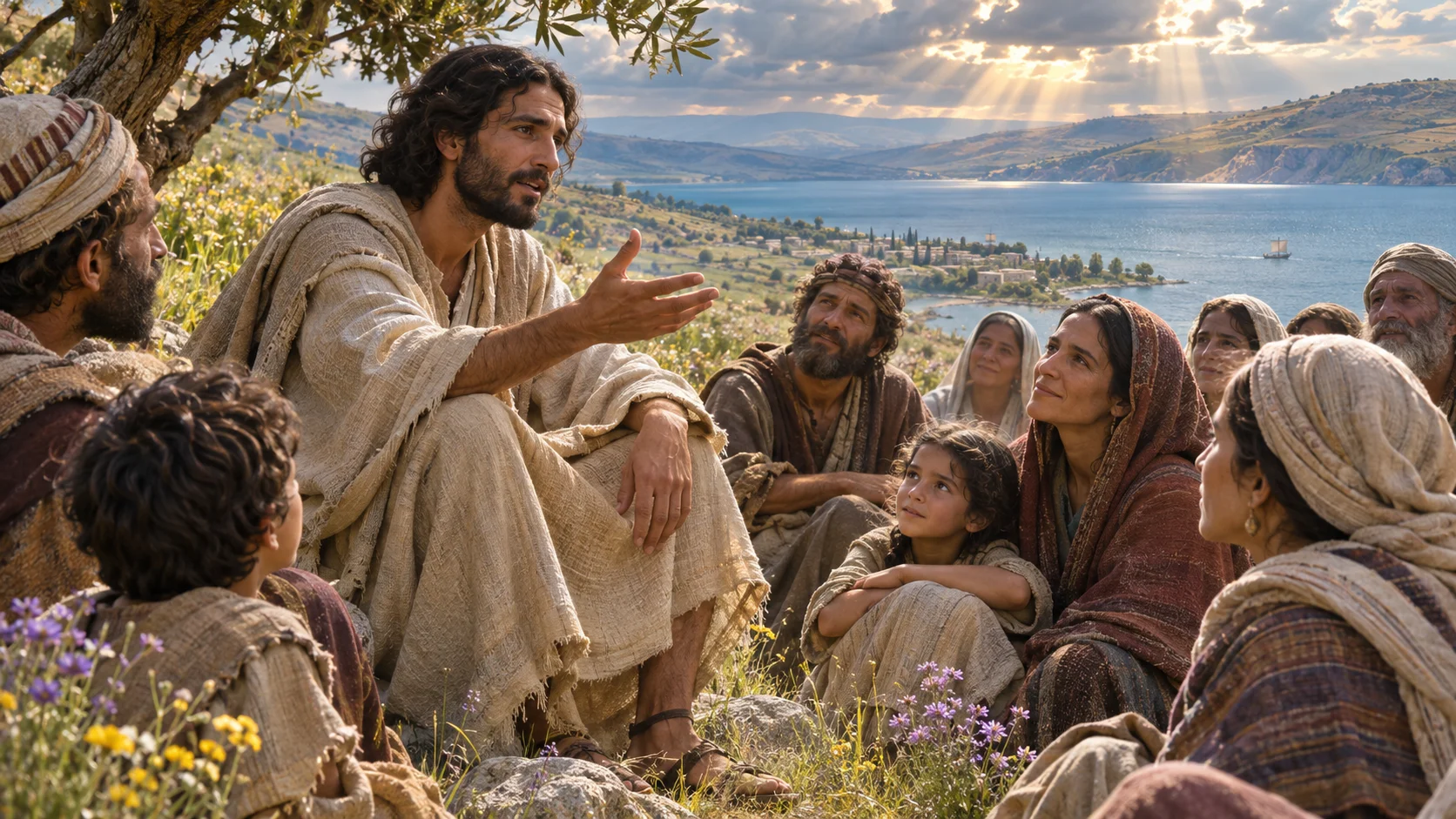
Matthew 5:1–12Find a place on the hillside. Before Matthew’s sermon begins asking what a faithful life will do, Jesus names people who are already carrying something: poverty of spirit, mourning, hunger for righteousness. The opening words make room for lives that do not look secure or successful. Listen from where you actually are.
FIRST, THE SETTING
Matthew places these blessings at the opening of the Sermon on the Mount. Jesus sees the crowds, goes up the mountain, sits, and teaches his disciples. The larger sermon will move through reconciliation, prayer, generosity, and the practice of love. The blessings are the doorway into that way of life.
Luke 6:20–26 preserves a related set of blessings and woes, with different wording and emphasis. Read both accounts as they stand. The poor in Luke and the poor in spirit in Matthew should each be allowed to challenge and enlarge our hearing.
Read Matthew 5:1–12+
1Seeing the multitudes, he went up onto the mountain. When he had sat down, his disciples came to him.
2He opened his mouth and taught them, saying,
3“Blessed are the poor in spirit, for theirs is the Kingdom of Heaven.
4Blessed are those who mourn, for they shall be comforted.
5Blessed are the gentle, for they shall inherit the earth.
6Blessed are those who hunger and thirst for righteousness, for they shall be filled.
7Blessed are the merciful, for they shall obtain mercy.
8Blessed are the pure in heart, for they shall see God.
9Blessed are the peacemakers, for they shall be called children of God.
10Blessed are those who have been persecuted for righteousness’ sake, for theirs is the Kingdom of Heaven.
11“Blessed are you when people reproach you, persecute you, and say all kinds of evil against you falsely, for my sake.
12Rejoice, and be exceedingly glad, for great is your reward in heaven. For that is how they persecuted the prophets who were before you.
World English Bible · Public domain
Read the whole chapter ↗The people who come into view
Read the names slowly: the poor in spirit, those who mourn, the gentle, those who hunger and thirst for righteousness, the merciful, the pure in heart, the peacemakers, and those persecuted for righteousness. There is no single temperament here. Some are in pain; others are actively practicing mercy or peace.
These blessings turn our attention toward people a crowd might overlook. They also question what we call a good life. Security, recognition, and the ability to win an argument are not the measures Jesus begins with.
A promise inside mourning
The blessing for mourners holds a promise of comfort. It does not demand that grief first become cheerful. Someone listening with an absence in their life can hear their mourning named without being asked to disguise it.
We should not make suffering into a requirement for worth, or tell a grieving person that their pain is a lesson they must appreciate. As a practice of this teaching, comfort can become our responsibility: a meal, a call, a patient return after the first week of attention has passed.
Mercy and peace take shape
Mercy concerns how we treat another person when we have room to condemn, exclude, or withhold. Peacemaking asks for more than quiet. It may require a truthful conversation, a repair, a refusal to spread contempt, or protection for someone being harmed.
Gentleness does not have to mean surrendering another person to injustice. The sermon’s hunger for righteousness belongs beside its mercy. Hold them together: attention to what is wrong, and a refusal to lose sight of the human beings involved.
Let the blessing become a way of seeing
Return to the people around you. Who is carrying sorrow? Who has little influence? Who is quietly making peace at a cost? The passage can reshape where our attention goes before it reshapes what we say.
You can also receive it personally. Read one blessing without making yourself pass an examination. Let it name a possibility of welcome and a direction for the day.
ONE SMALL WAY TO BEGIN
Let it meet
your day.
You can choose one of these practices. This is an invitation, not a measure of your worth.
- Choose one blessing and read it twice, leaving a little silence between readings.
- Notice one person whose burden or quiet goodness you might usually miss.
- Offer one concrete act of mercy or comfort without asking for recognition.
QUESTIONS TO STAY WITH
Which blessing feels closest to your life today?
What would comfort or peacemaking look like in one real relationship?
AN ORIGINAL PRAYER
Receive me here
Jesus, meet me in the life I actually have. Give me room to mourn, courage to seek what is right, and tenderness toward the people beside me. Let your blessing widen the way I see.
Words you can borrow
Continue learning ↗Source: Matthew 5:1–12, World English Bible. Commentary and prayers are original reflections. Images are artistic reconstructions; parable scenes illustrate a story Jesus tells. Read the whole passage alongside the reflection.