LEARN WITH HIM / 08
A branch does not grow alone
The vine & the branches
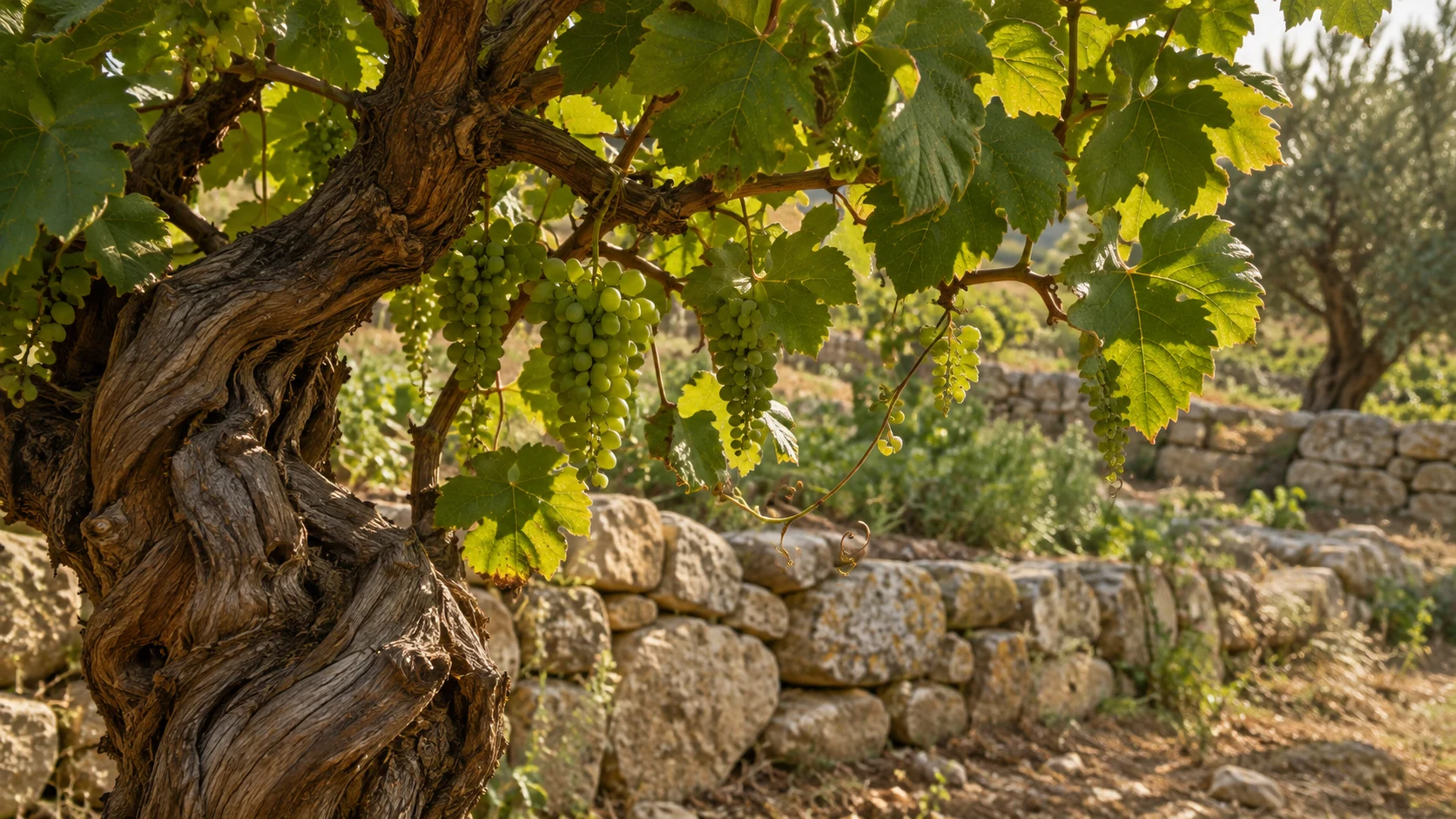
John 15:1–17Picture a vine rooted in the earth, its branches receiving what they need through a life they share. Jesus uses this image in the long conversation surrounding his departure. The language of remaining gives his companions a way to imagine faithfulness when his presence will no longer be familiar in the same way.
FIRST, THE SETTING
John 15 belongs to the farewell teaching that follows the supper and foot washing. The disciples are being addressed within a relationship of love, commandment, impending loss, and promise. The vine is part of that larger conversation.
The passage includes both intimate language of friendship and severe images of branches removed and burned. Read the whole passage rather than selecting only the lines that feel comfortable. Its call to remain is made concrete in the command to love one another.
Read John 15:1–17+
1“I am the true vine, and my Father is the farmer.
2Every branch in me that doesn’t bear fruit, he takes away. Every branch that bears fruit, he prunes, that it may bear more fruit.
3You are already pruned clean because of the word which I have spoken to you.
4Remain in me, and I in you. As the branch can’t bear fruit by itself unless it remains in the vine, so neither can you, unless you remain in me.
5I am the vine. You are the branches. He who remains in me and I in him bears much fruit, for apart from me you can do nothing.
6If a man doesn’t remain in me, he is thrown out as a branch and is withered; and they gather them, throw them into the fire, and they are burned.
7If you remain in me, and my words remain in you, you will ask whatever you desire, and it will be done for you.
8“In this my Father is glorified, that you bear much fruit; and so you will be my disciples.
9Even as the Father has loved me, I also have loved you. Remain in my love.
10If you keep my commandments, you will remain in my love, even as I have kept my Father’s commandments and remain in his love.
11I have spoken these things to you, that my joy may remain in you, and that your joy may be made full.
12“This is my commandment, that you love one another, even as I have loved you.
13Greater love has no one than this, that someone lay down his life for his friends.
14You are my friends if you do whatever I command you.
15No longer do I call you servants, for the servant doesn’t know what his lord does. But I have called you friends, for everything that I heard from my Father, I have made known to you.
16You didn’t choose me, but I chose you and appointed you, that you should go and bear fruit, and that your fruit should remain; that whatever you will ask of the Father in my name, he may give it to you.
17“I command these things to you, that you may love one another.
World English Bible · Public domain
Read the whole chapter ↗Life received through relationship
A branch’s fruit depends on its connection to the vine. The image challenges a picture of spiritual life as a solitary performance. Receiving, listening, and remaining belong before visible fruit.
For a reader exhausted by trying to prove their worth, this can become a different question: what helps me remain attentive to love? The answer may be ordinary and repeatable rather than impressive.
Fruit that has a human shape
The surrounding verses speak of love, joy, friendship, and keeping Jesus’ commandments. Fruit should be read within that context. It is not simply a measure of money, public influence, productivity, or the appearance of success.
A life may bear fruit in patient care, honest work, generosity, reconciliation, or a willingness to protect someone overlooked. Some of that fruit will remain largely unseen by an audience.
Handle the pruning image carefully
The passage uses a gardener’s cutting and tending as part of its image. It should not become an explanation that every illness, loss, or injury is a punishment or a necessary lesson sent to improve someone. The text does not give us that authority over another person’s suffering.
The practical invitation can be more modest: notice what is nourishing love and what repeatedly draws you away from it. Discernment may involve another person’s wisdom, patient reflection, and changes that make more room for faithful care.
Remain in my love
Jesus connects remaining to the love he has received from the Father and given to the disciples. He calls them friends and commands mutual love. The image of the vine opens into a community of relationships.
A daily practice might be a short passage, a prayer, a conversation in which you listen well, or a consistent act of care. These do not purchase belonging. They can become ways of attending to the relationship the passage describes.
ONE SMALL WAY TO BEGIN
Let it meet
your day.
You can choose one of these practices. This is an invitation, not a measure of your worth.
- Choose a small daily rhythm of reading, prayer, or attentive care.
- Notice one demand that repeatedly crowds out love, and consider a reasonable change.
- Reach toward a trustworthy community or person rather than trying to sustain everything alone.
QUESTIONS TO STAY WITH
What nourishes a more loving life in you?
What fruit would matter even if no one applauded it?
AN ORIGINAL PRAYER
Help me remain
Jesus, keep me close to the love you teach. Nourish what is patient, truthful, and generous in me. Help me receive care, seek wise company, and let the fruit of my life be love.
Come with what is heavy
Continue learning ↗Source: John 15:1–17, World English Bible. Commentary and prayers are original reflections. Images are artistic reconstructions; parable scenes illustrate a story Jesus tells. Read the whole passage alongside the reflection.