AN ENCOUNTER / THE WOMAN OF SAMARIA
He asked
for water.
A well at noon. A woman with questions.
A conversation that reaches a town.
SIXTH
HOUR.
A JOURNEY.
A PLACE TO SIT.
A NEED TO NAME.
01 / The sixth hour
Even he
is thirsty.
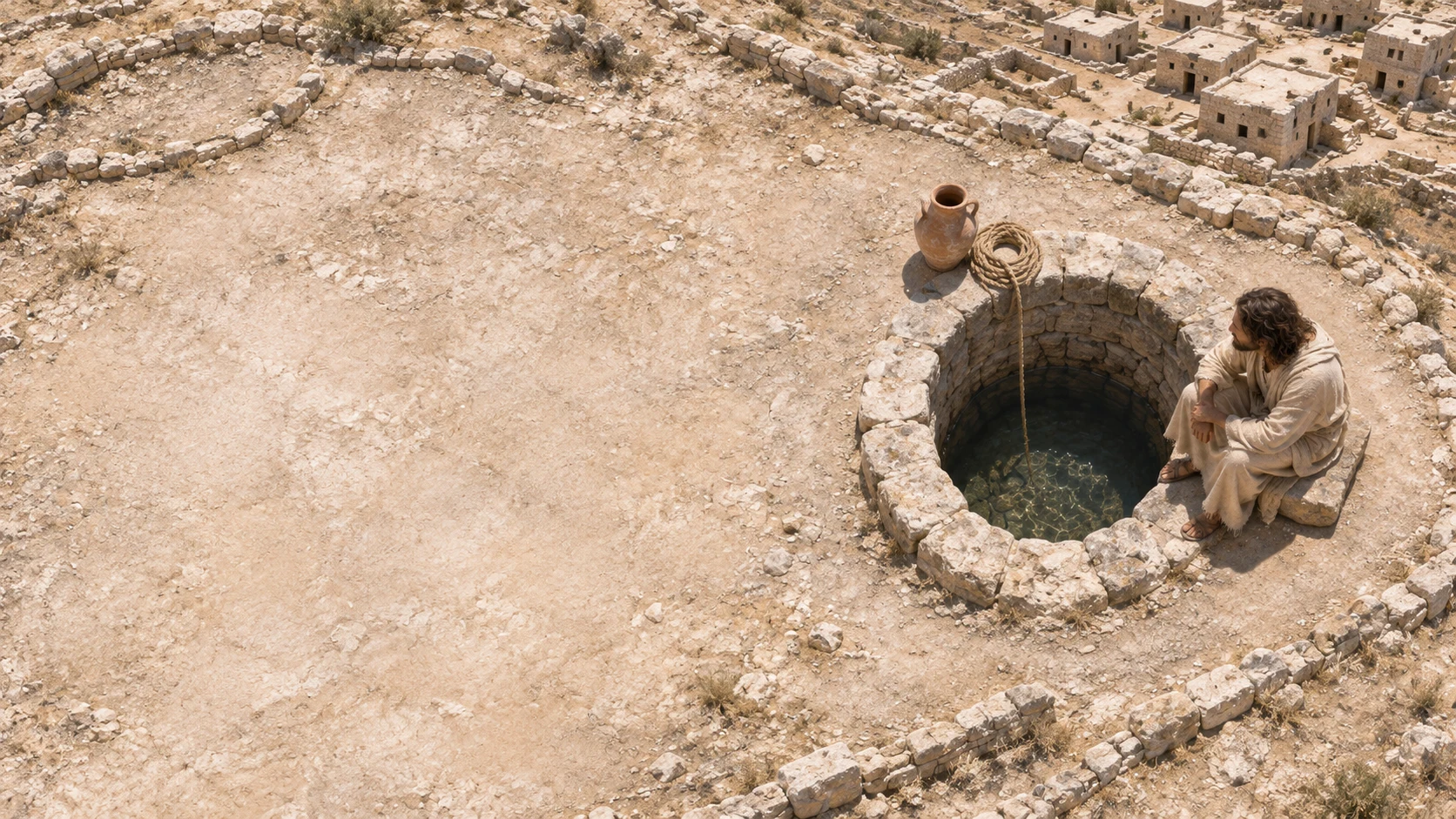
Begin with the weight of a journey. Jesus has left Judea for Galilee and is passing through Samaria. Near Sychar, at Jacob’s well, he sits down because he is tired. John places the meeting at about the sixth hour, understood as noon in this edition.
Imagine the light on the terrace. The pale ground gives back the heat. A little shadow gathers along the well’s thick rim. The scene has no crowd waiting for a miracle. For a moment, allow the human fact of his weariness to become visible.
The disciples have gone into the town to buy food. A woman comes to draw water. Her name is not supplied. In the scene we imagine, the vessel settles against the stone and the rope gathers in her hand. The ordinary task has brought her to the place where he is resting.
Jesus asks her for a drink. The first movement of the conversation is a request. He is willing to name a need in the presence of someone from whom she would not expect him to ask.
John 4:6 ↗02 / A request across a boundary
“Give me
a drink.”
Come close enough, in the imagined scene, to see the fibers of the rope. A hand closes around them. The vessel waits against the stone. Then a voice interrupts the familiar work: Jesus asks for water. Hold that small request beside everything you have heard about him.
The woman answers with a question about the request itself. How does a Jewish man ask her, a Samaritan woman, for a drink? John makes the division between Jews and Samaritans explicit. She notices the boundary and names it.
Listen to her answer with the same attention you give his. She questions him. She will bring the depth of the well, the memory of Jacob, her own life, and the hope of the Messiah into this meeting. There is room here for her voice. Let yourself hear it.
For a little while, stay beside the practical things: the jar, the rope, a man who is tired, a woman who has come for water. Across the distance she has named, a conversation is now possible. She has asked a question. He will answer her.
John 4:7 ↗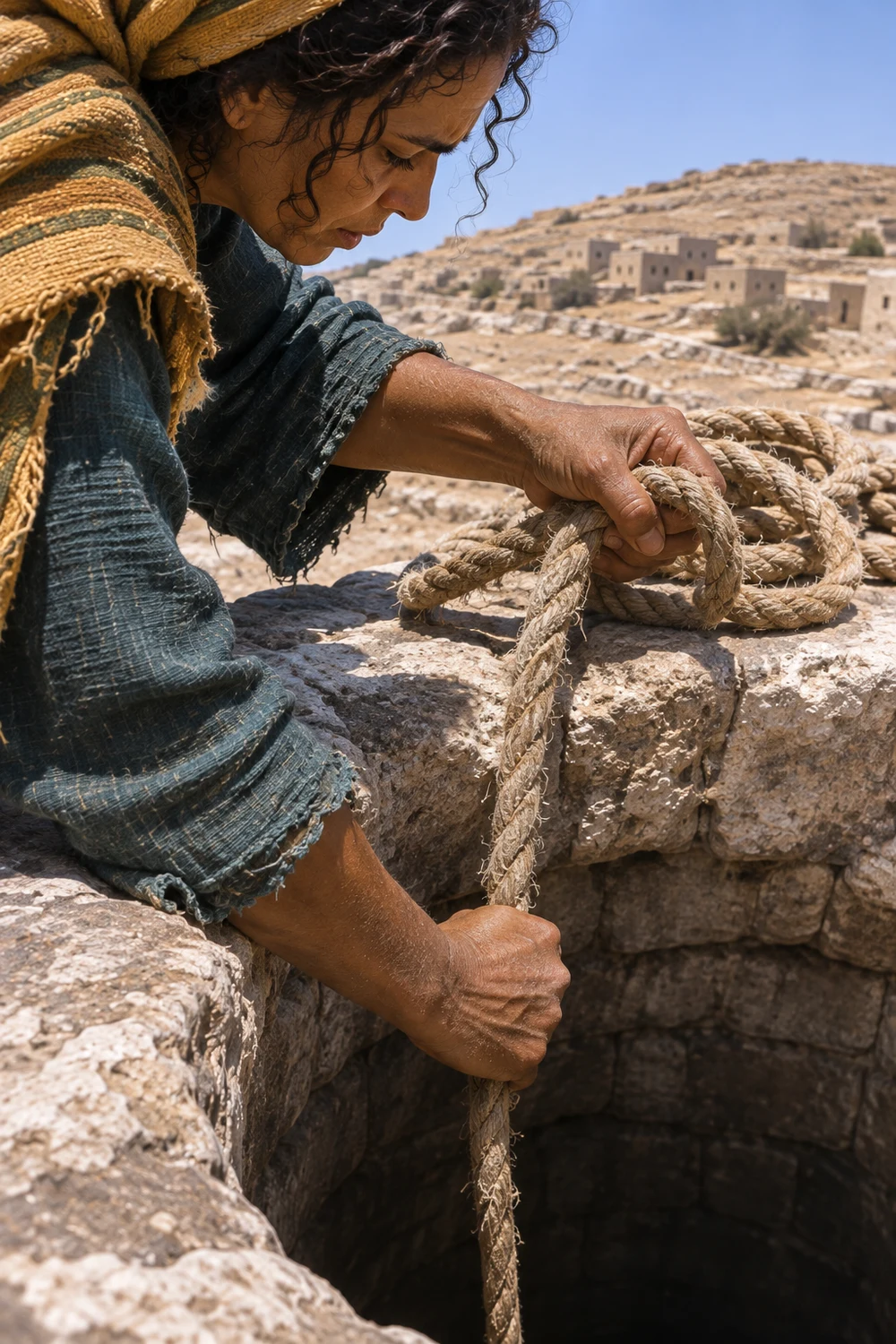
“The well
is deep.”JOHN 4:11 · EXCERPT
03 / A practical question
The well
is deep.
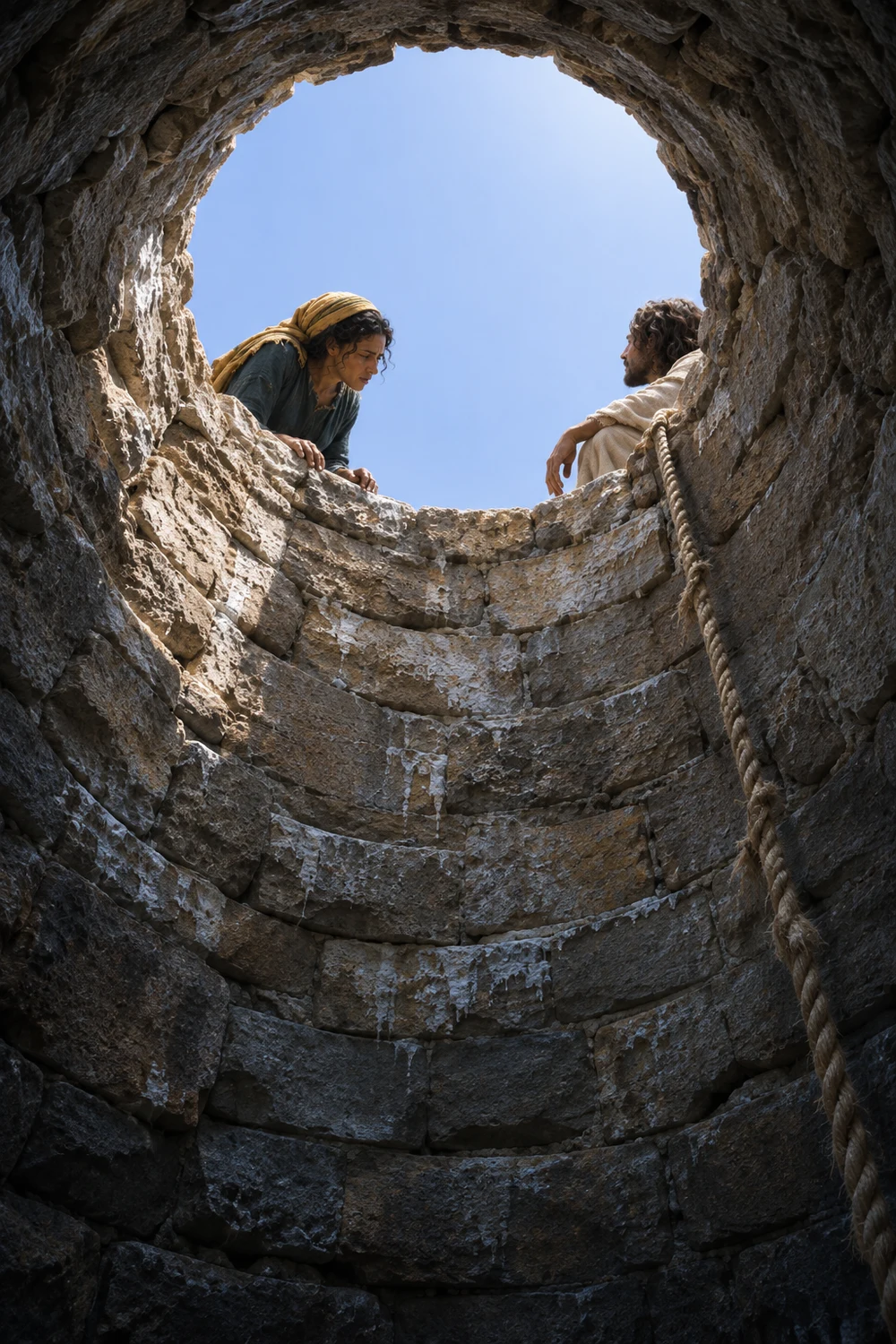
Jesus speaks of the gift of God and of living water. The woman brings the words back to the well in front of them. “Sir, you have nothing to draw with, and the well is deep.” Look with her into the opening. Where would this water come from?
Let the question remain intelligent. A person who comes to draw water knows that water has to be reached and carried. She also places the well within an inherited story: Jacob, his children, his animals. Her question about Jesus’ greatness grows out of what this place means to her.
For a moment, stay looking down with her. The opening is dark; the words are larger than what she can yet see. Living water. A gift of God. The question has not closed the conversation. It has drawn another answer from him.
If you bring a practical question to a spiritual conversation, you may recognize something here. How would this help? Where would it come from? What does it mean in the life I actually have? Such questions can become part of learning.
John 4:11 ↗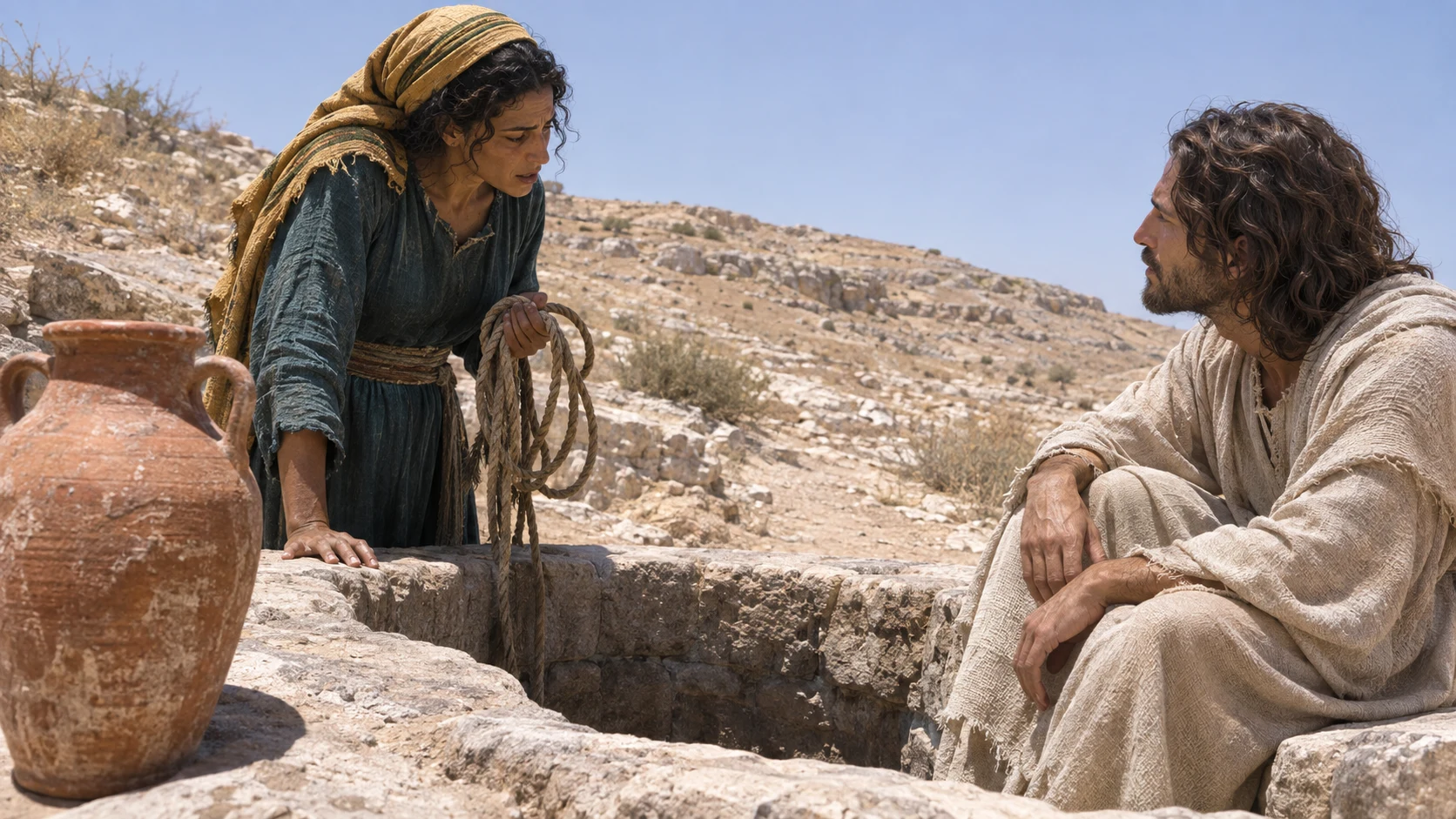

04 / The gift begins to open
Jesus says that someone who drinks the water from this well will thirst again. He speaks of the water he gives becoming a spring within a person, springing up to eternal life. The image moves from an external source repeatedly visited to life received inwardly.
The woman asks for this water so that she will not thirst or have to keep coming to draw. Her response still carries the ordinary labor of the day. A gift that could change that labor would matter. John allows the words to hold that immediate hope while the conversation reaches beyond it.
Read the promise once more, slowly. A spring within. Something received that becomes a source of life. John later connects living water explicitly with the Spirit in John 7:37–39. Here, beside the well, the words are still arriving in a conversation. Give them time to arrive in you.
Perhaps you came to this page tired of carrying something. You can bring that tiredness to the words without pretending it has disappeared. Food, water, companionship, care: your practical needs still deserve an answer. Stay here with the offered life and with the life you actually have.
John 4:14 ↗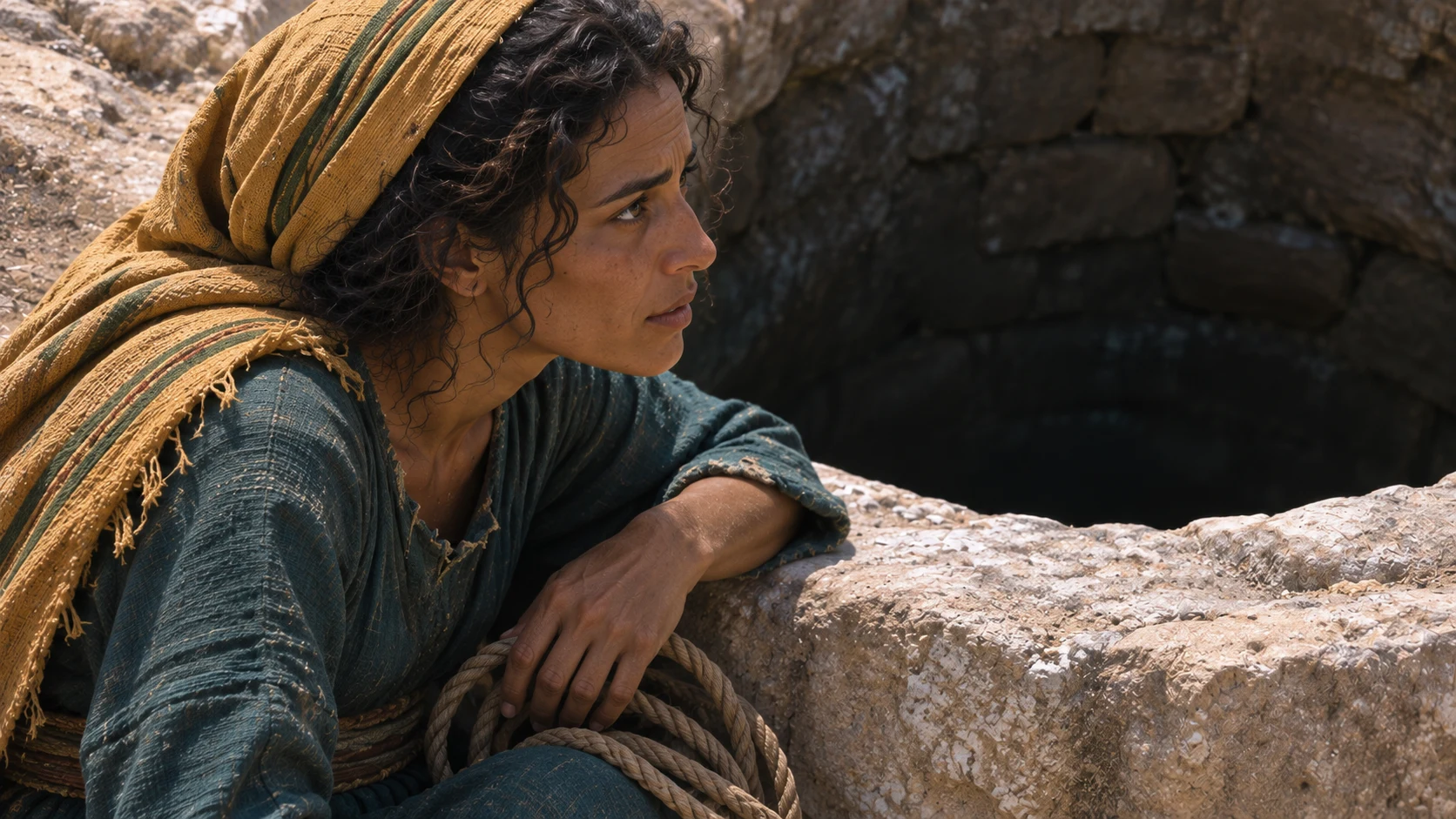
05 / A life spoken truthfully
She answers
with the truth.
Jesus asks her to call her husband and return. She says that she has no husband. He affirms the truth of her answer, speaks of five husbands, and says that the man she now has is not her husband.
The passage supplies these statements, but not the story behind every marriage or separation. It does not say whether the earlier relationships ended through death, divorce, abandonment, or other circumstances. We should not turn what is left unsaid into an accusation.
The woman recognizes Jesus as a prophet. Her life has entered the conversation, and the conversation continues. The next subject is worship. The narrative does not reduce her to a moral label or end her participation when the history of her relationships is named.
If you have ever wanted to be understood without having to defend your whole life, pause here. Let her pause at the well in the imagined scene. Let the conversation continue. You are reading the story of a woman who still has questions to ask, words to hear, and a town to invite.
John 4:17 ↗06 / THE MOUNTAIN AND THE CITY
Where do
we worship?
06 / The mountain and the city
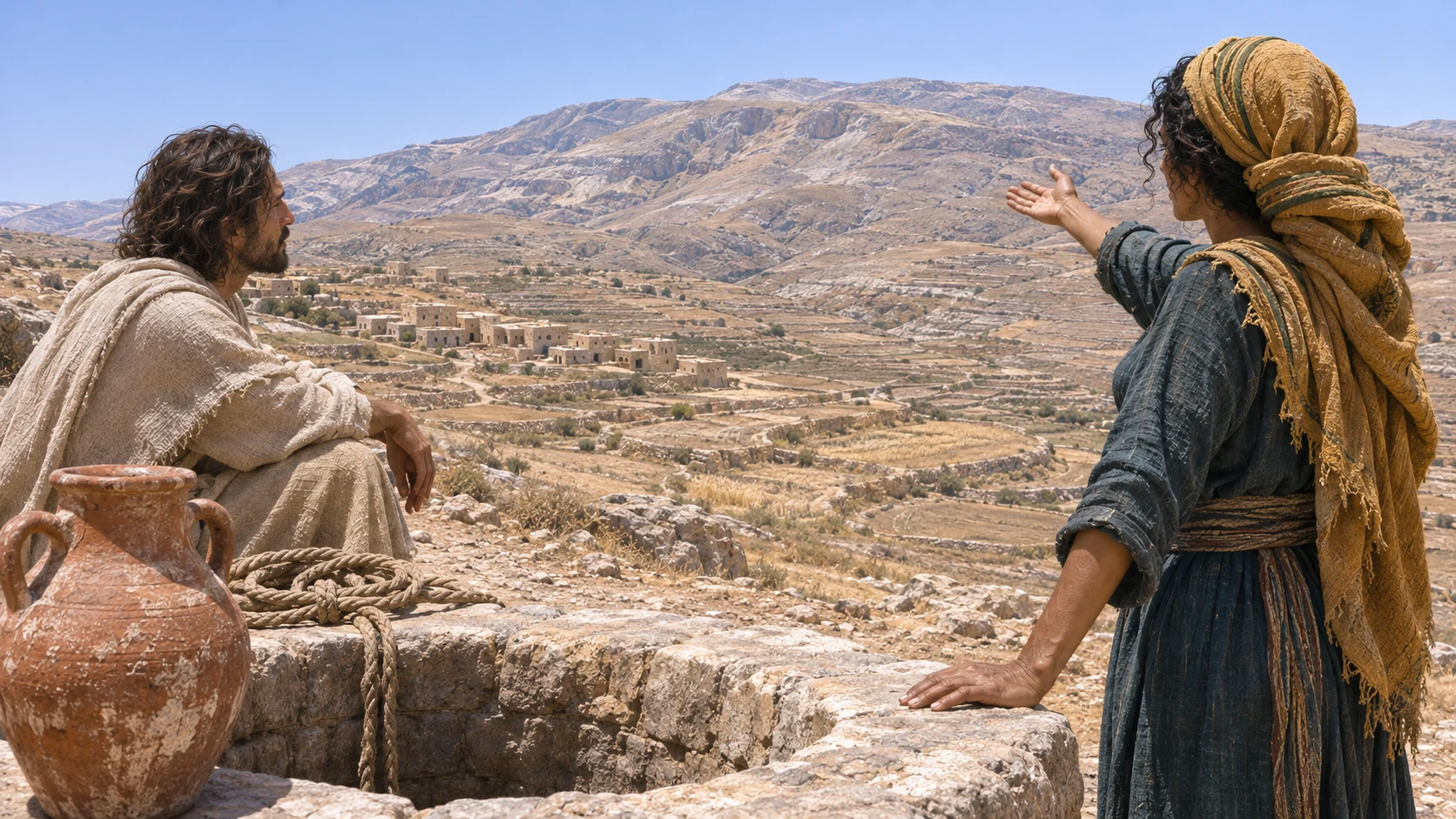
She speaks about the mountain associated with her ancestors’ worship and about Jerusalem, where Jewish people say worship should take place. The landscape belongs to a serious question about inherited faith and the place of meeting God.
There is no need to dismiss the question as a distraction. The text does not explain her private motive for asking it. She has just identified Jesus as a prophet, and now brings a matter of religious difference into the conversation.
Jesus speaks of an hour coming when worship of the Father will not be confined to either location. He also says that salvation is from the Jews. His Jewish identity and the Jewish roots of the story remain part of the exchange; crossing a boundary does not require erasing them.
He describes worship in spirit and truth. Christian traditions understand the depth of those words in different ways. Within the passage, they direct attention to God’s nature and the reality of worship, reaching beyond a contest over locations. They should not become an excuse to treat the woman’s community, or any other community, with contempt.
John 4:20 ↗“God is spirit,
and those who worship him
must worship
in spirit and truth.”JOHN 4:24 · WORLD ENGLISH BIBLE
07 / The person in the conversation
The woman says that she knows the Messiah is coming and will explain all things. Jesus answers that he is the one speaking to her.
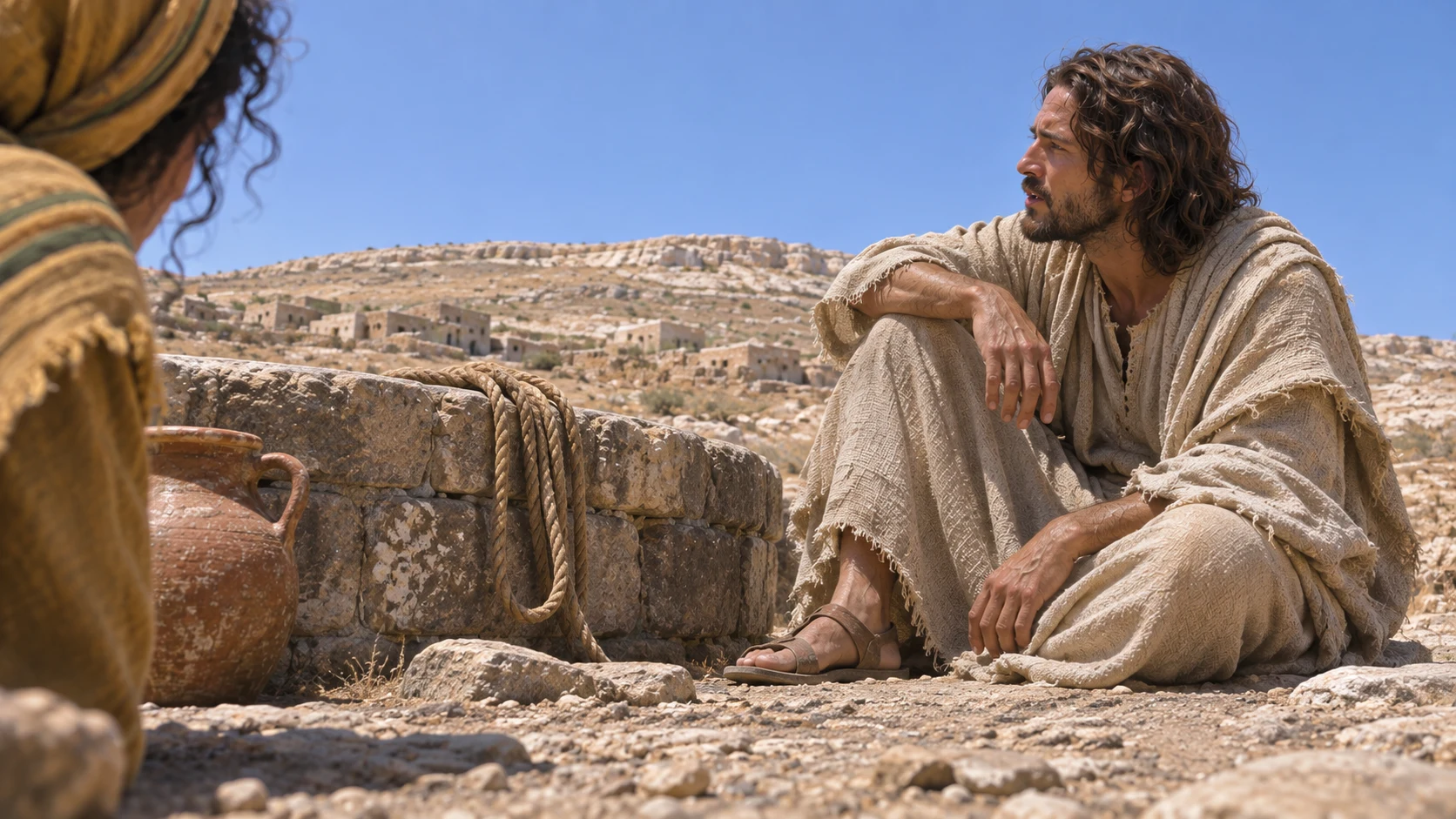
Read the exchange with the well still in view. The disclosure comes inside a conversation that began with thirst. The person who asked her for water is the one whose identity she is now being invited to consider.
The account moves through several ways she addresses or understands him: a Jewish man, someone she calls sir, a possible greater figure than Jacob, a prophet, and now the Messiah brought into the exchange. The recognition unfolds through her participation rather than through a narrator taking her questions away.
Imagine the light holding steady. The stone is still stone. The vessel is still beside the well. Yet listen again to who is speaking. The one she has been waiting to hear about is speaking to her. Stay with the nearness of that sentence before you move on.
John 4:26 ↗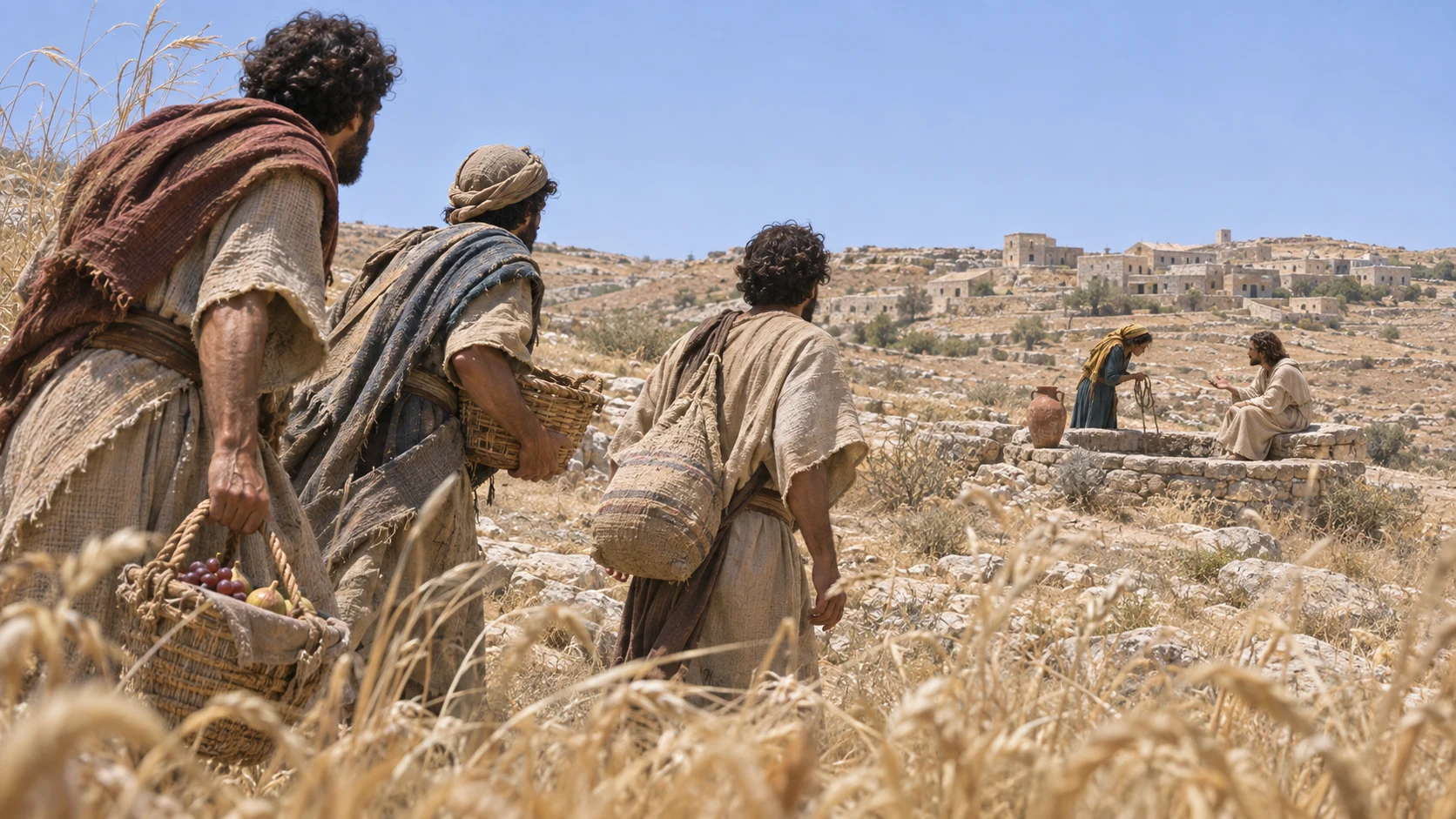
08 / What she leaves behind
The water pot
stays.
The disciples return and are surprised that Jesus is speaking with a woman. John tells us the questions they do not ask aloud. Their arrival brings another set of expectations into a conversation already underway.
The woman leaves her water pot and goes to the town. The object with which she entered the story now remains beside the well while she carries something else: an invitation to come and see.
The Gospel does not explain every meaning of the abandoned pot. Readers have long reflected on the detail, but it need not be turned into a claim that she permanently leaves ordinary work or physical needs behind. For this moment, the story’s direction has changed.
Look at the vessel for a little while. In our image its shape casts a short shadow on the pale ground. A practical object can hold the memory of a conversation without becoming a puzzle we must solve.
John 4:28 ↗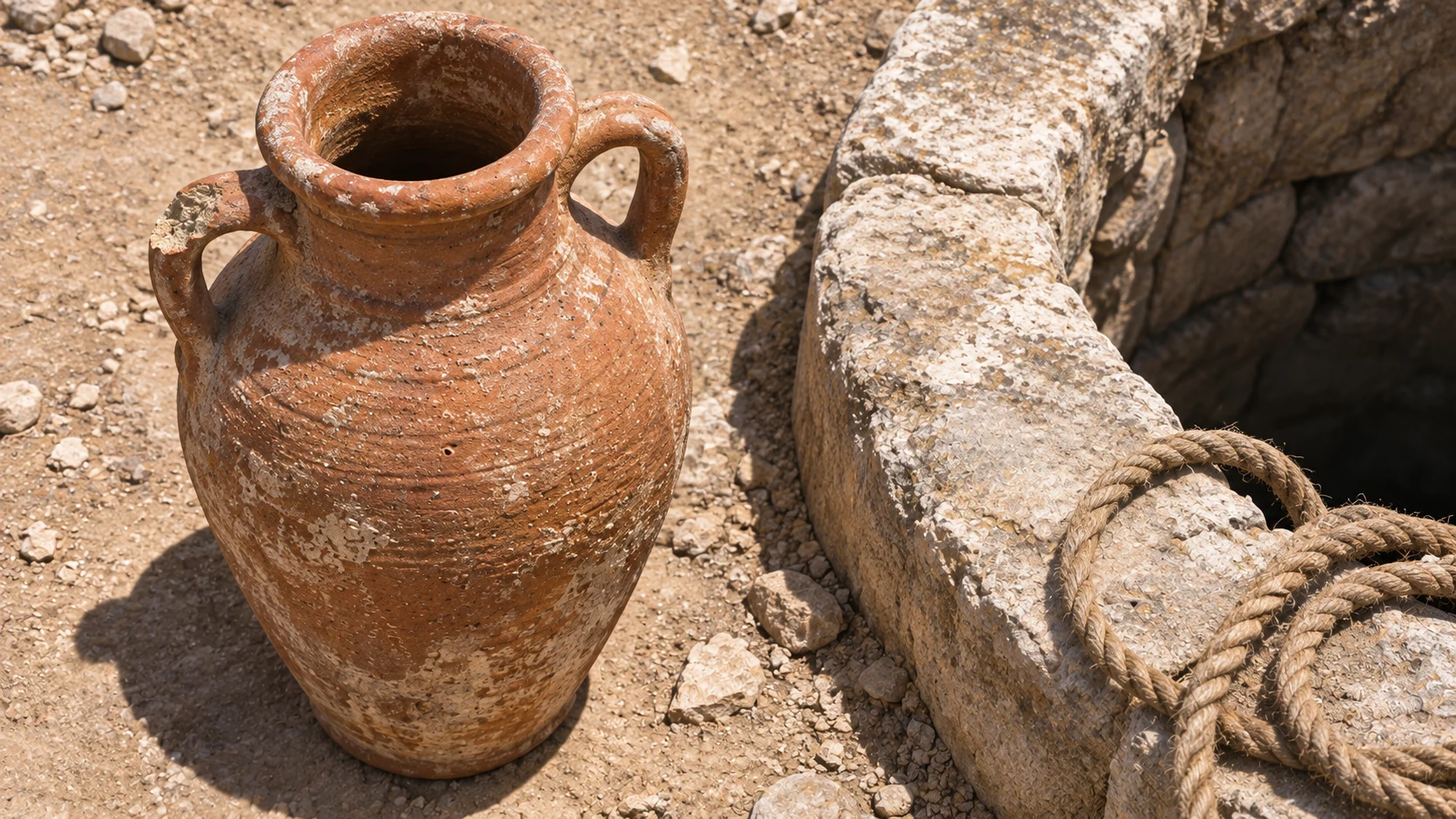
09 / A VOICE IN THE TOWN
Now she has
an invitation.
09 / A voice in the town
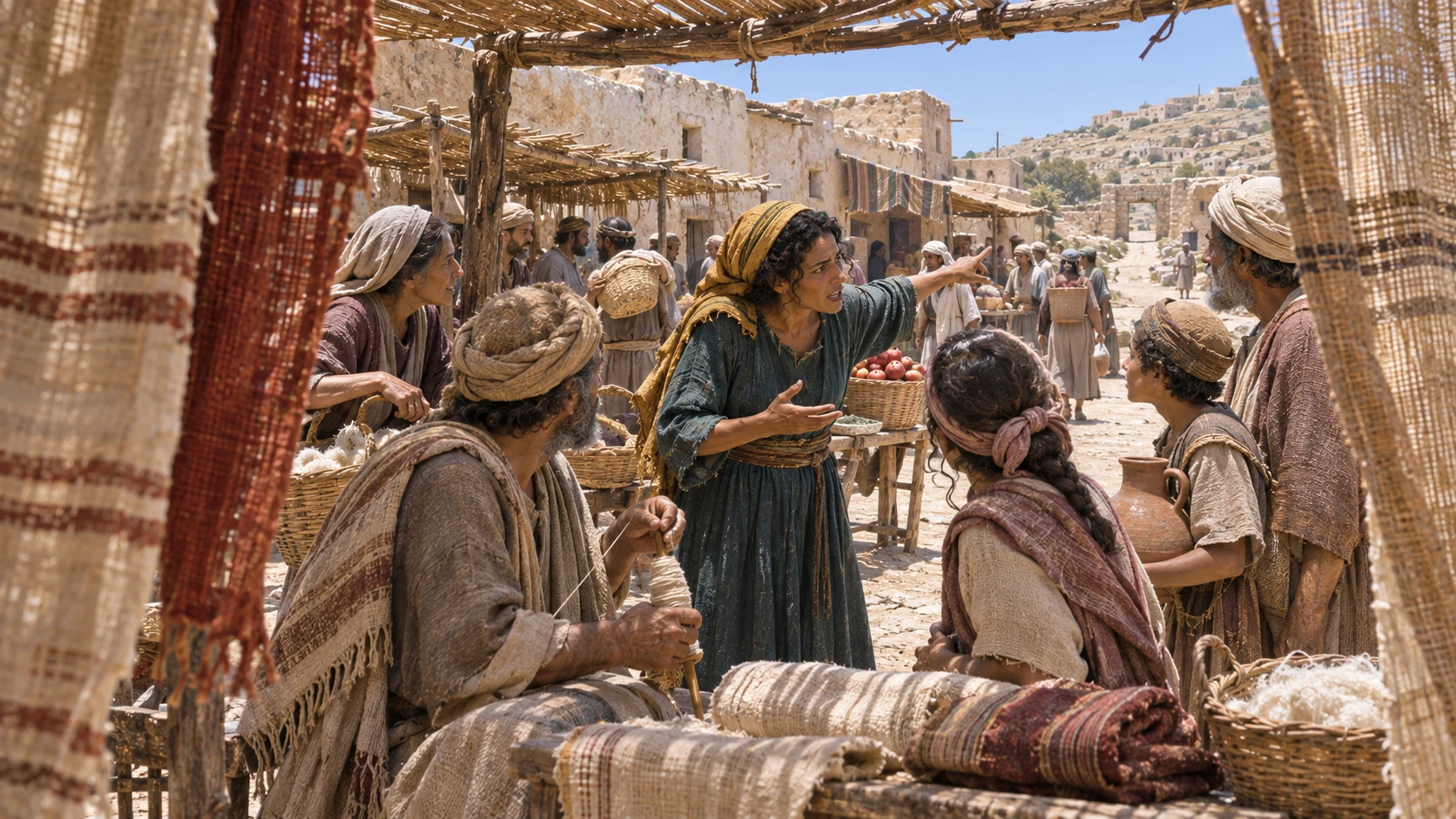
“Come, see a man who told me everything that I have done. Can this be the Christ?” Her invitation reaches the people in the form John preserves: an account of the encounter, and a question.
That detail makes room for a witness whose understanding is still being expressed. She does not have to deliver a finished lecture before she can point toward an encounter. She gives the people a reason to go and listen for themselves.
John says that they leave the town and come toward Jesus. Notice how the scene has widened. A conversation between two people at the well begins to move a community.
In the town scene we imagine, a conversation begins among woven cloth, baskets, and the work of the day. Faces turn toward her. Follow the direction of her invitation. A little while ago she was asking where the water could come from. Now other people are on their way to the well.
John 4:29 ↗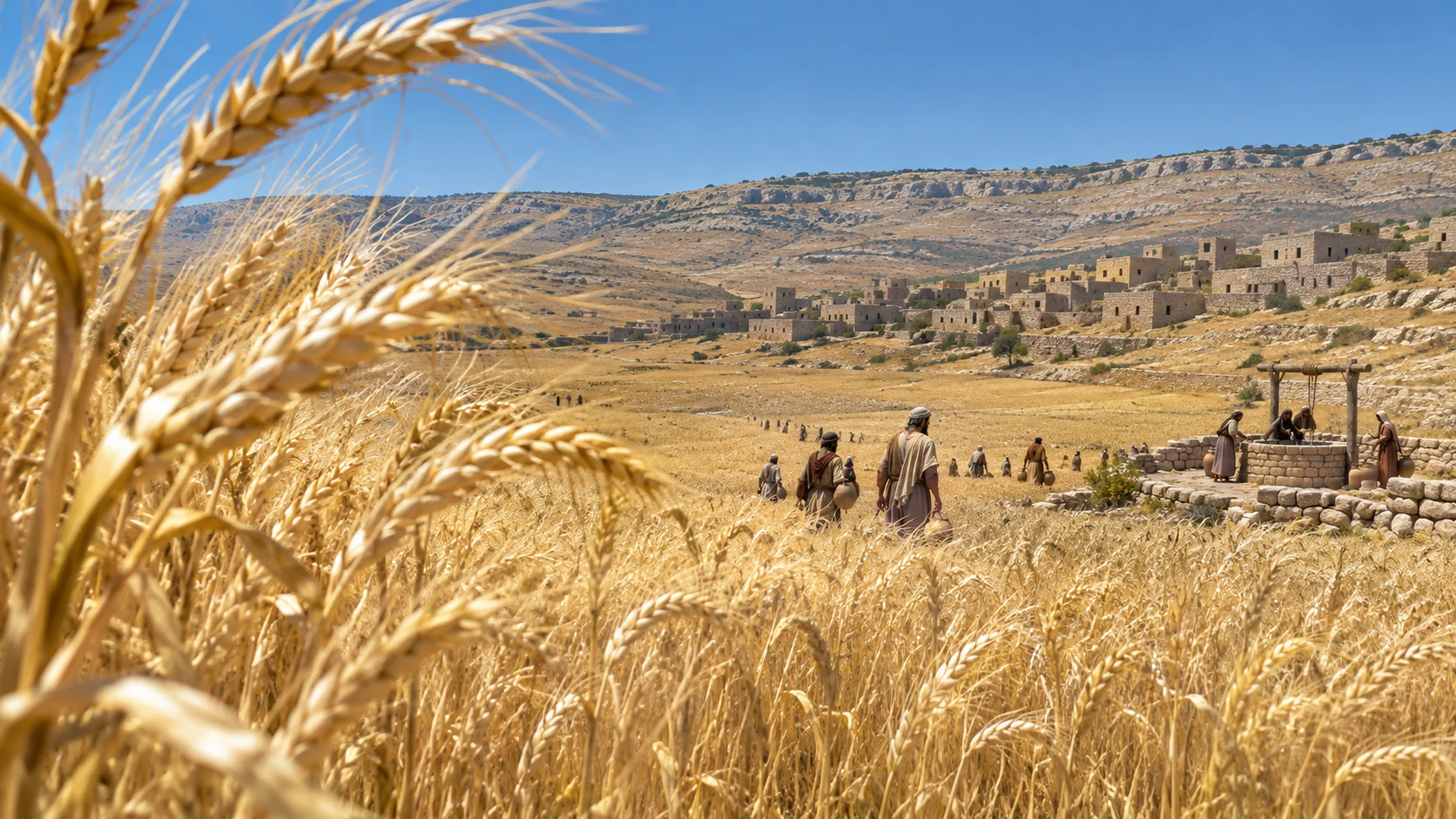
Lift up
your eyes.
10 / A horizon larger than the well
While the townspeople are on their way, the disciples urge Jesus to eat. He speaks of food they do not know about, and they wonder whether someone else has brought him a meal. The conversation again moves between an ordinary bodily need and a meaning that is being opened.
Jesus describes his food as doing the will of the one who sent him and completing that work. He then asks the disciples to lift their eyes toward the fields and speaks of harvest, sowing, reaping, and shared joy.
The image gives the disciples a different way of seeing the moment they have returned to. There is work already underway, and there are others whose labor preceded theirs. Their place in it is connected rather than solitary.
Our field scene is a visual interpretation of this language, not a claim about the precise state of crops at Sychar that day. Let it make room for the widening horizon: the town is coming, and the conversation is becoming larger than the disciples expected.
John 4:35 ↗DAYS.
HE ANSWERS THEIR INVITATION
WITH TIME. / JOHN 4:40
11 / They hear for themselves
He stays
with them.
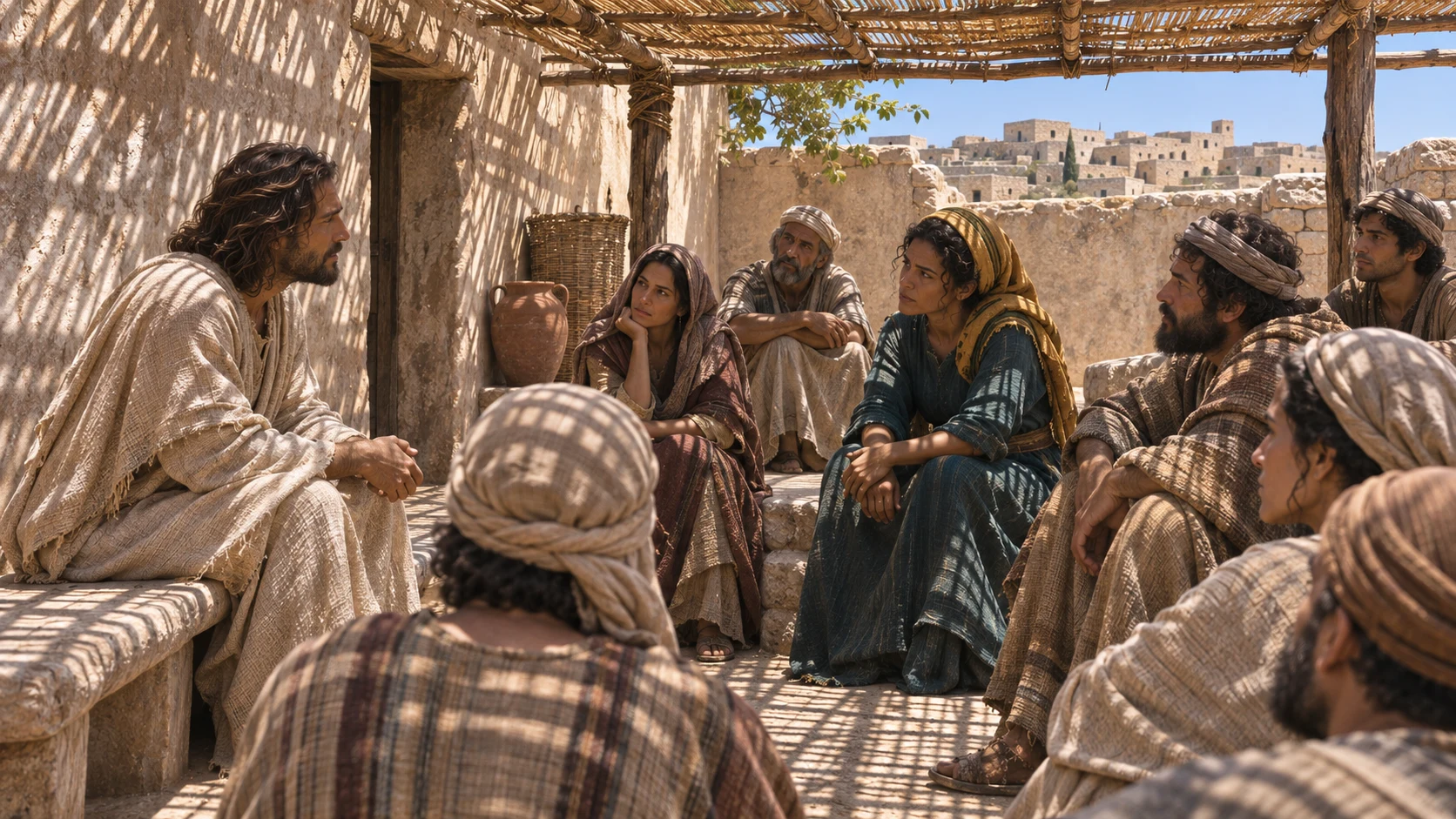
Many Samaritans believe because of the woman’s testimony. When they come to Jesus, they ask him to stay. John says that he remains with them for two days, and that many more believe because of his word.
Stay with the generosity of that duration. The account began with a traveler resting beside a well; it now makes room for a community to hear him. Their invitation is answered with time.
The people tell the woman that they have heard for themselves and call Jesus the Savior of the world. Their response grows beyond a report passed from one person to another. Her testimony has opened a way toward their own hearing.
Before you leave, return in your mind to the first request. A tired traveler asked for a drink. A woman answered. Now a town has heard him for itself. John never gives us her name, but he lets us hear her voice. Carry it with you: come and see.
John 4:40 ↗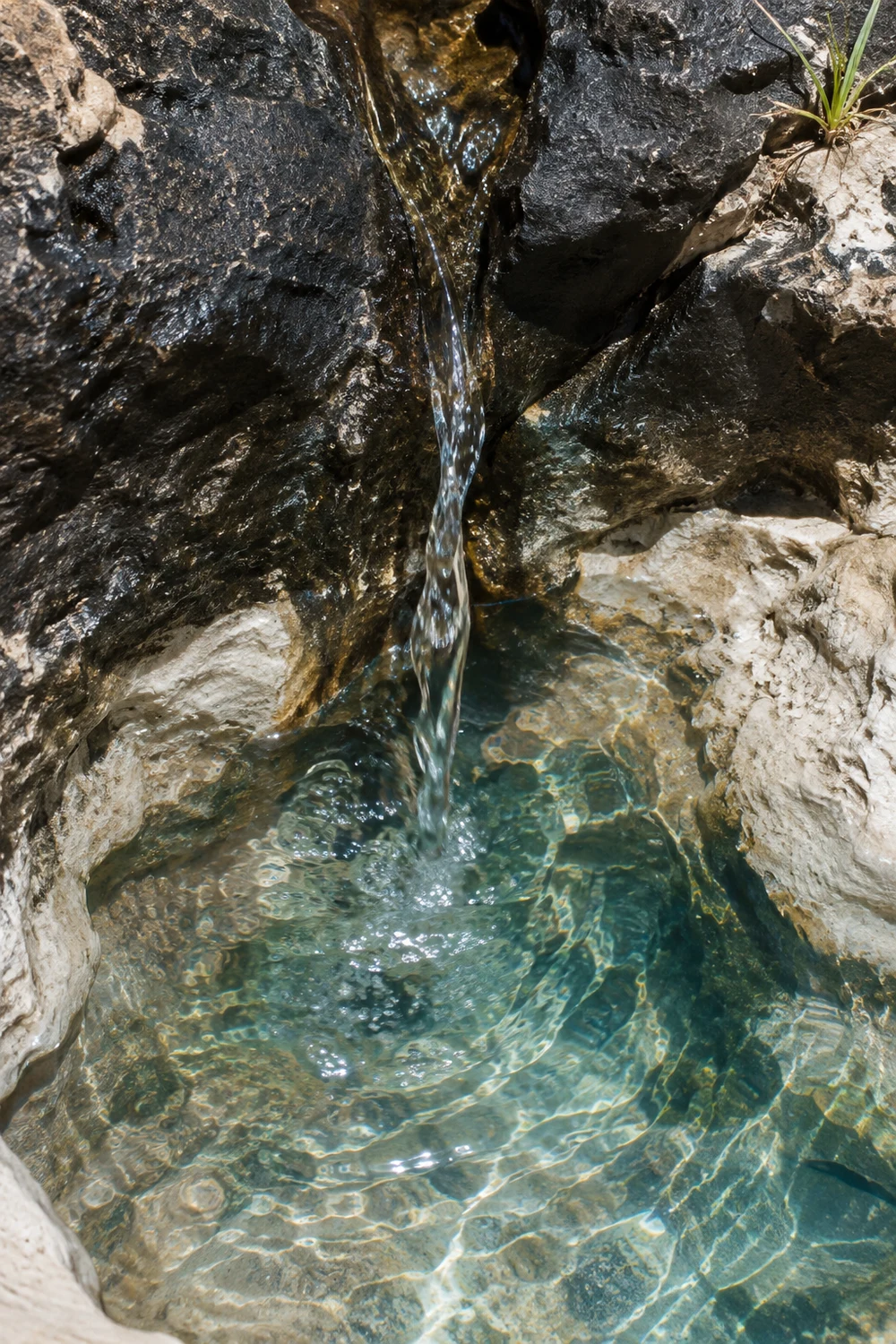
A LITTLE ROOM FOR YOUR OWN LIFE
What question
would you bring?
You can begin with what you actually need. You can listen without already knowing the answer.
- Name a practical need you could share with someone trustworthy.
- Think of someone whose story you have assumed you understand. Make room to listen.
- Choose one question from the passage and read its surrounding verses slowly.
WORDS YOU CAN BORROW
Bring your thirst.
Bring your questions.
01Let me bring my questions
+
Jesus, receive the questions I am afraid to ask. Help me listen carefully, speak honestly, and meet others without deciding their whole story in advance. Let learning become a place of dignity.
02Known without humiliation
+
God, help me face the truth of my life without giving up on my worth. Bring wise and compassionate company. Teach me to speak truth in ways that leave another person room to grow.
03For the thirst beneath the day
+
Jesus, meet the needs I can name and the longing I struggle to understand. Help me receive what gives life, seek the practical care I need, and make room for a hope that can deepen with time.
04Across the distance between us
+
God, give me courage to meet people beyond familiar boundaries. Keep me attentive to our differences and our shared humanity. Let respect, honest conversation, and patient care shape what I do next.
THE WORDS AT THE HEART OF THE ENCOUNTER
Read the
conversation.
John 4:1–42 · World English Bible
Read John 4:1–42+
1Therefore when the Lord knew that the Pharisees had heard that Jesus was making and baptizing more disciples than John
2(although Jesus himself didn’t baptize, but his disciples),
3he left Judea and departed into Galilee.
4He needed to pass through Samaria.
5So he came to a city of Samaria called Sychar, near the parcel of ground that Jacob gave to his son Joseph.
6Jacob’s well was there. Jesus therefore, being tired from his journey, sat down by the well. It was about the sixth hour.
7A woman of Samaria came to draw water. Jesus said to her, “Give me a drink.”
8For his disciples had gone away into the city to buy food.
9The Samaritan woman therefore said to him, “How is it that you, being a Jew, ask for a drink from me, a Samaritan woman?” (For Jews have no dealings with Samaritans.)
10Jesus answered her, “If you knew the gift of God, and who it is who says to you, ‘Give me a drink,’ you would have asked him, and he would have given you living water.”
11The woman said to him, “Sir, you have nothing to draw with, and the well is deep. So where do you get that living water?
12Are you greater than our father Jacob, who gave us the well and drank from it himself, as did his children and his livestock?”
13Jesus answered her, “Everyone who drinks of this water will thirst again,
14but whoever drinks of the water that I will give him will never thirst again; but the water that I will give him will become in him a well of water springing up to eternal life.”
15The woman said to him, “Sir, give me this water, so that I don’t get thirsty, neither come all the way here to draw.”
16Jesus said to her, “Go, call your husband, and come here.”
17The woman answered, “I have no husband.” Jesus said to her, “You said well, ‘I have no husband,’
18for you have had five husbands; and he whom you now have is not your husband. This you have said truly.”
19The woman said to him, “Sir, I perceive that you are a prophet.
20Our fathers worshiped in this mountain, and you Jews say that in Jerusalem is the place where people ought to worship.”
21Jesus said to her, “Woman, believe me, the hour is coming when neither in this mountain nor in Jerusalem will you worship the Father.
22You worship that which you don’t know. We worship that which we know; for salvation is from the Jews.
23But the hour comes, and now is, when the true worshipers will worship the Father in spirit and truth, for the Father seeks such to be his worshipers.
24God is spirit, and those who worship him must worship in spirit and truth.”
25The woman said to him, “I know that Messiah is coming, he who is called Christ. When he has come, he will declare to us all things.”
26Jesus said to her, “I am he, the one who speaks to you.”
27Just then, his disciples came. They marveled that he was speaking with a woman; yet no one said, “What are you looking for?” or, “Why do you speak with her?”
28So the woman left her water pot, went away into the city, and said to the people,
29“Come, see a man who told me everything that I have done. Can this be the Christ?”
30They went out of the city, and were coming to him.
31In the meanwhile, the disciples urged him, saying, “Rabbi, eat.”
32But he said to them, “I have food to eat that you don’t know about.”
33The disciples therefore said to one another, “Has anyone brought him something to eat?”
34Jesus said to them, “My food is to do the will of him who sent me and to accomplish his work.
35Don’t you say, ‘There are yet four months until the harvest’? Behold, I tell you, lift up your eyes and look at the fields, that they are white for harvest already.
36He who reaps receives wages and gathers fruit to eternal life, that both he who sows and he who reaps may rejoice together.
37For in this the saying is true, ‘One sows, and another reaps.’
38I sent you to reap that for which you haven’t labored. Others have labored, and you have entered into their labor.”
39From that city many of the Samaritans believed in him because of the word of the woman, who testified, “He told me everything that I have done.”
40So when the Samaritans came to him, they begged him to stay with them. He stayed there two days.
41Many more believed because of his word.
42They said to the woman, “Now we believe, not because of your speaking; for we have heard for ourselves, and know that this is indeed the Christ, the Savior of the world.”
World English Bible · Public domain
Read the whole chapter ↗A little deeper.
What does John actually tell us?+
This episode follows John 4:1–42: the journey through Samaria, the meeting at Jacob’s well near Sychar, the conversation, the disciples’ return, the woman’s invitation to the town, the teaching about food and harvest, and Jesus’ two-day stay. The full passage is available here and in the Scripture reader.
Why noon? Was she rejected by her community?+
John places the meeting at about the sixth hour, rendered as noon in the World English Bible’s note. The Gospel does not tell us why she came then or say that the town had ostracized her. This episode does not build an invented history of rejection around the time of day.
What can we say about her relationships?+
John 4:16–18 gives Jesus’ statements about her husbands and her present relationship, and affirms the truthfulness of her reply. It does not narrate how the earlier marriages ended or establish the choices and circumstances involved. We preserve those limits rather than assigning a moral biography.
What does living water mean?+
John 4 connects Jesus’ gift with a spring within a person and eternal life. John 7:37–39 explicitly relates another living-water saying to the Spirit. These passages support a spiritual reading without implying that bodily thirst or other human needs cease to matter.
How do we handle the religious differences?+
The woman names the division between Jewish and Samaritan communities and asks about worship. Jesus’ reply includes both worship in spirit and truth and the statement that salvation is from the Jews. The reading stays with this Christian Gospel’s claims while rejecting contempt toward either community or toward readers of another background.
What have the images imagined?+
All images are original AI reconstructions. Faces, gestures, clothing, light, the well’s construction, the town, and the surrounding terrain are artistic choices rather than authenticated likenesses or an archaeological reconstruction. Water and harvest details identified as visual meditations illustrate the passage’s language; they do not add narrated miracles or events.
A note about the woman’s name+
The woman is unnamed in John 4. This episode uses that description rather than assigning a later traditional name or inventing a personal biography.
Original narrative, reflections, prayers, and AI imagery by Via Jesus. Scripture: World English Bible, public domain. Faces, gestures, settings, and visual metaphors are imagined; the story and spoken words are anchored in John’s account.
ANOTHER ENCOUNTER TO STAY WITH