PETER BY THE SEA / JOHN 21
Love,
after the long night.
Empty nets. A voice from shore.
A morning he would not have to earn.
COME ABOARD. THERE IS ROOM.
You can come
with empty hands.
The complete Gospel passage is available below.
01 / After everything
A night with
nothing to show.
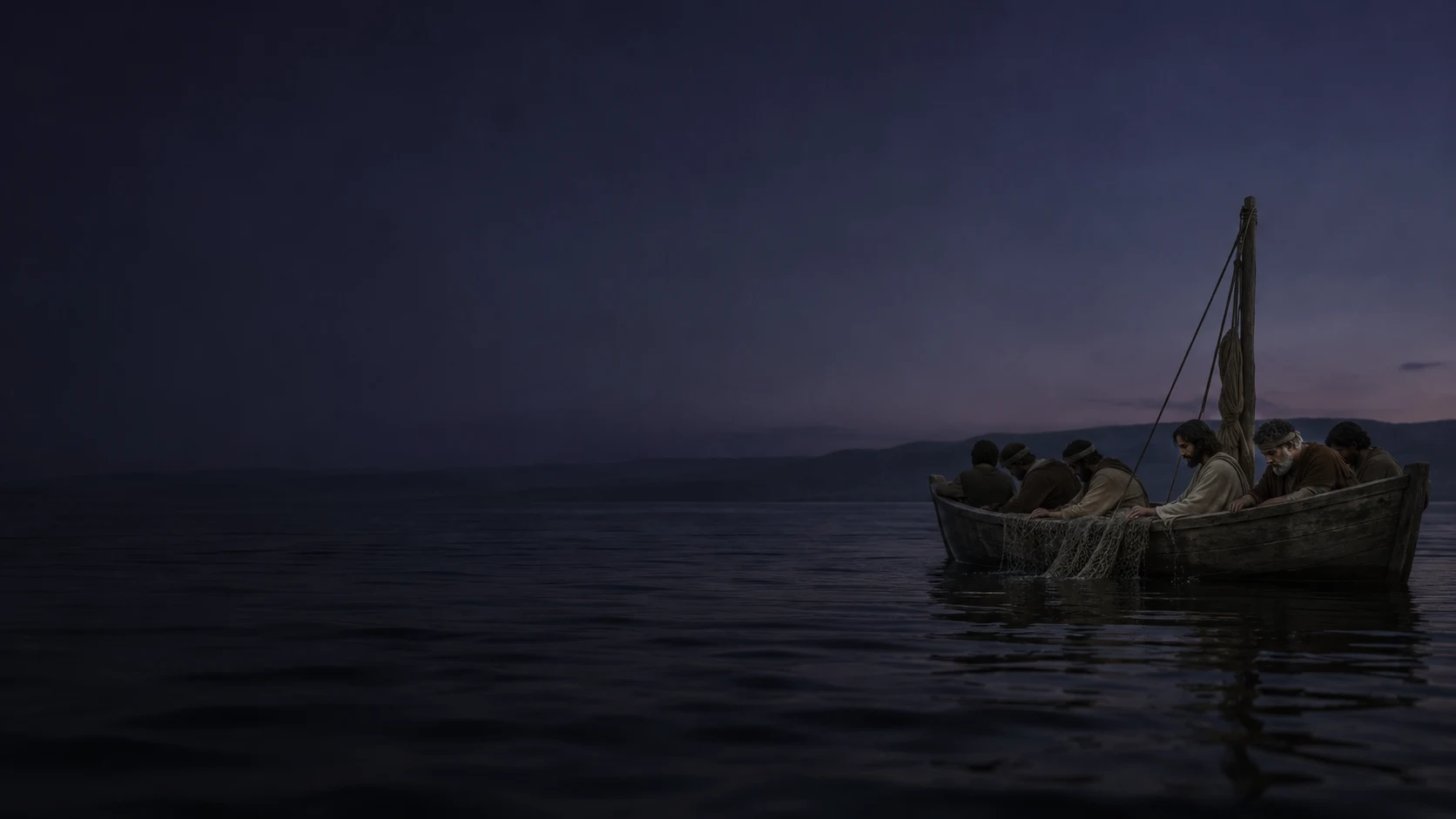
Begin where a night of work has brought them. John names Simon Peter, Thomas, Nathanael, the sons of Zebedee, and two other disciples. Seven people are together beside the Sea of Tiberias. Peter says he is going fishing. The others come with him. They enter the boat. That night they catch nothing.
Imagine the wet weight of the net when it holds only itself. Water comes through the mesh. The wood is dark beneath the hands. A familiar task has taken the hours it always takes, and the boat still carries no catch. In the scene we imagine, the lake keeps its low movement against the hull.
John has already told of the empty tomb and Jesus’ appearances to his disciples. This night belongs after those events. Yet the account makes room for something so ordinary it can ache: people working together, waiting for a result, reaching the end of the night without one.
Come aboard without deciding what Peter must be feeling. The Gospel does not say that fishing is his abandonment of faith, or explain his private reasons for going. It gives us his words, the others’ company, and an empty net. There is enough room in that small boat for an honest beginning.
John 21:3 ↗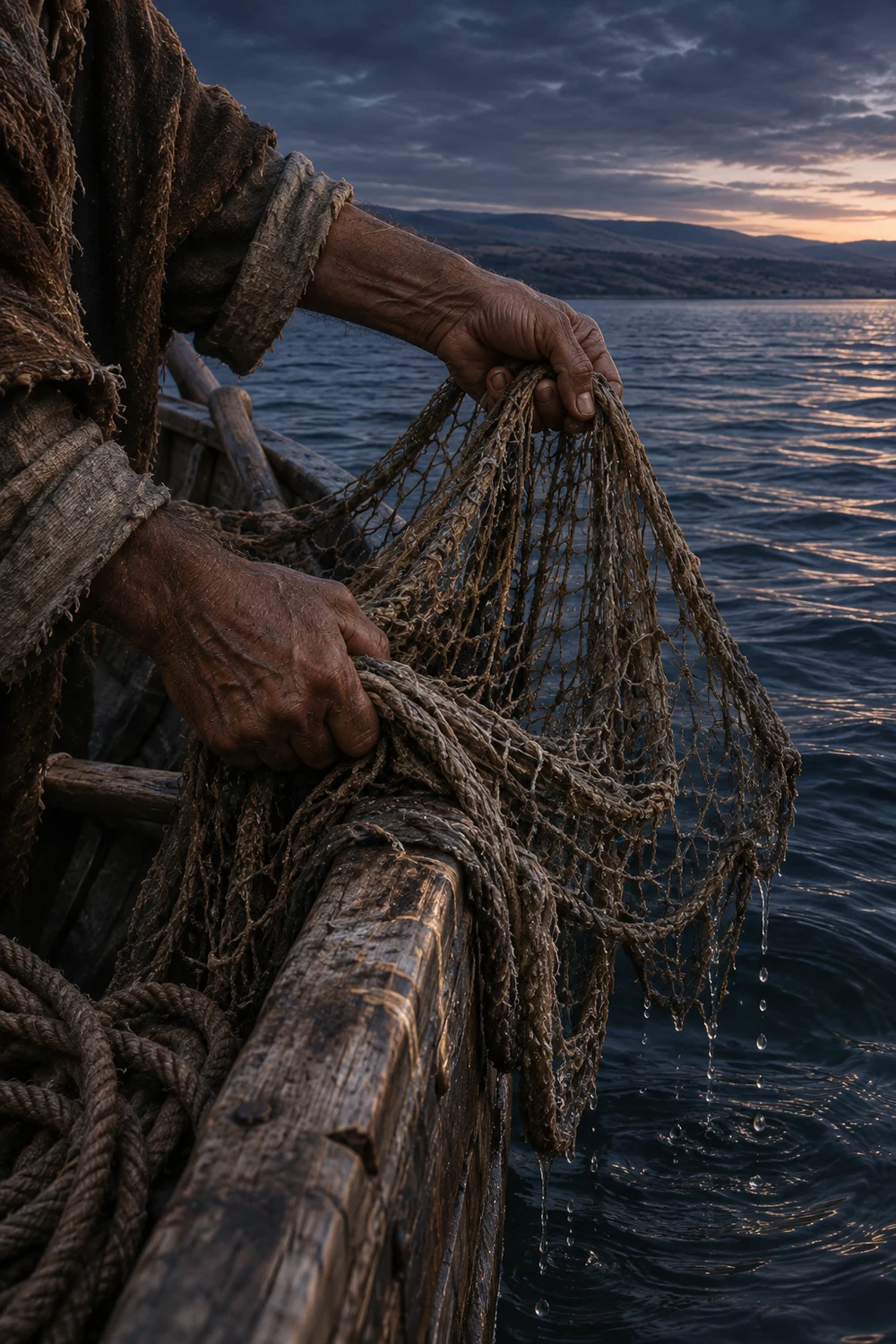

02 / Day is coming
Day has come. Jesus stands on the beach, but the disciples do not know that it is him. The reader sees a nearness the people in the boat cannot yet name. Across the water, he asks whether they have anything to eat. Their answer is no.
Let the distance remain for a moment. A figure on land. A voice reaching a boat. The people who have worked through the night do not have a successful account to offer him. They answer with the thing that is true. No.
In the imagined view, you look shoreward through the loose shapes of a net. Daylight has begun to separate water from land. The voice belongs to someone standing there, inside the world of their tired bodies and their unfinished task.
If you have arrived here with little to show for your effort, you can stay with that answer. You do not have to turn it into a lesson about why something went wrong. This particular morning has its own unfolding. For now, someone has asked about the need, and the need has been spoken.
John 21:5 ↗ONE MORE CASTING / JOHN 21:6
And then,
the weight.
03 / Another casting
The weight
changes.
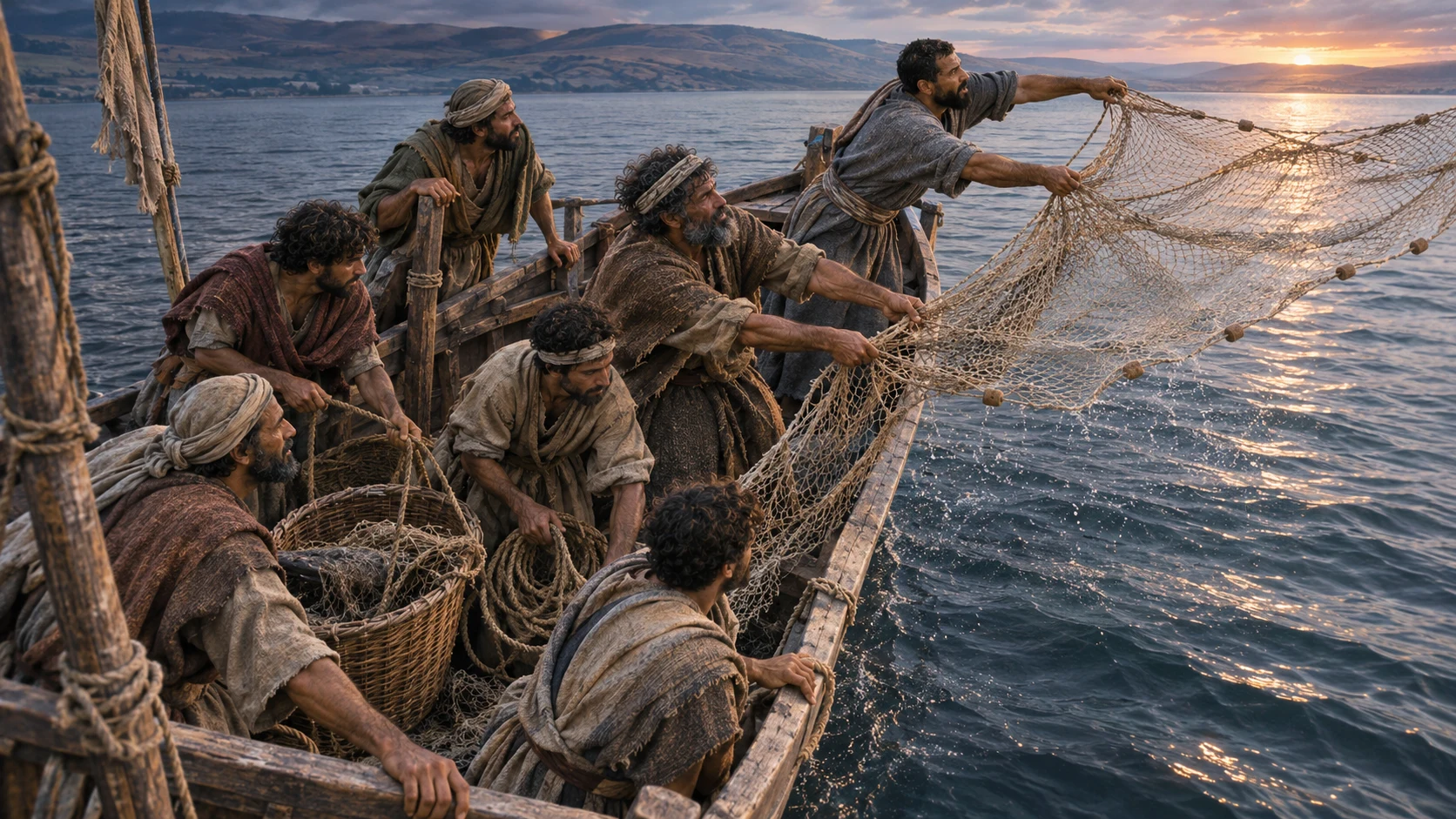
Jesus tells them to cast the net on the right side of the boat and says they will find some. They cast it. Now the net holds so many fish that they cannot draw it in. The same work has acquired a different weight.
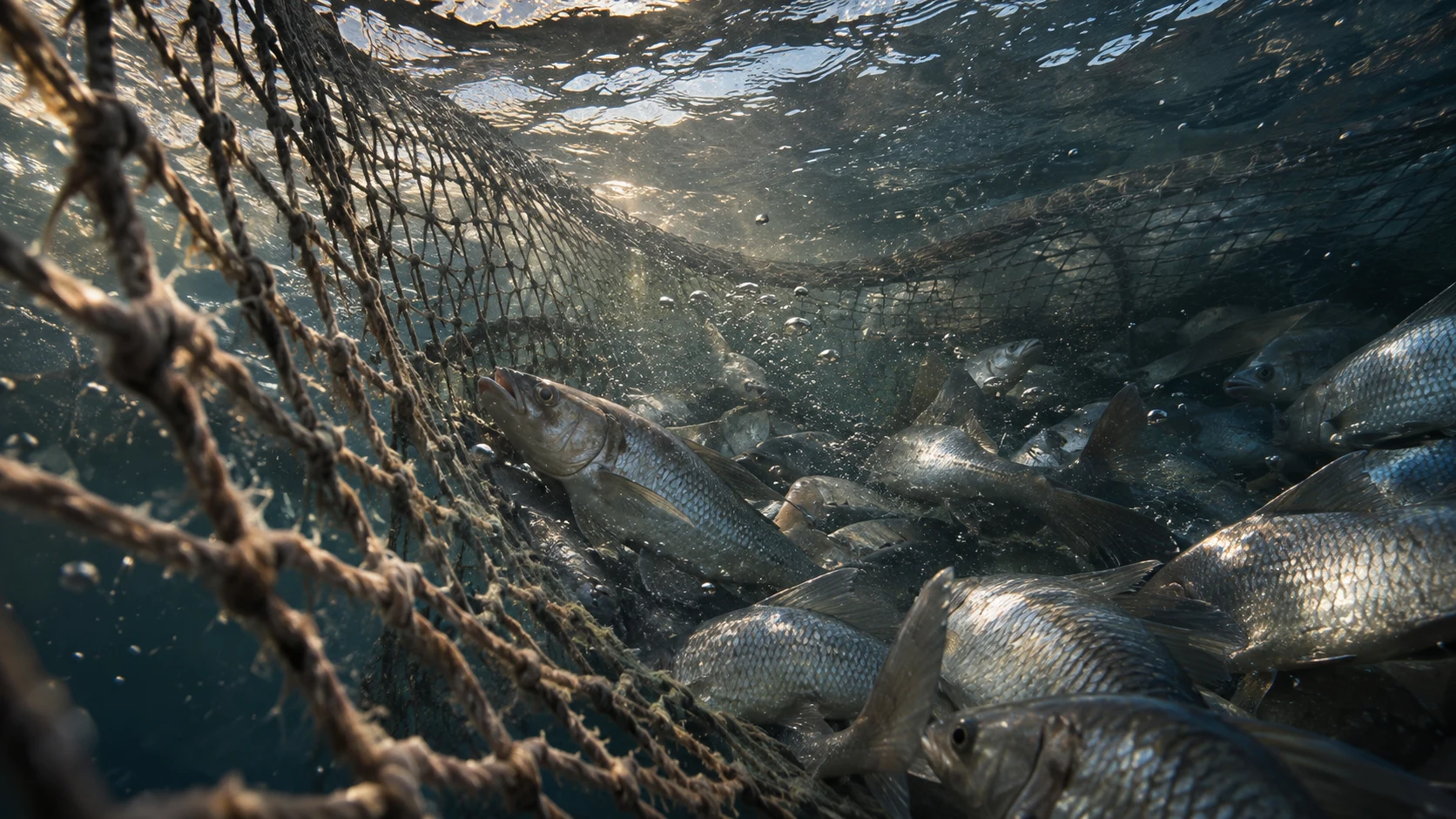
Imagine the first resistance in the rope. A hand that expected slack finds a pull. Another person shifts to help. Beneath the surface, our illustration lets silver bodies gather in the mesh. That underwater viewpoint is an artistic interpretation of the catch John describes.
Give the action time. The account does not skip from emptiness to a tidy pile on land. A full net still has to be brought in. The catch joins the disciples in a shared effort, and the story will follow it all the way to the beach.
Receive this as the Gospel’s account of a particular sign. It is not a formula promising that a different technique, a stronger belief, or another sleepless night will guarantee success in your work. Here the catch helps turn the disciples toward the person who has spoken to them.
John 21:6 ↗“It’s the Lord!”
JOHN 21:7 ↗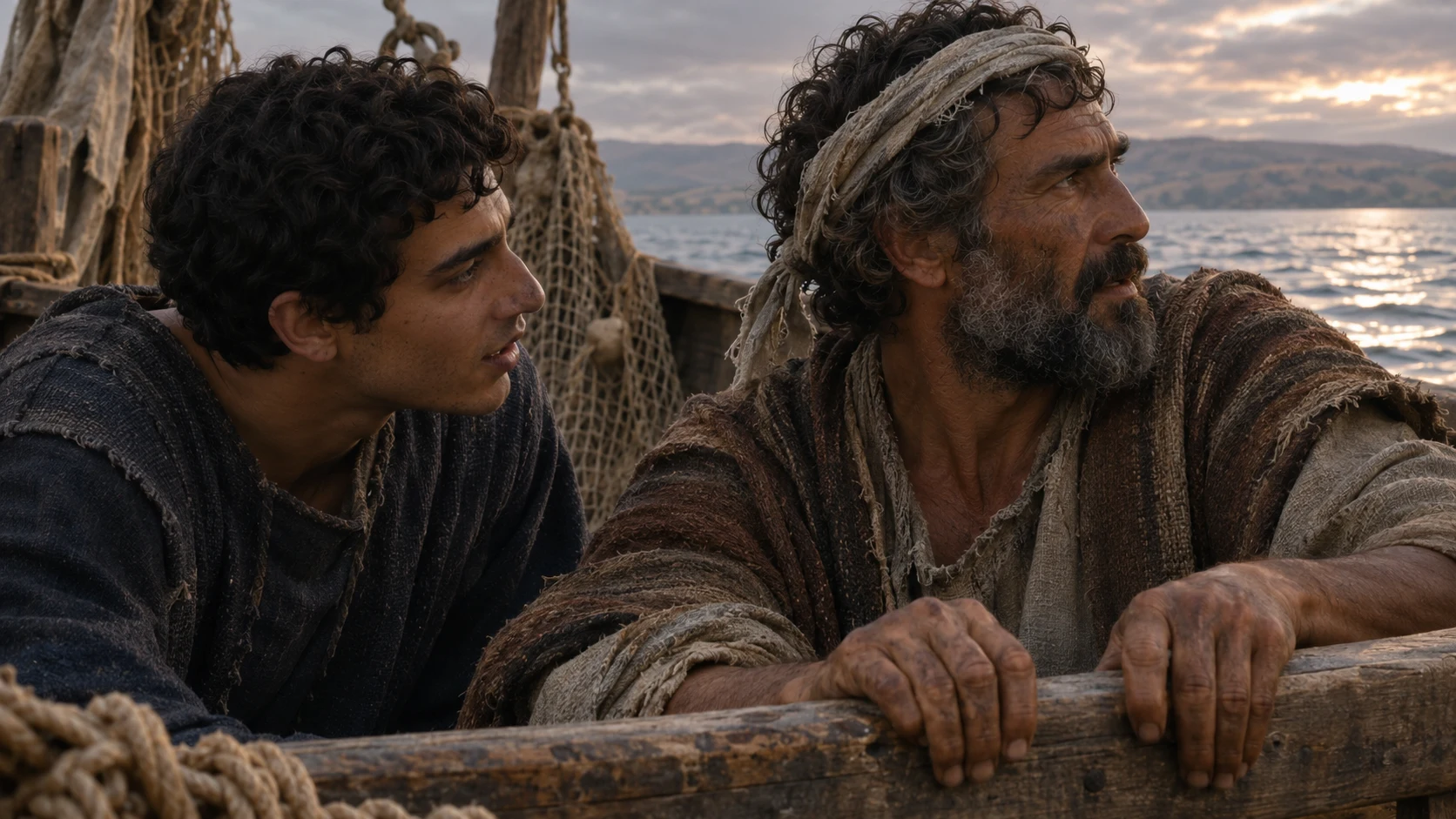
04 / The voice has a name
The disciple whom Jesus loved says to Peter, “It’s the Lord!” Recognition comes into the boat through another person’s voice. Peter hears. He wraps his coat around himself and throws himself into the sea.
Stay with the speed of that response. The Gospel does not give Peter a speech across the water. It gives him movement. In our image, the coat is secured, the boat’s side slips away from his hand, and water rises around him. His body has entered the distance between the boat and the shore.
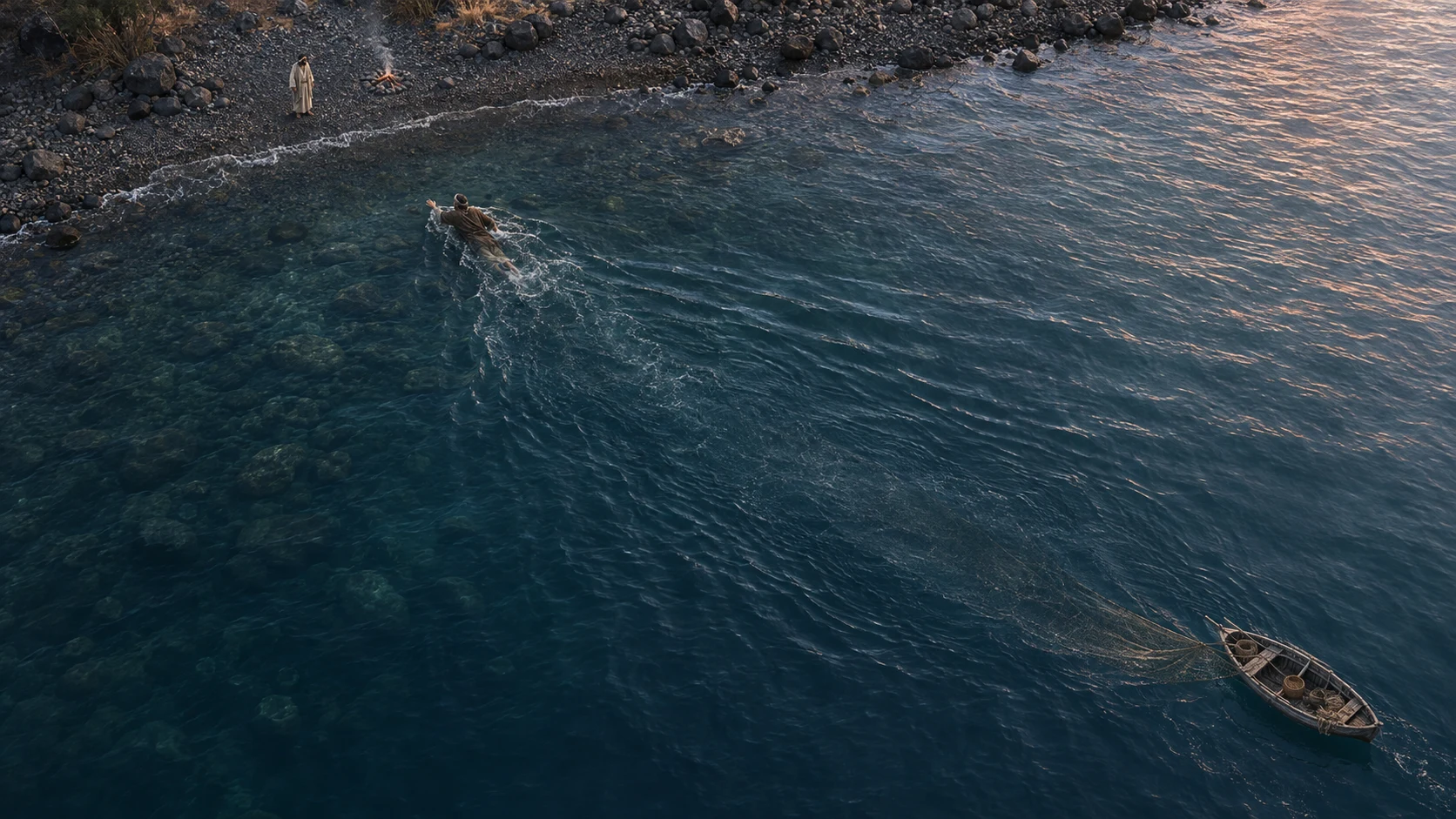
The other disciples come in the little boat, dragging the full net. John places them about two hundred cubits from land. We have imagined Peter swimming; the text says he throws himself into the sea. It also lets us see the others doing the necessary work of bringing the boat and catch.
There is more than one movement toward this meeting. One person names him. One enters the water. Others bring what cannot simply be left floating behind. Let your attention widen enough to include them all.
John 21:7 ↗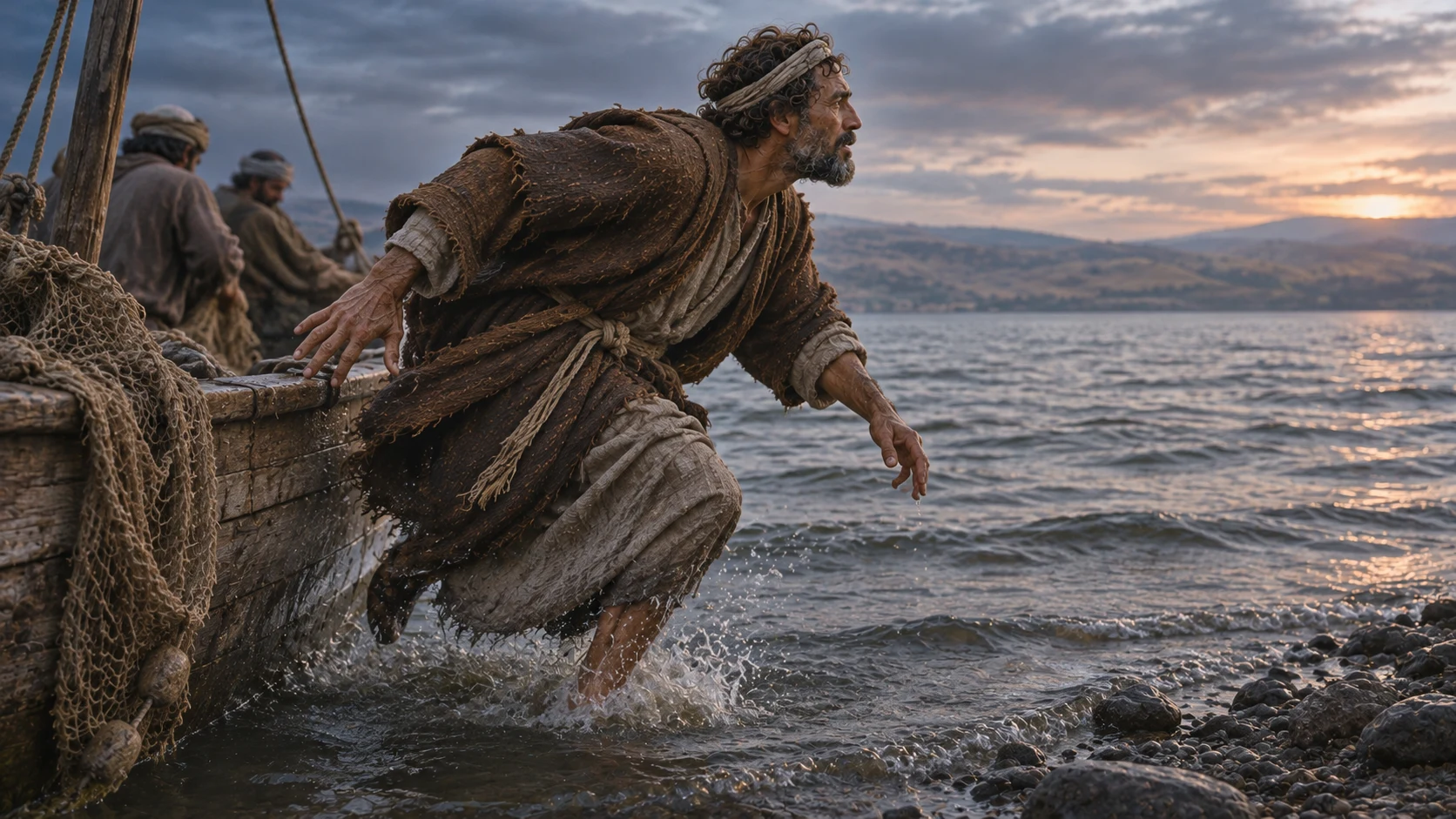
Between hearing
and reaching him,
there is water.
ON THE SHORE
A little warmth.
Something to eat.
05 / Something is already waiting
Another fire
of coals.
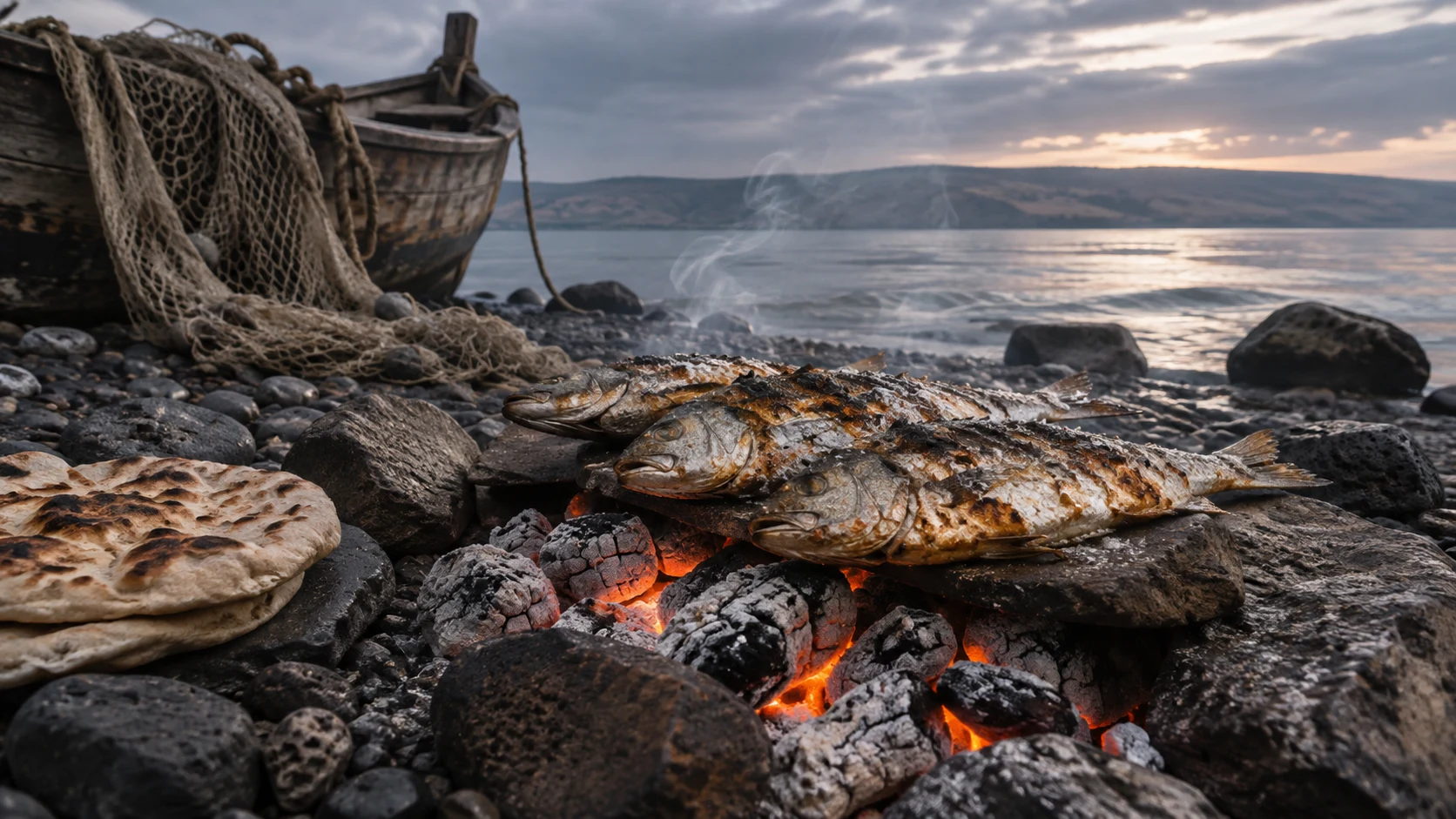
When they come onto land, they see a fire of coals with fish and bread laid on it. Before the conversation we remember most, before Peter answers the questions, there is food. Jesus asks them to bring some of the fish they have just caught.
Imagine the small warmth at your shins after the lake. The air carries smoke; wet cloth holds the morning against the skin. Dark stones surround the embers. The fish and bread belong to John’s account. Their arrangement, their smell, the ash settling at the edge of the fire are details we imagine to stay near the scene.
Another charcoal fire stands earlier in John’s Gospel. In the high priest’s courtyard, Peter warmed himself while Jesus was being questioned. Around that part of the story, Peter denied being his disciple. John 18:17–27 lets us hear the denials and the rooster. The echo between the fires is painful to read.
Do not hurry to explain the echo away. The same man is here. The past has not become unreal. Yet this fire is set beside a meal, and Jesus is present on the shore. Let both facts stand together long enough to feel their weight.
John 21:9 ↗GREAT FISH.
COUNTED ON THE SHORE.
A net that did not tear.
06 / What they bring
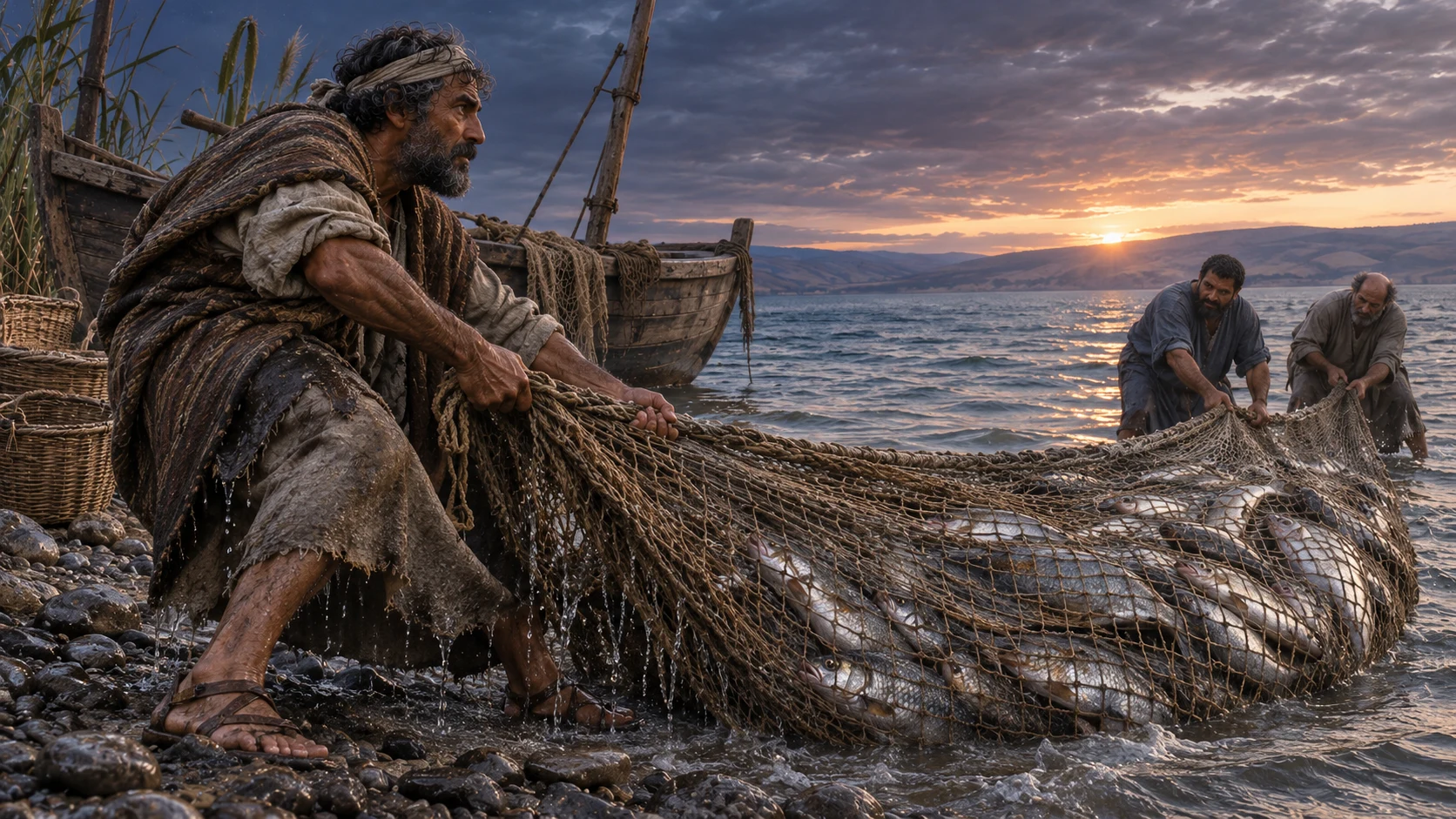
Peter goes up and draws the net onto land. John gives a number: one hundred fifty-three great fish. With so many, the net is not torn. The catch has crossed the distance from water to shore.
Look at the mesh in the image. It bends around actual weight. Hands and feet must find their purchase among the stones. This is abundance with texture: something gathered, something brought, something that involves the people who will eat.
The number is precise, but John supplies no key for turning it into a secret calculation. Many readers have explored symbolic possibilities. We can begin with what the account makes plain: the catch is large, it is counted, and the net remains whole.
Notice, too, the invitation to bring some of their fish. Food is already at the fire, and their catch is welcomed into the meal. They come to something prepared; they also take part. Keep that small generosity in view as you move toward breakfast.
John 21:11 ↗BEFORE THE QUESTIONS / JOHN 21:12
“Come and
eat breakfast!”
07 / Before the questions
Come and
eat breakfast.
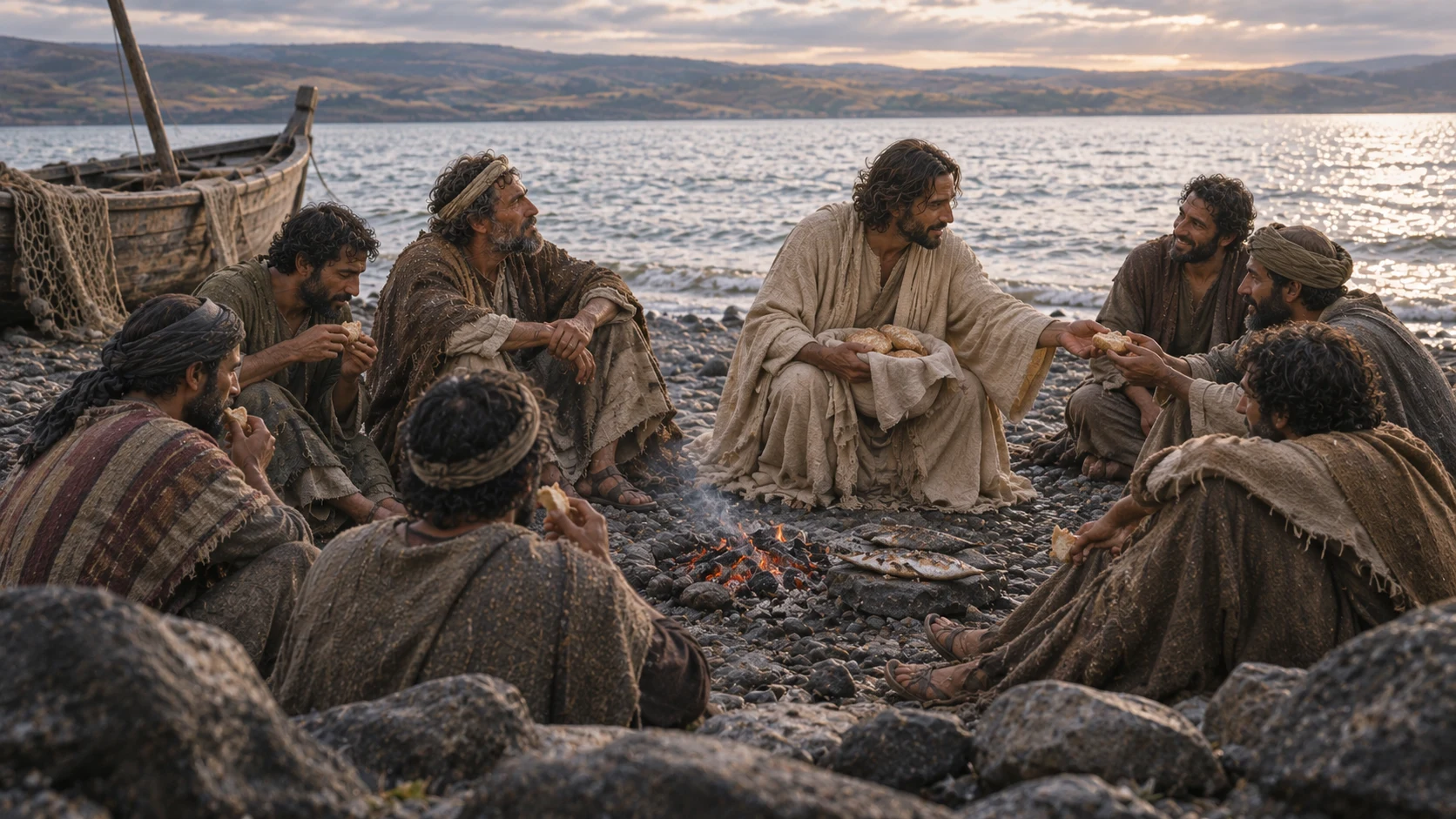
Jesus invites them to breakfast. None of the disciples dares ask who he is, because they know it is the Lord. He comes, takes the bread, gives it to them, and does the same with the fish. John calls this the third time he was revealed to his disciples after rising from the dead.
Let the morning slow here. In the scene we imagine, the seven settle unevenly on the beach. A hand makes room; another receives. There is no grand table to hide behind. The lake is close. The food passes between people who know who is giving it.
A palm opens. Bread is placed in it. Let yourself stay with the smallness of receiving something you need. Peter is among those who are fed before the account turns to his love and his care for others. Before the difficult answer, there is something given.
If regret has made you feel that you must earn every kindness before receiving it, stay with the meal for a little while. Food and rest are human needs. You can accept an ordinary act of care while there is still something difficult to face. The conversation comes after breakfast.
John 21:12 ↗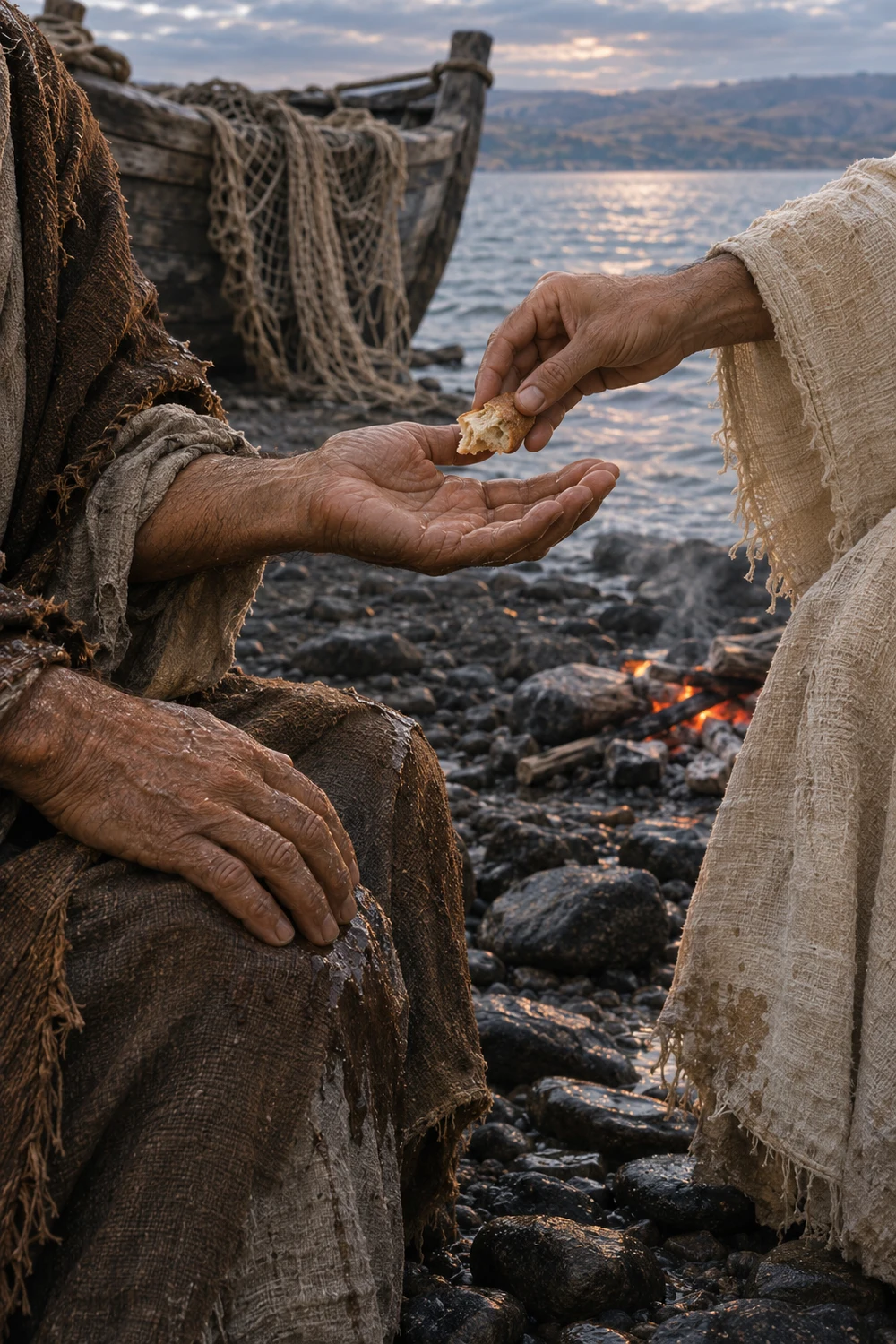
Stay a little.
The conversation
comes after breakfast.
AFTER THEY HAVE EATEN / JOHN 21:15–17
Three times.
Still love.
Stay with each question.
Listen to what he entrusts to him.
JESUS ASKS / JOHN 21:15
“Simon, son of Jonah, do you love me more than these?”
PETER ANSWERS
“Yes, Lord; you know that I have affection for you.”
JESUS ENTRUSTS
“Feed my lambs.”
Read the exchange ↗08 / After they have eaten
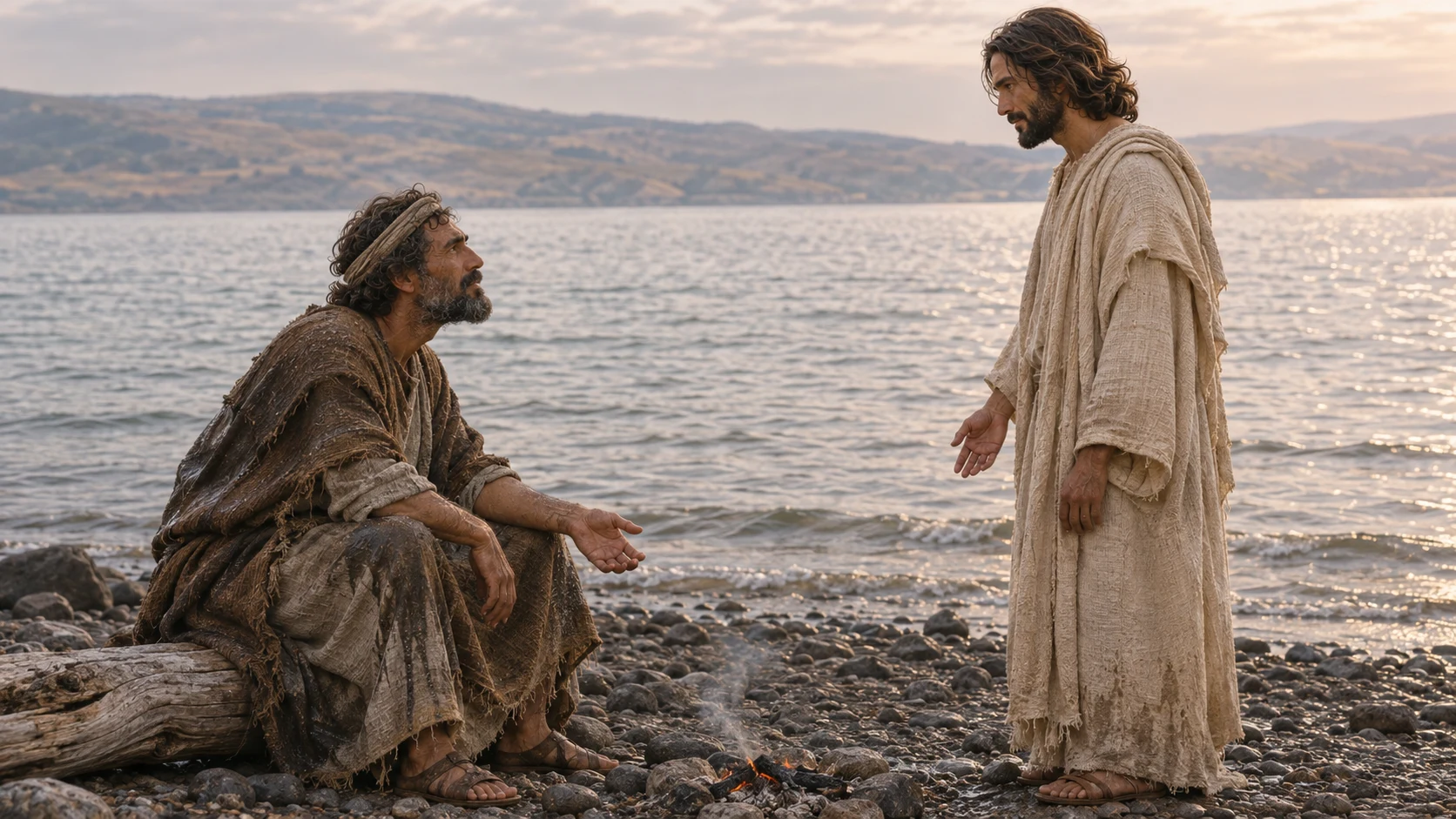
When breakfast is finished, Jesus speaks to Simon Peter. The World English Bible gives the question this way: “Simon, son of Jonah, do you love me more than these?” Peter answers, “Yes, Lord; you know that I have affection for you.” Jesus tells him, “Feed my lambs.”
Hear how personal the address is. Simon. A question put to a person, in the presence of a history the reader knows. The account does not give us every pause, tone, or gesture. Our image leaves space between the two men so you can attend to the exchange itself.
The words “more than these” have prompted different readings: comparison with the others’ love, with Peter’s love for them, or with the things around him. John does not expand the phrase into an explanation. Its uncertainty need not prevent us hearing the question at its center.
Peter answers by appealing to what Jesus knows. Then love is directed toward care. Feed my lambs. The answer does not remain a private feeling between two people; it opens toward others whose lives will matter to Peter’s calling.
John 21:15 ↗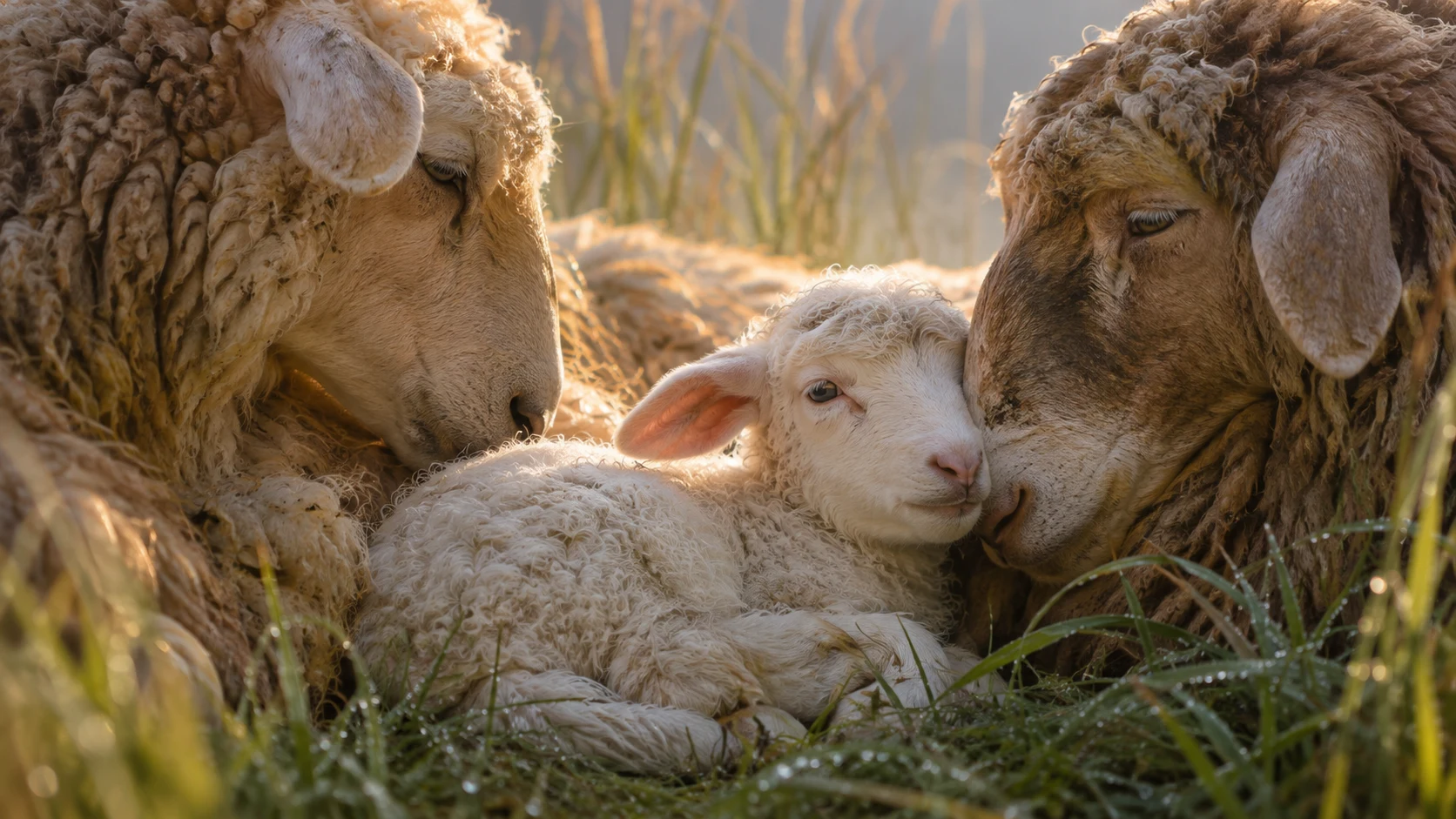
JESUS ASKS / JOHN 21:16
“Simon, son of Jonah, do you love me?”
PETER ANSWERS
“Yes, Lord; you know that I have affection for you.”
JESUS ENTRUSTS
“Tend my sheep.”
Read the exchange ↗09 / He asks again
Jesus asks a second time whether Simon loves him. Peter again says that the Lord knows his affection. This time the charge is, “Tend my sheep.” Read the exchange without rushing over it because the shape sounds familiar.
The repeated question makes the reader stay. We are accustomed to moving quickly past the words that hurt or matter most. Here the conversation asks for another hearing. Another answer. Another commission to attend to lives beyond Peter’s own.
The image of a flock gives care a living object. Creatures need feeding, tending, protection, and patient attention. Our lamb illustration is a visual meditation on Jesus’ words; John does not place a flock on this beach. The figure of speech turns love into responsibility.
For a reader, the invitation can be small and concrete. Who has been placed within reach of your care? What would tending look like today: listening well, keeping a promise, providing a meal, telling the truth, or making a repair without demanding recognition for it?
John 21:16 ↗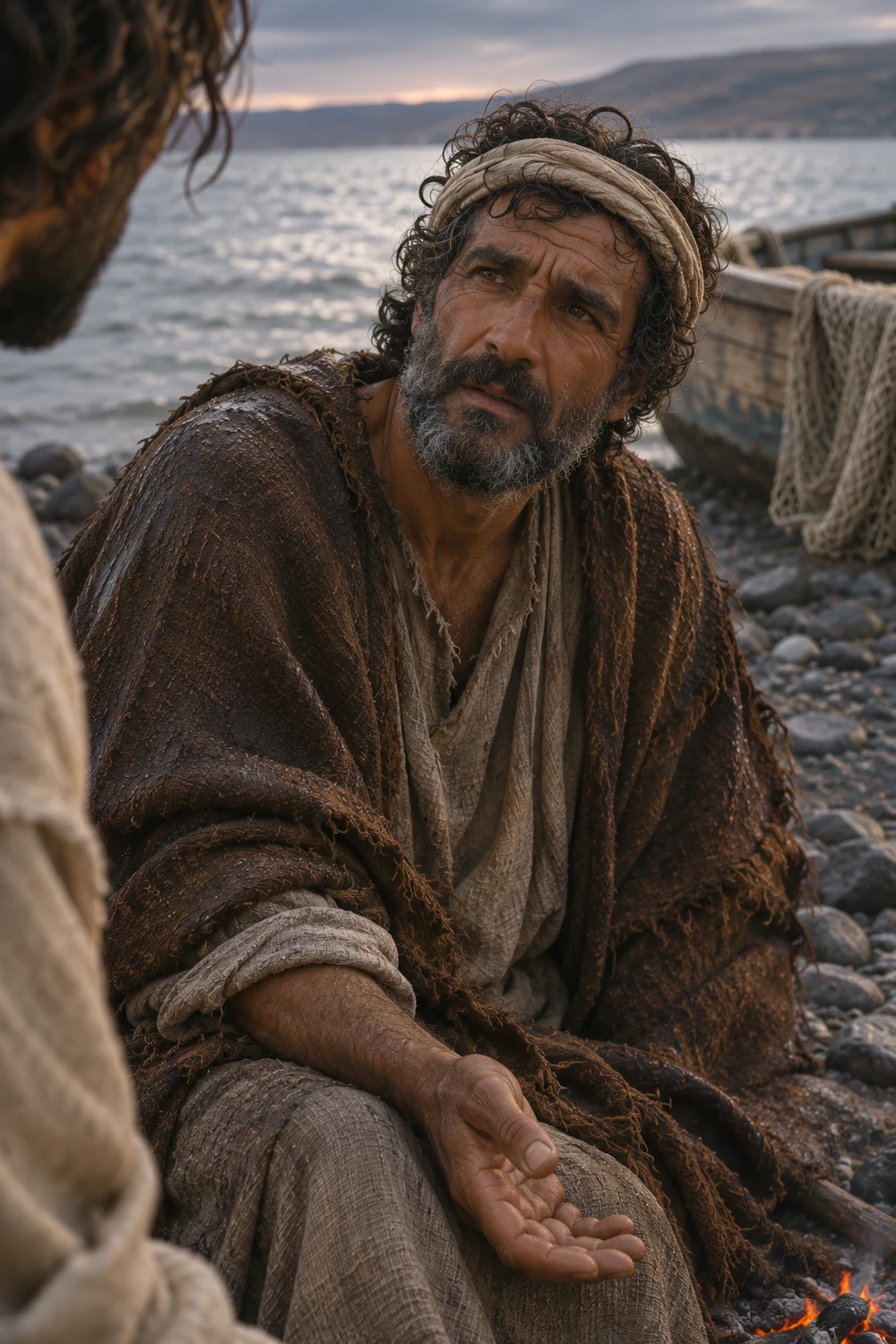
JESUS ASKS / JOHN 21:17
“Simon, son of Jonah, do you have affection for me?”
PETER ANSWERS
“Lord, you know everything. You know that I have affection for you.”
JESUS ENTRUSTS
“Feed my sheep.”
Read the exchange ↗10 / The third time
The third question grieves Peter. John says so. In this translation, Jesus asks whether Simon has affection for him. Peter answers, “Lord, you know everything. You know that I have affection for you.” Jesus tells him, “Feed my sheep.”
Let the grief be real. The story has not become a scene in which every difficult feeling vanishes as soon as Jesus speaks. Three denials are behind the reader; three questions now stand in the morning. Many readers hear restoration in that correspondence. John gives us the repeated exchange and Peter’s sorrow.
There is a kind of answer that has fewer defenses left in it. Lord, you know. As a reflection, you may recognize the longing to be understood beyond the account you can successfully make of yourself. You can bring that longing to these words without inventing what Peter thought between them.
And listen to what comes next. Feed my sheep. His grief is not the last thing said about his future. The conversation entrusts him with care. Stay beside that sentence: a real past, an honest answer, and work of love still ahead.
John 21:17 ↗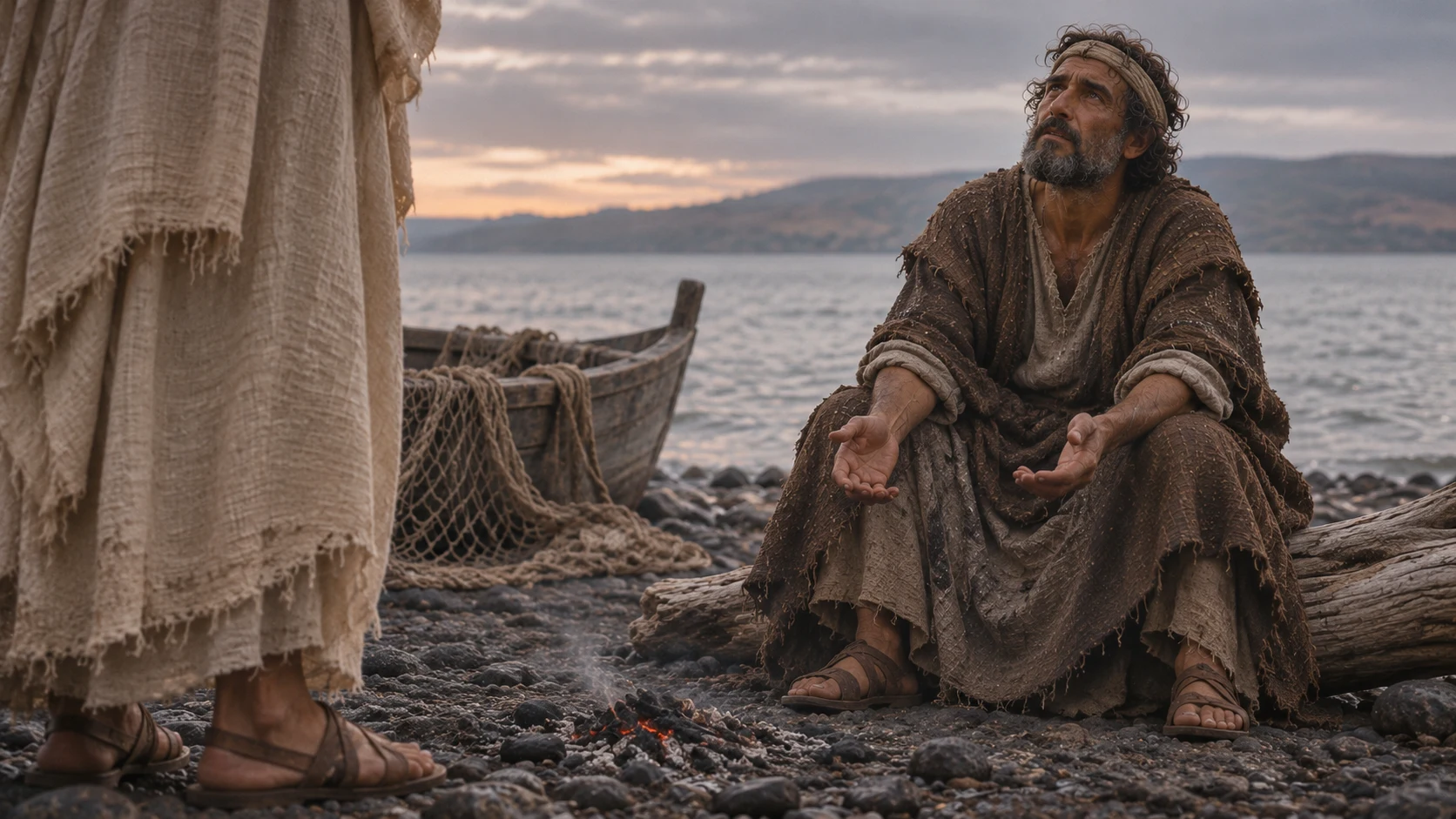
A real past.
An honest answer.
Care still ahead.
A FUTURE WITH WEIGHT / JOHN 21:18–19
“Follow me.”
11 / A future with weight
Jesus then speaks of Peter’s youth and old age: once he dressed himself and went where he wished; later another would dress him and carry him where he did not wish to go. John explains that these words signify the kind of death by which Peter would glorify God. Jesus says, “Follow me.”
The morning’s tenderness includes a costly future. Restoration does not become a promise that Peter will be spared suffering. The Gospel places his calling in the story of his life and death, with Jesus’ invitation still addressed to him.
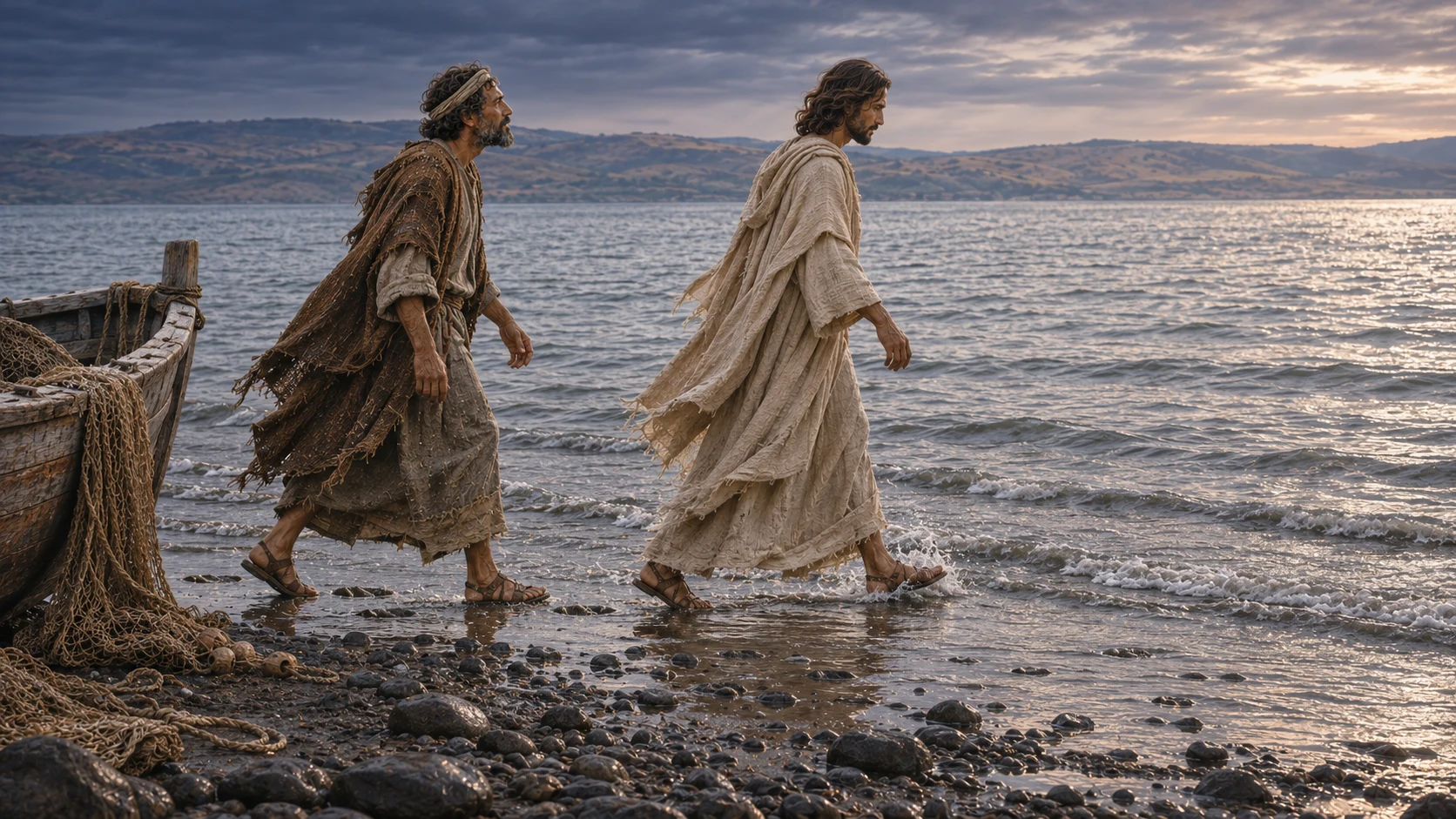
Stay with the two words. Follow me. In the walking scene we imagine, water reaches the edge of a footprint and settles into it. There is another step to take. The invitation still has Peter’s name and history inside it, even as it opens toward what he cannot yet see.
Receive the account with care for your own circumstances. Following Jesus is not permission for someone to demand your exposure to abuse or danger. The tending named in this conversation concerns lives that deserve care, including the life of the person who is learning to give it.
John 21:19 ↗12 / The other disciple
Peter turns and sees the disciple whom Jesus loved following. He asks Jesus what will happen to this man. Jesus answers with a conditional statement about the disciple remaining until he comes, then returns Peter to his own calling: “You follow me.”
John is careful about how those words are heard. A saying spread that the disciple would not die, but Jesus had not said that. The account repeats the conditional sentence. Even near its ending, the Gospel asks the reader to listen precisely instead of letting a rumor become a promise.
The question about another person is recognizable. What will happen to them? Will their road be easier? Will I be asked for more? Those are reflections we may bring; John does not supply Peter’s private motive. The answer brings attention back to his own following.
You can care about another person without making their future the measure of your worth. Today there may be one honest thing within your reach: an apology, a boundary, a task of care, a passage read again. Let it be small enough to do, and serious enough to matter.
John 21:22 ↗
There is
more.
13 / More than the books can hold
The closing verses turn toward testimony: the disciple who bears witness, the writing, and the assurance that his witness is true. Then the Gospel imagines the world itself unable to contain all the books that could be written about what Jesus did.
After such a close morning—the rope, the water, the fish, the bread, the questions—the ending opens wide. We have stayed with one encounter. The account leaves us with the sense that this life exceeds the pages that tell it.
Before you go, return to the beach. Someone who knew failure received breakfast. Someone who was grieved answered as honestly as he could. Someone with a difficult history was called toward care. These are movements in Peter’s story that can give a reader room to breathe.
You do not have to force a feeling here. Read again if you want to. Borrow a prayer. Receive some care, or offer one fitting act of it. Let the last words you carry be near enough to live with: feed, tend, follow.
John 21:25 ↗A LITTLE ROOM FOR YOUR LIFE
One small
act of care.
If this story meets you in regret, you can begin gently and honestly.
- Receive something you need today: a meal, rest, or trustworthy company.
- Where you have caused harm, name one possible repair. Respect the other person’s boundaries and their pace.
- Choose a fitting act of care you can offer without a promise you cannot keep.
WORDS YOU CAN BORROW
Bring what
you cannot say.
01When my hands feel empty
+
Jesus, meet me in the work that has left me tired. Help me tell the truth about what I need. Give me rest, good company, and the courage to ask for practical help. Let my worth be larger than what I can produce.
02Let me receive care
+
God, loosen the fear that I must earn every kindness. Help me receive food, rest, attention, and trustworthy love while my life is still unfinished. Teach me to welcome the care I need today.
03When I remember what I did
+
Jesus, help me face what I regret without hiding or making excuses. Where repair is possible, teach me to begin it with humility. Help me respect the needs and boundaries of those I have hurt. Keep me open to truth, mercy, and a different way of living.
04You know what I cannot say
+
Lord, you know the love I struggle to express and the parts of my story I cannot arrange into a defense. Receive my honest answer. Help me listen, learn, and take the next small step toward a life of care.
05Teach my love to become care
+
Jesus, make my love attentive. Help me notice hunger, loneliness, weariness, and the need for safety. Give me patience to keep promises, wisdom to accept limits, and humility to receive care as well as offer it.
06One faithful step
+
God, bring my attention back from comparing my life with someone else’s. Show me the good that is within reach today. Help me take one honest step, with courage, compassion, and room to learn.
THE WORDS AT THE HEART OF THE MORNING
Read the
whole encounter.
John 21:1–25 · World English Bible
Read John 21:1–25+
1After these things, Jesus revealed himself again to the disciples at the sea of Tiberias. He revealed himself this way.
2Simon Peter, Thomas called Didymus, Nathanael of Cana in Galilee, and the sons of Zebedee, and two others of his disciples were together.
3Simon Peter said to them, “I’m going fishing.” They told him, “We are also coming with you.” They immediately went out and entered into the boat. That night, they caught nothing.
4But when day had already come, Jesus stood on the beach; yet the disciples didn’t know that it was Jesus.
5Jesus therefore said to them, “Children, have you anything to eat?” They answered him, “No.”
6He said to them, “Cast the net on the right side of the boat, and you will find some.” They cast it therefore, and now they weren’t able to draw it in for the multitude of fish.
7That disciple therefore whom Jesus loved said to Peter, “It’s the Lord!” So when Simon Peter heard that it was the Lord, he wrapped his coat around himself (for he was naked), and threw himself into the sea.
8But the other disciples came in the little boat (for they were not far from the land, but about two hundred cubits away), dragging the net full of fish.
9So when they got out on the land, they saw a fire of coals there, with fish and bread laid on it.
10Jesus said to them, “Bring some of the fish which you have just caught.”
11Simon Peter went up, and drew the net to land, full of one hundred fifty-three great fish. Even though there were so many, the net wasn’t torn.
12Jesus said to them, “Come and eat breakfast!” None of the disciples dared inquire of him, “Who are you?” knowing that it was the Lord.
13Then Jesus came and took the bread, gave it to them, and the fish likewise.
14This is now the third time that Jesus was revealed to his disciples after he had risen from the dead.
15So when they had eaten their breakfast, Jesus said to Simon Peter, “Simon, son of Jonah, do you love me more than these?” He said to him, “Yes, Lord; you know that I have affection for you.” He said to him, “Feed my lambs.”
16He said to him again a second time, “Simon, son of Jonah, do you love me?” He said to him, “Yes, Lord; you know that I have affection for you.” He said to him, “Tend my sheep.”
17He said to him the third time, “Simon, son of Jonah, do you have affection for me?” Peter was grieved because he asked him the third time, “Do you have affection for me?” He said to him, “Lord, you know everything. You know that I have affection for you.” Jesus said to him, “Feed my sheep.
18Most certainly I tell you, when you were young, you dressed yourself and walked where you wanted to. But when you are old, you will stretch out your hands, and another will dress you and carry you where you don’t want to go.”
19Now he said this, signifying by what kind of death he would glorify God. When he had said this, he said to him, “Follow me.”
20Then Peter, turning around, saw a disciple following. This was the disciple whom Jesus loved, the one who had also leaned on Jesus’ chest at the supper and asked, “Lord, who is going to betray you?”
21Peter, seeing him, said to Jesus, “Lord, what about this man?”
22Jesus said to him, “If I desire that he stay until I come, what is that to you? You follow me.”
23This saying therefore went out among the brothers that this disciple wouldn’t die. Yet Jesus didn’t say to him that he wouldn’t die, but, “If I desire that he stay until I come, what is that to you?”
24This is the disciple who testifies about these things, and wrote these things. We know that his witness is true.
25There are also many other things which Jesus did, which if they would all be written, I suppose that even the world itself wouldn’t have room for the books that would be written.
World English Bible · Public domain
Read the whole chapter ↗A little deeper.
What is Scripture, and what have we imagined?+
The sequence and spoken words follow John 21:1–25 in the World English Bible. Water, charcoal, fish, bread, the catch, the repeated questions, Peter’s grief, and the commission belong to the account. Weather, faces, gestures, the exact boat, breakfast arrangement, swimming action and the walking composition are imagined. The underwater view, flock and final wave are visual interpretations. The complete source is included below.
Which disciples are here?+
John names Simon Peter, Thomas called Didymus, Nathanael of Cana, the sons of Zebedee, and two others: seven disciples in all. The beloved disciple is not personally named in this chapter. The younger man in the illustrations is an artistic depiction, not an authenticated identification or likeness.
Why connect this breakfast with Peter’s denial?+
John 18:17–27 narrates Peter’s denials and places him warming himself beside a fire of coals. John 21:9 supplies another fire of coals, and John 21:15–17 gives three questions and commissions. Reading the later scene as Peter’s restoration is an interpretation grounded in that narrative correspondence. The chapter does not reproduce a private confession or use an explicit formula of absolution.
Does the catch promise success after failure?+
The catch is a particular sign in this Gospel account. It should not become a technique for guaranteed income, healing, or success. John does not explain Peter’s decision to fish as a rejection of Jesus, and the empty night should not be used to accuse exhausted readers of insufficient faith.
What about the number 153?+
John 21:11 reports one hundred fifty-three great fish and an untorn net. The text gives no explicit symbolic explanation of the number. This episode keeps the counted abundance in view without presenting a speculative code as the Gospel’s stated meaning.
Why “love” and “affection”? What are “these”?+
The dialogue here preserves the World English Bible’s English wording, including its changes between “love” and “affection.” The full exchange matters more than a shortcut built from a single word. The phrase “more than these” is not expanded in the passage; the reflection acknowledges several readings rather than asserting a certain referent.
Does “feed my sheep” settle a denominational question?+
Christian traditions understand Peter’s role and its continuing implications differently. This episode attends to the commission as John narrates it: Jesus repeatedly directs Peter’s love toward feeding and tending those called his sheep. It does not ask the reader to accept one denomination’s account of church authority.
What does the ending say about death and rumor?+
John 21:18–19 explicitly interprets Jesus’ words as signifying Peter’s death. It does not narrate its location or manner in detail. Verses 20–23 correct the claim that the beloved disciple would not die by distinguishing it from Jesus’ conditional words. The episode follows both parts rather than stopping after the breakfast conversation.
Original narrative, reflections, prayers, and AI imagery by Via Jesus. Scripture: World English Bible, public domain. This is an imaginative reading grounded in the Gospel, with artistic details distinguished from its account.
ANOTHER MORNING TO ENTER